 seolounge
Nowadays, every business decision starts at the point of search engines. If a person is looking for a service provider, comparing solutions, or researching a problem, most likely, their first step would be to search a query. That is why SEO is very important here.
This is a simple SEO guide: we will cover what SEO is, how it works, and why it is important to businesses without technical terms or unnecessary words. After finishing, you will be able to explain how SEO increases visibility, website traffic, and business growth to someone.
What Is SEO?
Imagine someone Googling a service that you offer and your website is one of the first to come up at the moment they need it. That is exactly the kind of help that Search Engine Optimization (SEO) gives you.
In short, SEO is the art of optimizing your site so that search engines can better understand it and thus present it to the appropriate audience. It also means making content that is helpful, boosting the website’s speed and usability, and offering visitors a great experience overall. If done right, visitors brought by SEO are those already interested in your offer and hence, they will more likely make a purchase.
SEO reaches its peak when you think about the long, term benefits. It is not like other short, term marketing tactics that work only once. Instead, SEO keeps running even if no one is paying attention to it. Once your website has gained sufficient authority and trust, it will use these to bring in traffic, leads, and brand awareness continuously without you having to promote it all the time.
How Search Engines Work
Before diving into SEO strategies, its crucial to first figure out how search engines work internally. Humans can look at a website page and understand what it is, but this is not the way search engines like Google see websites at all. They are based on robots that are equipped with automated systems to find, understand, and evaluate billions of web pages in a fraction of a second.
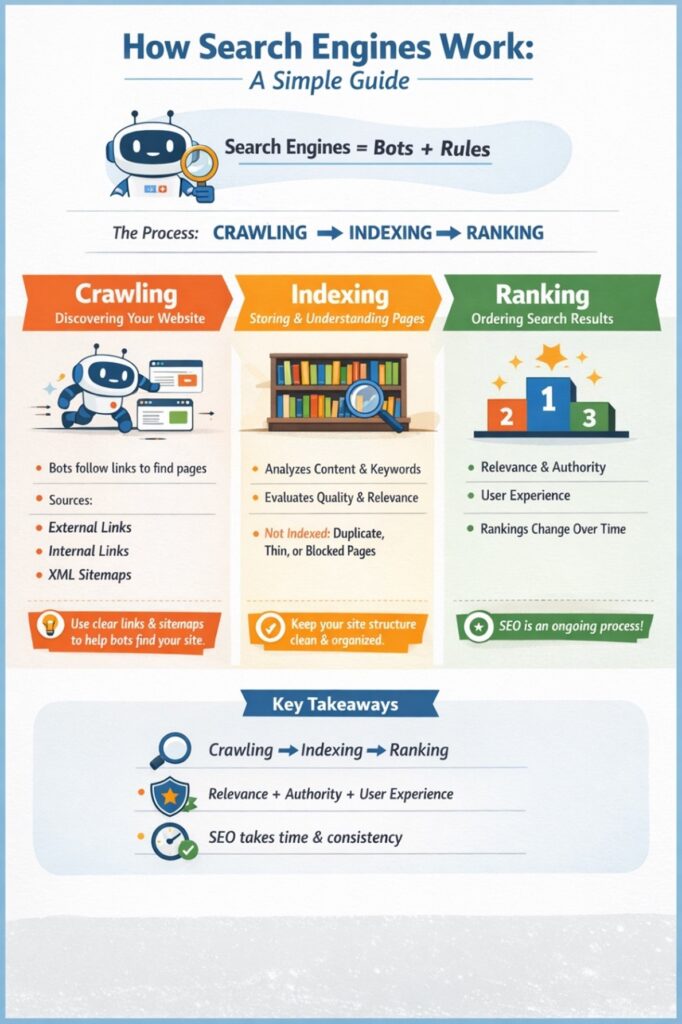
In general, search engines operate in three successive steps: Crawling, Indexing, and Ranking. The steps are not a one time occurrence; they are a continuous cycle in response to web changes.
Crawling: How Search Engines Discover Your Website
Crawling is the starting point of SEO. If a search engine cannot crawl your website, it simply cannot exist in search results.
Search engines use automated programs called bots, spiders, or crawlers (for example, Googlebot) to scan the web. These bots move from one page to another by following links, like how a user clicks through websites.
What Search Engine Bots Are
Search engine bots are software programs designed to:
- Visit web pages
- Read page content and code
- Follow links to discover new or updated pages
They prioritize pages based on factors like site authority, freshness, and internal linking.
How Websites Are Discovered
Search engines typically find websites through:
- Links from already indexed websites
- Internal links connecting one page to another
- XML sitemaps submitted via search console tools
A website with no links and no sitemap is extremely difficult for search engines to discover.
Role of Internal Links and Sitemaps
- Internal links act as pathways that guide bots across your website
- XML sitemaps provide a structured list of important pages you want search engines to crawl
Effective internal linking combined with well, configured sitemaps allows search engines to easily crawl and comprehend your whole site, particularly the deep or new pages.
Indexing: How Search Engines Store and Understand Pages
Once a page gets crawled, the next step is indexing. Indexing refers to the process where after analysis, web pages are stored in a huge database known as the search index.
The index can be thought of as a digital library where search engines store content according to subjects, keywords, media, and contexts.
How Pages Are Stored in Search Engines
During indexing, search engines:
- Analyze text, headings, images, and metadata
- Understand page intent and topical relevance
- Evaluate content quality and uniqueness
If a page is indexed, it becomes eligible to appear in search results.
Reasons Pages Don’t Get Indexed
Not every crawled page gets indexed. Common reasons include:
- Thin, duplicate, or low-quality content
- Technical issues such as no-index tags or blocked resources
- Poor internal linking or orphan pages
- Slow loading speed or rendering problems
A page that isn’t indexed is essentially invisible no matter how good the content is.
Importance of a Clean Site Structure
A clean and logical site structure helps search engines:
- Understand page relationships
- Identify important content
- Efficiently index large websites
Websites with clear navigation, proper categories, and consistent URLs are easier to index and perform better in search results over time.
Ranking: How Search Engines Decide Who Appears First
Ranking is the most vibrant and competitive phase of SEO. When a user searches, search engines don’t just give a list of indexed pages but rank them based on hundreds of signals with the primary objective to provide the most relevant and helpful results.
How Search Engines Decide Rankings
Search engines evaluate pages based on:
- How well the content matches the search query
- How authoritative and trustworthy the website is
- How users interact with the page
The goal is to provide the best possible answer, not just the most optimized page.
Role of Relevance, Authority, and User Experience
- Relevance: Does the content directly answer the user’s question?
- Authority: Is the website trusted by other reputable websites?
- User Experience: Is the page fast, mobile-friendly, and easy to navigate?
Strong rankings happen when all three work together – not when one is optimized in isolation.
Why Rankings Change Over Time
Search rankings are not permanent. They change due to:
- Algorithm updates
- New or better content from competitors
- Changes in user behavior and intent
- Website performance or technical issues
This is why SEO is an ongoing process, not a one-time task.
The 3 Pillars of SEO
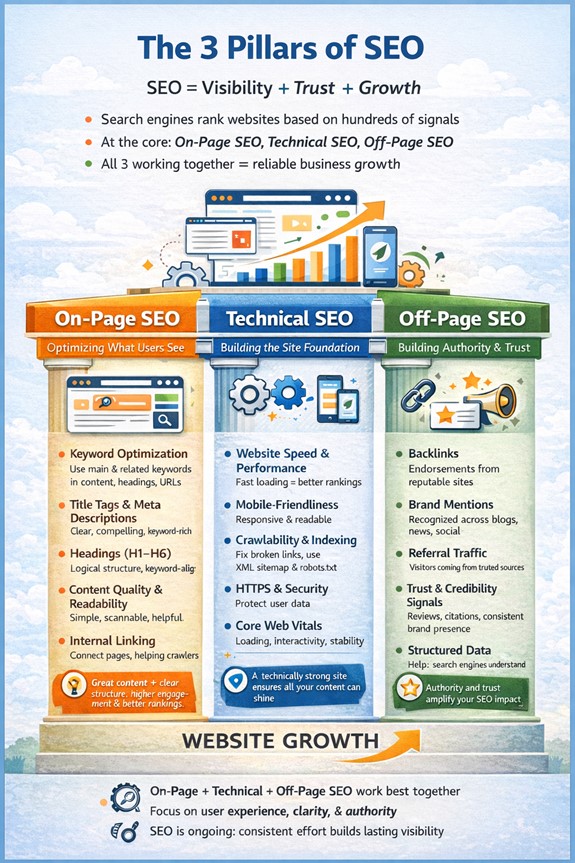
Search engines don’t rank websites randomly. Every ranking you see on Google is the result of hundreds of signals working together. At the foundation of all those signals are three core pillars of SEO: On-Page SEO, Technical SEO, and Off-Page SEO.
Think of SEO like building a high-performance business website:
- On-Page SEO tells search engines what your content is all about
- Technical SEO ensures search engines can access and understand your site
- Off-Page SEO proves your site is trustworthy and authoritative
When all three pillars work together, SEO becomes a reliable way to grow your business, not a matter of trial and error.
On-Page SEO: Optimizing What Users and Search Engines See
On-Page SEO is all about the things inside your web pages. It involves producing content that satisfies the user’s needs and at the same time clearly shows the search engines the content’s relevance.
Keyword Optimization:
Keyword optimization should begin with figuring out what your target audience is really looking for. As a matter of fact, contemporary SEO is not about stuffing keywords but is more about incorporating main and related keywords in a natural way in the text:
- Page content
- Headings
- URLs
- Image alt text
The goal is to keep things clear so search engines can easily understand what your page is about.
Title Tags and Meta Descriptions:
Title tags and meta descriptions are your website’s first impression on Google. A well-written title tag improves rankings, while a compelling meta description increases click-through rates.
Strong metadata:
- Clearly describes the page content
- Includes relevant keywords
- Encourages users to click
Even the best content won’t perform if users don’t choose it in search results.
Headings (H1–H6):
Headings help to structure your content not just for the users but also for the search engines. They work like a roadmap, leading readers through your page and at the same time helping search engines to recognize the content hierarchy.
Best practices include:
- One clear H1 per page
- Logical use of H2s and H3s
- Keyword-aligned but natural headings
Well-structured content improves readability, engagement, and rankings.
Content Quality and Readability:
High-ranking content solves real problems. Search engines prioritize pages that demonstrate expertise, usefulness, and clarity.
Quality content:
- Answers user questions completely
- Uses simple, scannable language
- Includes examples, lists, and visuals
- Keeps users engaged longer
If users stay, scroll, and interact—search engines notice.
Internal Linking:
Internal links connect your website pages also helping search engines to discover new content and distribute authority across your website.
Effective internal linking:
- Improves crawlability
- Strengthens important pages
- Enhances user navigation
It’s one of the most underrated yet powerful on-page SEO tactics.
Image Optimization:
Images improve the user experience a lot. However, this is only true if they are properly optimized. After all, search engines are not capable of “seeing” images unless you assist them.
Image optimization includes:
- Descriptive file names
- Alt text for accessibility and SEO
- Compressed file sizes for faster loading
Optimized images contribute to better performance, rankings, and user satisfaction.
Technical SEO: Building a Strong Foundation for Search Engines
Technical SEO focuses on how well search engines can access, crawl, and index your website. Without a strong technical foundation, even great content can fail to rank.
Website Speed and Performance:
Fast websites rank better and convert more users. Search engines prioritize pages that load quickly across all devices.
Performance optimization includes:
- Reducing server response time
- Optimizing images and scripts
- Using caching and content delivery networks (CDNs)
Speed matters because it directly affects how users experience your website.
Mobile-Friendliness:
With mobile-first indexing, Google primarily evaluates your mobile version for rankings. A mobile-friendly site ensures:
- Responsive design
- Easy navigation
- Readable text without zooming
If your website doesn’t work properly on mobile, it can lose rankings.
Crawlability and Indexing Issues:
Search engines must be able to find and understand your pages. Technical SEO ensures:
- Important pages aren’t blocked
- Broken links are fixed
- XML sitemaps and robots.txt are configured correctly
This helps search engines focus on the right pages and skip the ones that don’t matter.
HTTPS and Site Security:
Security matters for SEO. Using HTTPS keeps user data safe and helps build trust with both visitors and search engines.
A secure website:
- Encrypts data
- Improves credibility
- Reduces browser warnings
Trust begins at the technical level.
Core Web Vitals:
Core Web Vitals measure real-world user experience, focusing on:
- Loading performance
- Interactivity
- Visual stability
Websites that deliver smooth, stable experiences are rewarded with better visibility in search results.
Structured Data (Basic Explanation):
Structured data helps search engines understand your content more precisely. It enables enhanced search features like:
- Rich snippets
- FAQs
- Reviews
- Event details
It doesn’t guarantee top rankings, but it does help your page get seen more and attract more clicks.
Off-Page SEO: Building Authority, Trust, and Credibility
Off-Page SEO focuses on signals outside your website that indicate reputation and authority. Search engines trust websites that others trust.
Backlinks and Link Authority:
Backlinks are like endorsements in the digital world. Whenever reputable sites refer to your content, search engines get the signal that your site is trustworthy and offers valuable content.
Quality is more important than quantity. A small number of relevant, trustworthy links work better than many low-quality ones.
Brand Mentions:
Even without direct links, brand mentions across the web help search engines to recognize your business as legitimate and established.
Mentions from:
- Industry blogs
- News sites
- Social platforms
all contribute to stronger brand authority.
Referral Traffic:
Referral traffic shows that users are discovering your site through trusted sources. This sends positive engagement signals and often brings high-intent visitors.
Trust and Credibility Signals:
Search engines evaluate trust using multiple off-page signals, including:
- Online reviews
- Business citations
- Consistent brand presence
Strong trust signals differentiate real businesses from low-quality or spam websites.
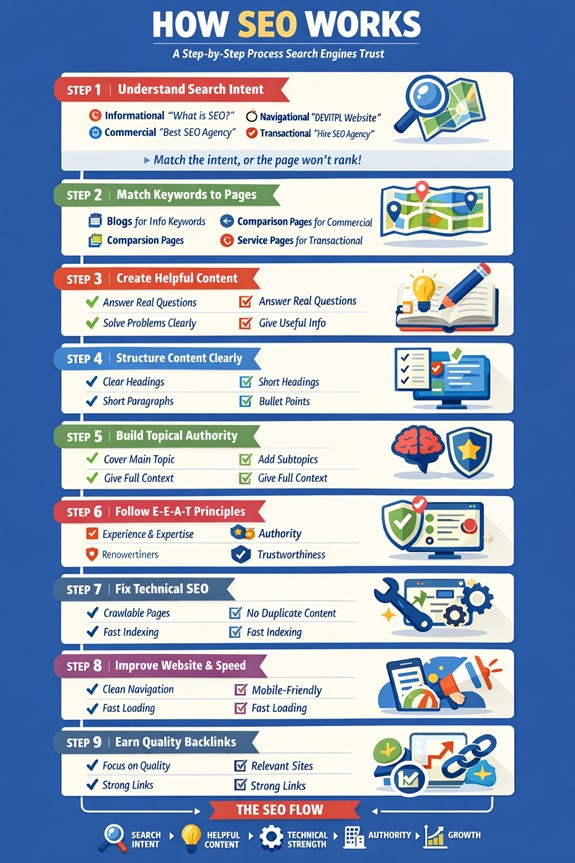
How SEO Works: A Step-by-Step Process That Search Engines Trust
SEO can’t be summed up as a single task or checklist it is an ongoing process that functions to consistently align user intent, content quality, technical issues, and authority with the way search engines assess relevance and trust. Here’s an easy, practical explanation of how SEO really works.
Keyword Research & Search Intent
SEO no longer starts with keywords; it starts with understanding why someone is searching. Every search query reflects a specific intent, and search engines prioritize pages that best satisfy that intent.
Types of Search Intent
- Informational Intent – Users are looking for answers or knowledge
(e.g., “what is SEO”, “how does SEO work”) - Navigational Intent – Users want to reach a specific website or brand
(e.g., “DEVITPL website”, “Google Search Console login”) - Commercial Intent – Users are comparing solutions before making a decision
(e.g., “best SEO agency for SaaS”, “SEO services pricing”) - Transactional Intent – Users are ready to take action
(e.g., “hire SEO agency”, “SEO services near me”)
Why Search Intent Matters More Than Keywords
Two pages can target the same keyword but only the one that matches intent will rank.
For example, a service page will not rank for an informational query, no matter how well it’s optimized.
Search engines analyze:
- Page format (blog, service page, landing page)
- Content depth and clarity
- User engagement signals
Intent alignment is what separates ranking pages from invisible ones.
Mapping Keywords to the Right Pages
Effective SEO involves mapping:
- Informational keywords → Blog posts & guides
- Commercial keywords → Comparison or solution pages
- Transactional keywords → Service or conversion pages
This prevents keyword cannibalization and creates a clean, scalable site structure that search engines understand.
Content Creation & Optimization
Content is not written for search engines but it is written for people and optimized for algorithms.
Creating Content That Solves Real Problems
Modern SEO content focuses on:
- Answering real user questions
- Addressing pain points clearly
- Providing actionable insights, not filler text
Search engines reward content that reduces the need for users to go back and search again.
Content Structure & Formatting
Well-optimized content is:
- Easy to scan (clear headings and short paragraphs)
- Logically structured from basics to advanced
- Supported with examples, lists, and contextual explanations
Good structure improves:
- Readability
- Time on page
- Search engine comprehension
Semantic SEO & Topical Relevance
Search engines no longer rely on exact-match keywords. They evaluate:
- Topic depth
- Related subtopics
- Contextual relevance
By covering a topic holistically, your content signals topical authority, increasing its ability to rank for multiple related queries.
E-E-A-T Principles (Experience, Expertise, Authority, Trust)
Search engines favor content that demonstrates:
- Experience – Practical insights, real use cases
- Expertise – Technical accuracy and depth
- Authority – Brand credibility and recognition
- Trust – Transparency, accuracy, and reliability
This is especially critical for business, technology, and service-based websites.
Technical Implementation
Even the best content fails if search engines can’t access or understand it.
Fixing Crawl & Indexing Issues
Technical SEO ensures that:
- Search engines can crawl all important pages
- Duplicate or low-value pages don’t dilute rankings
- Indexing is intentional, not accidental
This forms the foundation of SEO performance.
Optimizing Site Architecture
A well-structured website:
- Uses logical URL hierarchies
- Has clear internal linking
- Helps search engines understand page relationships
Good architecture improves both crawl efficiency and user navigation.
Improving Performance & User Experience
Search engines increasingly rank websites based on user experience signals such as:
- Page speed
- Mobile responsiveness
- Visual stability and interaction
A fast, smooth website isn’t just better for users, it’s a direct ranking advantage.
Authority Building
Search engines treat authority as a vote of confidence from the web.
Earning High-Quality Backlinks
Backlinks signal that your content is valuable enough to be referenced by others. However:
- Quality matters far more than quantity
- Relevance and trust outweigh volume
One authoritative backlink can outperform dozens of weak ones.
Content-Led Link Building
The most sustainable links are earned through:
- In-depth guides
- Original insights
- Industry-specific resources
When content is genuinely useful, links happen naturally.
Digital PR & Strategic Partnerships
Brand mentions, partnerships, and PR coverage strengthen:
- Domain authority
- Brand trust
- Long-term ranking stability
SEO today is as much about brand building as it is about optimization.
Monitoring & Continuous Improvement
SEO is not “set and forget.” It evolves continuously.
Tracking What Matters
Effective SEO monitoring includes:
- Keyword rankings
- Organic traffic growth
- User behavior
- Conversion performance
Data-driven insights guide smarter decisions.
Updating Content for Freshness
Search engines prefer content that stays relevant. Regular updates:
- Improve rankings
- Maintain accuracy
- Capture new search trends
Content freshness is a competitive edge.
Adapting to Algorithm Changes
Search algorithms change, but strong SEO foundations remain stable. Websites that focus on users, quality, and technical excellence adapt naturally without chasing every update.
Advanced SEO Concepts
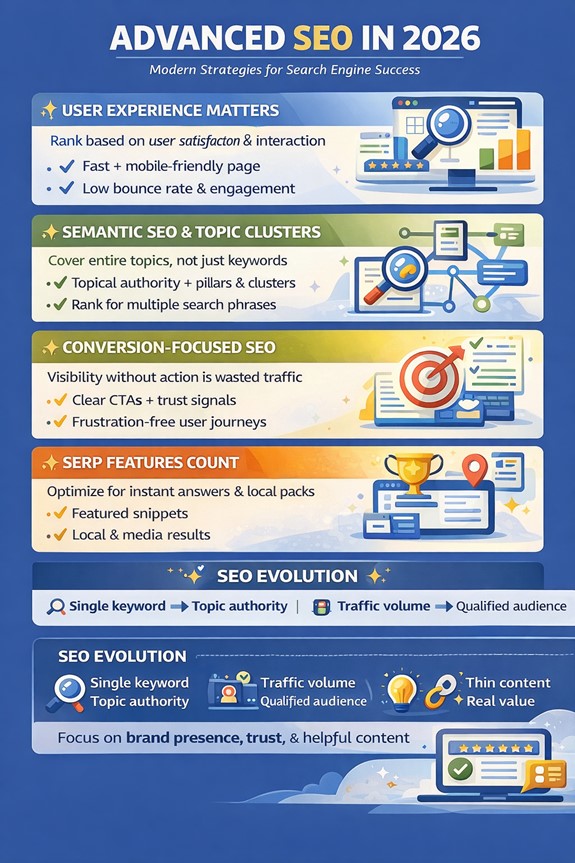
SEO in 2026 is a completely different concept than just ranking a single keyword on a single page. Today, search engines take into consideration user behavior, content depth, contextual relevance, and the actual value of the content in the real world. Advanced SEO is all about the user experience on your site and how smartly your content satisfies the needs through multiple formats and search surfaces.
User Experience (UX) & SEO
Search engines don’t just rank pages, but they observe how users interact with them.
Bounce Rate & Engagement Signals
When a user clicks your page and:
- Leaves immediately
- Doesn’t scroll
- Doesn’t interact
…it signals that the result didn’t meet search intent.
Modern SEO prioritizes:
- Time on page
- Scroll depth
- Click interactions
- Task completion
If users stay on a page and find it useful, it often moves higher in search results over time, even if it starts with a lower ranking.
In short: User satisfaction has become a ranking advantage.
Page Experience Signals
Google now evaluates how your page feels, not just what it says.
Key experience factors include:
- Mobile-first usability
- Fast load times
- Visual stability (no layout shifts)
- Secure browsing (HTTPS)
- Minimal intrusive elements
Pages that load fast and feel smooth consistently outperform content-heavy but poorly optimized pages.
Conversion-Focused SEO
Ranking without conversions is wasted visibility.
Advanced SEO aligns content with:
- Clear CTAs
- Logical page flow
- Trust elements (reviews, credentials, case studies)
- Frictionless forms
Instead of asking “Does this page rank?”, modern SEO asks:
“Does this page help users take the next step?”
Semantic SEO & Topic Clusters
Search engines no longer match keywords—they understand meaning.
Keyword Clustering (Not Keyword Stuffing)
Instead of optimizing one page for one keyword, semantic SEO focuses on:
- Primary keyword
- Supporting variations
- Related questions
- Contextual phrases
Example:
A page targeting “SEO services” may naturally rank for:
- SEO company
- Search engine optimization services
- Professional SEO solutions
- SEO agency near me
All without repeating keywords unnaturally.
Topical Authority
Search engines reward websites that demonstrate deep expertise in a subject area.
Topical authority is built by:
- Creating a pillar page (broad topic)
- Supporting it with multiple in-depth cluster articles
- Interlinking content strategically
This signals:
“This website doesn’t just mention SEO—it understands SEO.”
Why One Page Ranks for Multiple Keywords
One well-structured page can rank for hundreds of keywords because:
- It answers multiple user intents
- It uses natural language
- It covers subtopics comprehensively
- It aligns with semantic search models
Advanced SEO is about coverage, not repetition.
SERP Features & Zero-Click Searches
Search results are no longer just blue links.
Featured Snippets
Featured snippets extract direct answers from your content.
To optimize:
- Use clear subheadings
- Answer questions concisely
- Structure content with bullet points and definitions
Ranking #1 isn’t always the top position—the snippet is.
Local Packs
For service-based businesses, local SEO dominates visibility.
Local packs are influenced by:
- Google Business Profile optimization
- Reviews and ratings
- NAP consistency
- Proximity and relevance
Local visibility often converts faster than organic listings.
Image & Video Results
Search engines now surface:
- Image carousels
- Short-form videos
- Visual answers
Optimizing images, alt text, filenames, and video metadata expands your reach beyond traditional listings.
Visibility Over Rankings
In 2026, success is measured by:
- How often your brand appears
- Across how many search formats
- At how many decision points
Being visible everywhere matters more than ranking #1 somewhere.
AI & the Future of SEO
AI has changed how search engines generate answers, but it hasn’t eliminated SEO—it has raised the bar.
AI-Powered Search Results
Search engines now:
- Summarize multiple sources
- Generate contextual responses
- Surface authoritative brands repeatedly
This means:
- Thin content disappears
- Generic AI content struggles
- Expertise-driven content wins
Content Quality vs AI Generation
AI can assist content creation—but it cannot replace:
- Real experience
- Original insights
- Industry context
- Business relevance
Search engines reward content that feels:
- Helpful
- Credible
- Human-backed
- Experience-driven
AI-written content without value is filtered out faster than ever.
How SEO Is Evolving in 2026
SEO is shifting from:
❌ Keyword rankings
➡️ Search presence
❌ Traffic volume
➡️ Traffic quality
❌ Content quantity
➡️ Content usefulness
Future-ready SEO focuses on:
- Brand authority
- Trust signals
- Content ecosystems
- Human + AI collaboration
Benefits of SEO for Businesses
SEO helps businesses to build visibility, trust, and long, term growth in a way no short, term marketing channel can match.
- Increased Organic Traffic with Real Intent: SEO brings users who are really looking for your products or services. Instead of chasing eyes, your website appears at the perfect time thus attracting relevant traffic that is more inclined to convert.
- Higher-Quality Leads: By targeting search intent, SEO brings in prospects who already have a need. This means fewer unqualified inquiries, better lead quality, and faster decision-making.
- Strong Brand Credibility and Trust: Ranking on the first page sends a very strong message about your brand’s authority. People trust search engines, so if you are always visible, it means that your brand is not only trustworthy but also well, established in your industry.
- Better ROI Than Paid Ads: Unlike paid campaigns that stop once the budgets are halted, SEO continues to work and deliver results. Eventually, the cost per lead reduces, hence SEO becomes one of the most cost, efficient digital channels.
- Long-Term Digital Asset Creation: Each optimized page contributes to the permanent value of your site. SEO works like a snowball, gradually turning your content into a scalable digital asset that keeps on attracting traffic and leads.
Common SEO Mistakes to Avoid
SEO often fails not because of algorithms, but because of avoidable strategic mistakes.
- Targeting the Wrong Keywords: Simply going after high, volume keywords without a clear understanding of user intent will result in traffic that doesn’t convert. SEO should be about relevance rather than just rankings.
- Ignoring Technical SEO: A slow website, issues with mobile, and crawl errors can prevent search engines to rank your content even if it’s very good.
- Poor or Generic Content: Low-quality, copied, or unhelpful content fails to engage users and signals low value to search engines.
- Low-Quality Backlinks: Spammy or irrelevant links can damage trust and rankings. Quality and relevance matter more than link volume.
- No Tracking or Measurement: Without data, SEO becomes guesswork. Tracking performance is essential for consistent improvement.
- Expecting Instant Results: SEO takes time. Businesses that look for quick wins often miss long-term, compounding growth.
Common SEO Myths
SEO is surrounded by outdated assumptions and half-truths that often lead businesses in the wrong direction. Let’s separate facts from fiction.
- SEO Is a One, Time Task: SEO requires continuous effort because user habits, competitors, and algorithms are regularly changing.
- SEO Gives Instant Results: SEO is a game of time; genuine outcomes will happen gradually and with perseverance.
- Ranking #1 Guarantees Sales: Being at the top certainly increases the chance of being seen, but the final decision to purchase depends on good content, experience, and trust.
- More Keywords Mean Better Rankings: Keyword stuffing is not a solution; What really matters are relevance and clarity.
- Backlink Quantity vs Quality: A couple of strong, relevant backlinks is far superior to hundreds of low, quality ones.
- Paid Ads Boost Organic Rankings: Ads cant be considered as a direct factor for SEO improvement; they are different marketing channels.
- AI Content Automatically Ranks: AI is a great tool but search engines reward original, helpful, content that was created with the help of a human, and they are less likely to be deceived by AI, generated ones.
SEO Is Dead: SEO is still alive but changing; the main criteria now are quality, intent, and user experience.
SEO Tools That Help You Succeed
SEO tools provide the data and insights needed to make informed optimization decisions.
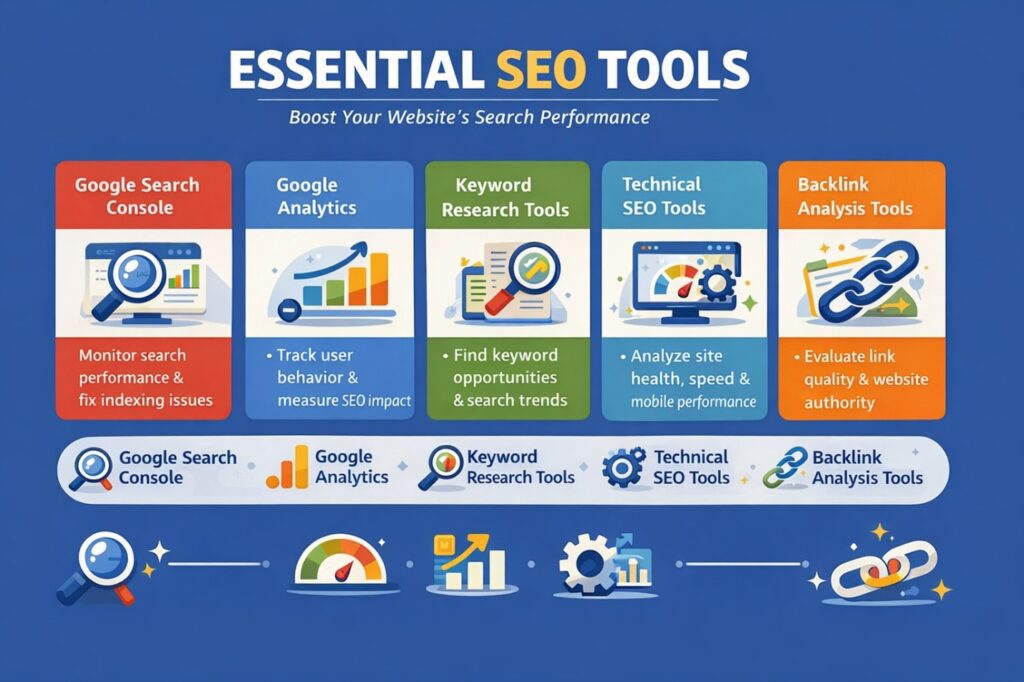
- Google Search Console: Helps you monitor search performance, indexing status, and technical issues directly from Google’s perspective.
- Google Analytics: Tracks user behavior, traffic sources, and conversions to measure the real impact of SEO efforts.
- Keyword Research Tools: Identify what users are searching for and uncover keyword opportunities based on intent and competition.
- Technical SEO Tools: Analyze site health, speed, crawlability, and mobile performance to ensure search engines can access and rank your pages.
Backlink Analysis Tools: Evaluate link quality, monitor authority, and discover opportunities to strengthen your website’s trust and credibility.
How Long Does SEO Take to Show Results?
SEO doesn’t work on a fixed timeline – it works on trust, relevance, and consistency. While small improvements can appear early, meaningful results take time to build and compound.
- Realistic SEO Timelines: Initial improvements appear in 3–4 months but strong traffic and leads usually take 6–9 months.
- Factors Affecting Speed: Progress depends on competition, keywords, content, technical health, backlinks, and consistency.
- New vs Established Sites: New sites take longer to build trust and established sites often see faster results.
Patience Pays Off: Consistent SEO delivers lasting visibility, lower costs, and sustainable growth.
SEO vs PPC: Which One Should You Choose?
SEO and PPC are often seen as competitors, but in reality, they solve different business problems. The right choice depends on your goals, timeline, and growth strategy.
|
Factor |
SEO (Search Engine Optimization) |
PPC (Pay-Per-Click Advertising) |
|---|---|---|
|
Cost Structure |
No cost per click; investment in long-term optimization |
Pay for every click or impression |
|
Time to See Results |
Takes time (3–6+ months) |
Immediate visibility |
|
Traffic Longevity |
Long-term, compounding traffic |
Stops when ad budget ends |
|
Lead Quality |
High-intent, trust-driven leads |
High-intent but transactional |
|
Scalability |
Grows over time without linear cost increase |
Scales only with increased spend |
|
Credibility & Trust |
Builds strong brand authority |
Perceived as promotional |
|
Control & Targeting |
Limited immediate control |
Full control over targeting, timing, and messaging |
|
Best Use Case |
Long-term growth and cost efficiency |
Quick wins, launches, and promotions |
|
ROI Over Time |
Increases steadily |
Declines when spend stops |
Conclusion
SEO is not just about rankings, it creates lasting visibility, trust and a continuous stream of the right audience.
When your SEO strategy is well planned, your website acts like a growth engine that is self, sufficient, generating high, quality leads and relying less on paid advertising. This is a process that requires time, however, the benefit is a very strong and long, term digital asset that persistently produces results.