 seolounge
On-page SEO remains one of the strongest ranking foundations in 2026, even as search engines increasingly rely on AI, machine learning, and generative search experiences. No matter how advanced algorithms become, they still depend on well-structured pages to understand context, relevance, and value.
Modern search engines evaluate content using multiple signals:
- Search intent fulfillment
- Content depth and accuracy
- User experience and engagement
- Technical and performance signals
Whereas earlier SEO practices were heavily focused on keyword stuffing, on-page SEO nowadays is more about making pages that really solve the users’ questions clearly, completely, and efficiently.
This post is a comprehensive on-page SEO checklist for 2026, and it explains the stuff not only you should optimize but also why it is important and how to do it right.
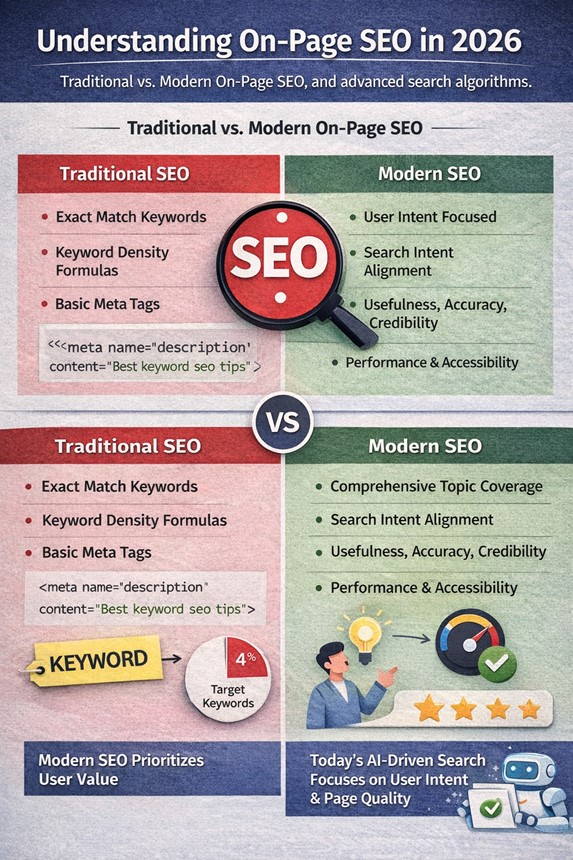
Understanding On-Page SEO in 2026
On, page SEO in 2026 means that the focus is on creating pages that truly satisfy users’ needs and at the same time clearly signal to search engines for the relevance of the pages. It encompasses optimizing your content, HTML structure, internal linking, and page experience so that users can effortlessly locate, comprehend, and interact with your information.
Traditional vs Modern On-Page SEO
Earlier on-page SEO focused mainly on technical signals, such as:
- Exact-match keyword usage
- Keyword density formulas
- Basic meta tags and headings
While these tactics helped search engines understand pages, they often ignored user experience.
Modern on-page SEO focuses on user value and intent, including:
- Comprehensive topic coverage instead of single keywords
- Clear alignment with search intent at each stage of the journey
- Content usefulness, accuracy, and credibility
- Page performance, accessibility, and overall experience
AI based search engines today primarily look at whether a page effectively responds to a user’s query, how thoroughly it discusses the subject matter, and if the users find the content truly useful, among other things.
1. Keyword Research & Search Intent Optimization
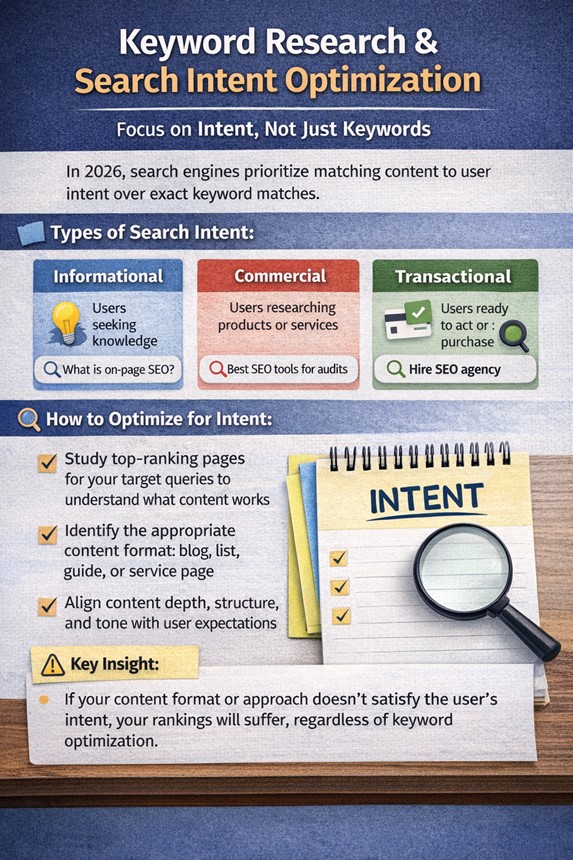
In 2026, search engines prioritize matching content to user intent over exact keyword matches. Understanding the purpose behind a query is critical for ranking effectively.
Types of Search Intent:
- Informational: Users seeking knowledge (e.g., “What is on-page SEO?”)
- Commercial: Users researching products or services (e.g., “Best SEO tools for audits”)
- Transactional: Users ready to act or purchase (e.g., “Hire SEO agency”)
How to Optimize for Intent:
- Study top-ranking pages for your target queries to understand what content works
- Identify the appropriate content format: blog, list, guide, or service page
- Align content depth, structure, and tone with user expectations
Key Insight: If your content format or approach doesn’t satisfy the user’s intent then your rankings will suffer and regardless of keyword optimization.
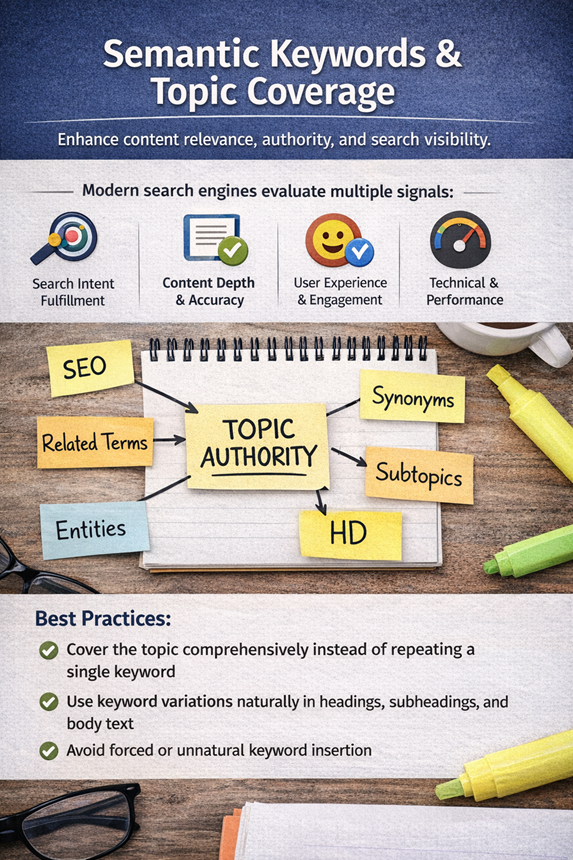
2. Semantic Keywords & Topic Coverage
Search engines evaluate content not just by exact keywords but by semantic relevance how well your content covers the topic in context. To improve relevance and authority,
Your page should naturally include:
- Related phrases and synonyms
- Supporting subtopics and ideas
- Entities and concepts connected to the main topic
Best Practices:
- Cover the topic comprehensively instead of repeating a single keyword
- Use keyword variations naturally in headings, subheadings, and body text
- Avoid forced or unnatural keyword insertion
Following this approach will help you build your topical authority, get found on the search engines, and at the same time, you won’t get penalized for over, optimization.
3. Optimizing for Conversational & AI Search
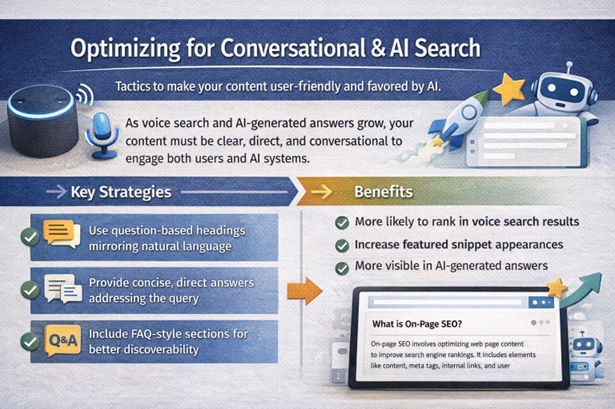
As voice search and AI-generated answers become more common, your content must be clear, direct, and conversational to engage both users and AI systems.
Key strategies for optimization:
- Write headings as questions, just like people would naturally ask them.
- Give short, clear answers that directly solve the question.
- Add FAQ sections to cover common questions and make your content easier to find.
Benefits:
The method makes it more likely that your content will appear in voice search results, featured snippets, and AI, generated answers, thus making it more visible and user, friendly.
4. Content Quality & EEAT Signals
Creating Experience-Driven Content
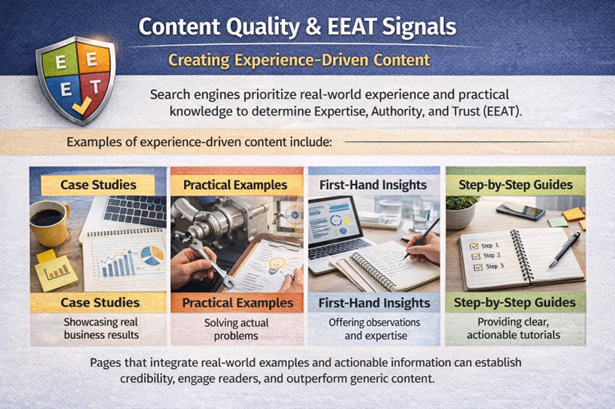
Search engines rank higher Contents that demonstrate expertise, authority and trust (EEAT) Search engines grade higher those contents that reflect real, world experience and practical knowledge rather than just generic summaries
Examples of experience-driven content include:
- Case studies showcasing real business results
- Practical examples that solve actual problems
- First-hand observations and insights
- Step-by-step tutorials or guides
Pages that combine real, life experiences and practical information are capable of establishing trust, engaging the audience, and even surpassing in performance the content that is dry and superficial.
5. Demonstrating Expertise & Authority
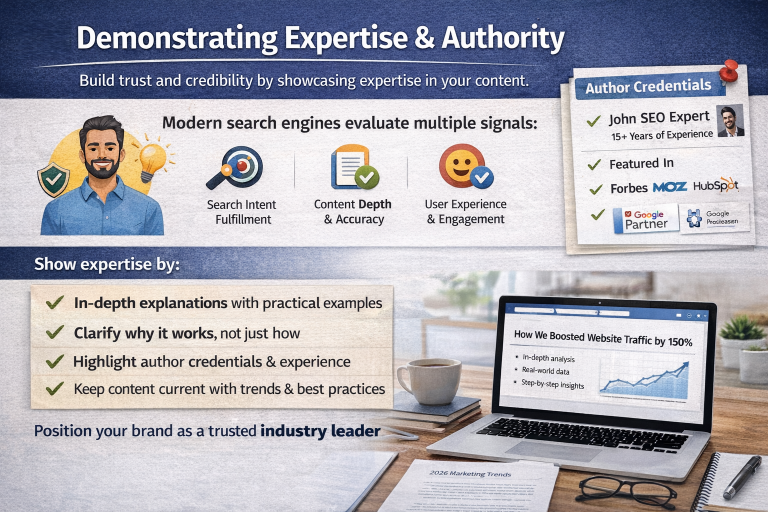
Establishing expertise is one of the ways to build trust and credibility, especially if you belong to a highly competitive industry or are writing about YMYL (Your Money or Your Life) topics. Real expertise is demonstrated when you offer accurate, insightful, and helpful content that is more than just a surface, level explanation.
How to showcase expertise effectively:
- Offer in-depth explanations with practical examples
- Clarify why something works, not just how
- Highlight the author’s credentials, experience, and background
- Keep content up to date with the latest trends, research, and best practices
By consistently demonstrating authority your content will gain credibility with both readers and search engines to position your brand as a trusted industry leader.
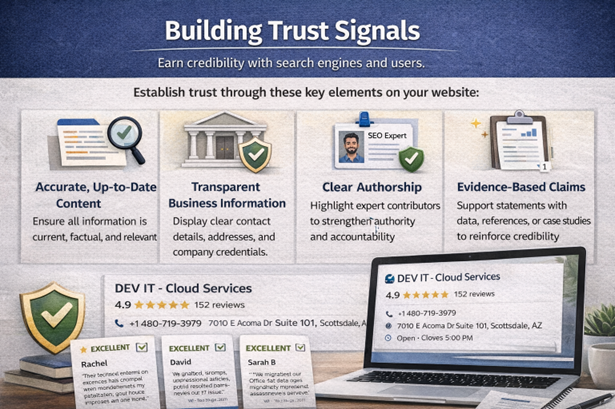
6. Building Trust Signals
Trust signals help search engines and users recognize the credibility and reliability of your website. Key elements of trust include:
Key trust elements include:
- Accurate, up-to-date content – Ensure all information is current, factual, and relevant.
- Transparent business information – Display clear contact details, addresses, and company credentials.
- Clear authorship – Highlight expert contributors to strengthen authority and accountability.
- Evidence-based claims – Support statements with data, references, or case studies to reinforce credibility.
7. Title Tags, Meta Descriptions & Headings
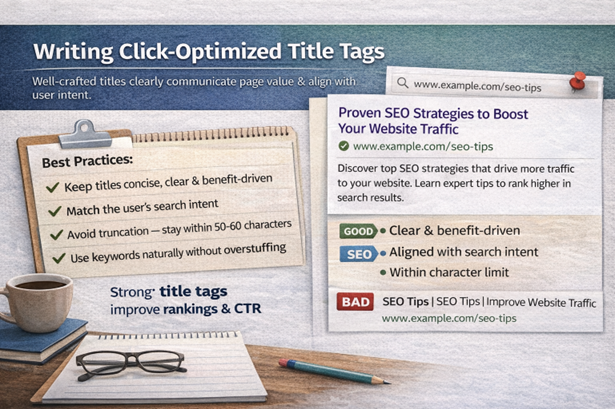
Title tags are crucial not only for search rankings but also for drawing clicks from search results. A perfectly crafted title not only conveys the value of the page but also stays in line with user intent.
Best Practices:
- Keep titles concise, clear, and benefit-driven
- Match the user’s search intent
- Avoid truncation by staying within 50–60 characters
- Use keywords naturally without overstuffing
Strong, thoughtful titles help your pages stand out in crowded SERPs, improve click-through rates, and set the right expectations for users before they even visit your site.
8. Meta Descriptions That Drive Clicks
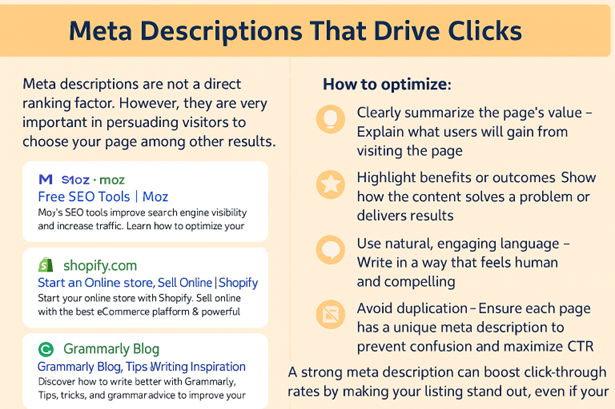
Meta descriptions are not a direct ranking factor. However, they are very important in persuading visitors to choose your page among other results.
How to optimize:
- Clearly summarize the page’s value – Explain what users will gain from visiting the page.
- Highlight benefits or outcomes – Show how the content solves a problem or delivers results.
- Use natural, engaging language – Write in a way that feels human and compelling.
- Avoid duplication – Ensure each page has a unique meta description to prevent confusion and maximize CTR.
A strong meta description can boost click-through rates by making your listing stand out, even if your page isn’t in the top spot.
9. Proper Heading Structure (H1–H6)
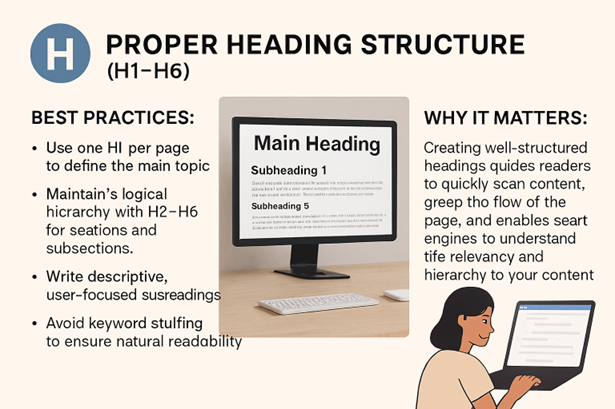
A clear heading structure improves both readability for users and crawlability for search engines.
Best Practices:
- Use one H1 per page to define the main topic
- Maintain a logical hierarchy with H2–H6 for sections and subsections
- Write descriptive, user-focused subheadings
- Avoid keyword stuffing to ensure natural readability
Why it matters: Creating well, structured headings guide readers to quickly scan content, grasp the flow of the page, and enables search engines to understand the relevancy and hierarchy of your content.
10. Content Structure & Readability
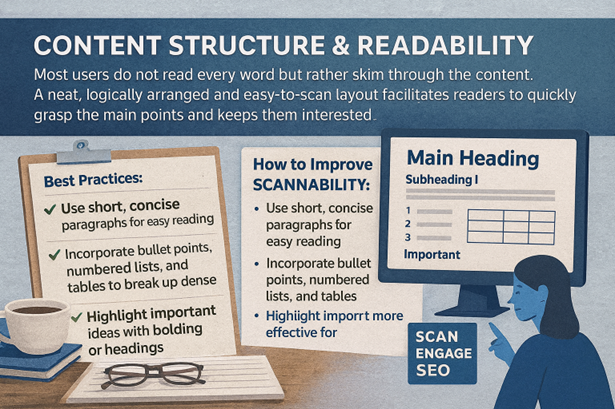
Most users do not read every word but rather skim through the content. A neat, logically arranged and easy too, scan layout facilitates readers to quickly grasp the main points and it also keeps them interested.
How to Improve Scannability:
- Use short, concise paragraphs for easy reading
- Incorporate bullet points, numbered lists, and tables to break up dense text
- Highlight important ideas with bolding or headings
A scannable content layout not only improves user engagement but also increases time on page, reduces bounce rates, and makes your content more effective for SEO.
11. Optimizing Featured Snippets & People Also Ask (PAA)
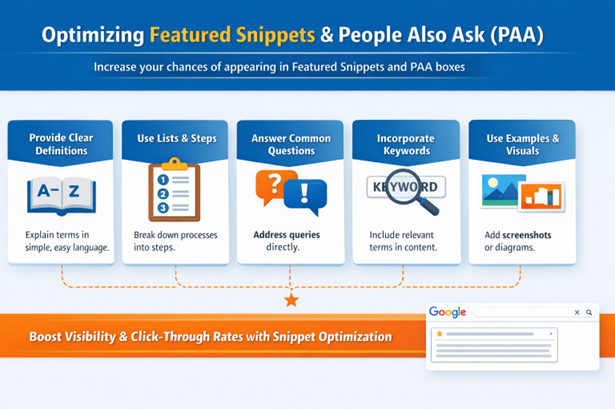
Featured snippets and PAA boxes highlight content that is clear, concise, and directly answers user queries.
To increase your chances of appearing:
- Provide clear definitions: Explain terms and concepts in simple, easy-to-understand language.
- Use structured lists or numbered steps: Break down processes or instructions to improve readability and scannability.
- Answer common questions directly: Address user intent in a straightforward manner, ideally within the first 40–60 words.
- Incorporate relevant keywords naturally: Include the main query or topic phrase in headings and answers to improve relevance.
- Use examples and visuals where possible: Screenshots, diagrams, and examples make your content more authoritative and user-friendly.
By following these best practices, your content is more likely to be selected by Google for snippets and PAA boxes, increasing visibility and click-through rates.
12. Visual Content Optimization
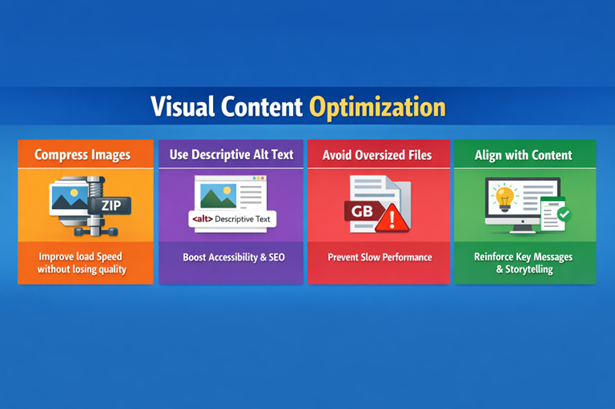
Visuals enhance understanding, retention, and user engagement. Optimize them effectively by:
- Compressing images to improve page load speed without losing quality
- Using descriptive alt text to boost accessibility and SEO
- Avoiding oversized files that slow down performance
- Aligning visuals with content to reinforce key messages and storytelling
13. Internal Linking & Topical Authority
Strategic Internal Linking
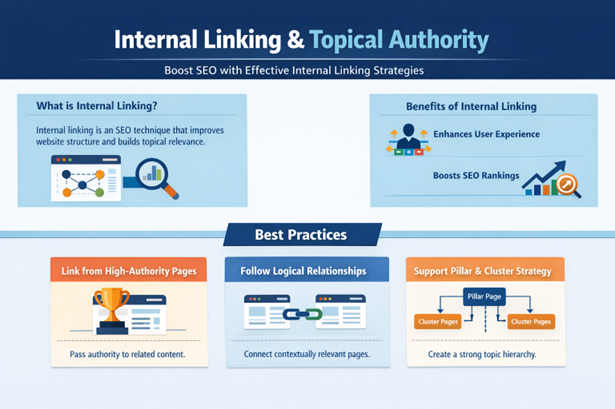
Internal linking is a SEO technique that helps both users and search engines understand the website structure, thus improving user experience. Besides, when used efficiently, internal links build your topical relevance and have a positive impact on your SEO results.
Best Practices:
- Link from high-authority pages: Use pages with strong rankings to pass authority to related content.
- Follow logical content relationships: Connect pages that are contextually relevant to guide both users and search engines.
- Support pillar–cluster structures: Build a clear hierarchy where pillar pages link to cluster pages and vice versa, reinforcing your expertise on a topic.
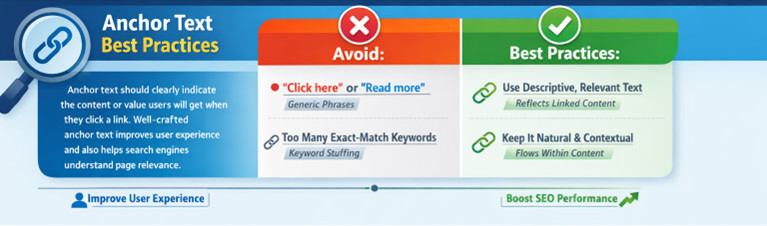
14. Anchor Text Best Practices
Anchor text should clearly indicate the content or value users will get when they click a link. Well-crafted anchor text improves user experience and also helps search engines to understand page relevance.
Avoid:
- Generic phrases like “click here” or “read more” that give no context
- Overusing exact-match keywords, which can appear spammy or manipulative
Best Practices:
- Use descriptive, concise text that reflects the linked page’s topic
- Make it natural and relevant within the surrounding content
15. Avoiding Orphan Pages
Orphan pages (pages without any internal links) are quite challenging for search engines to find and rank. Therefore, it is necessary your contents should be given proper visibility.
- Include internal links from relevant pages
- Make sure every important page is part of your website’s navigation and structure
Proper linking helps both users and search engines to find and engage with your content that improve SEO performance.
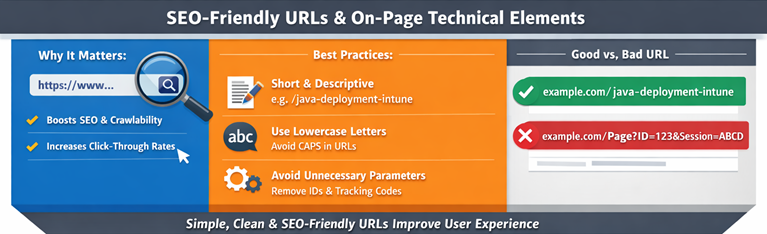
16. URL Structure & On-Page Technical Elements
EO-Friendly URLs
Having a neat and nicely ordered URL is beneficial for the user experience as well as the way search engines index the site. A well thought, out, straightforward URL makes it a lot easier for users to get a clue of the page content just by looking at it and it also gives a hand to search engines in crawling your website.
Best Practices:
- Short and descriptive: URLs should summarize the page content in a few readable words.
- Lowercase letters: Consistent lowercase avoids duplicate URLs and indexing issues.
- Avoid unnecessary parameters: Remove session IDs, tracking codes, or extra symbols that can confuse search engines.
Why it matters: A simple, logical URL structure not only boosts SEO but also increases thr click-through rates by making links more trustworthy and easier to share.
17. Schema Markup for On-Page SEO
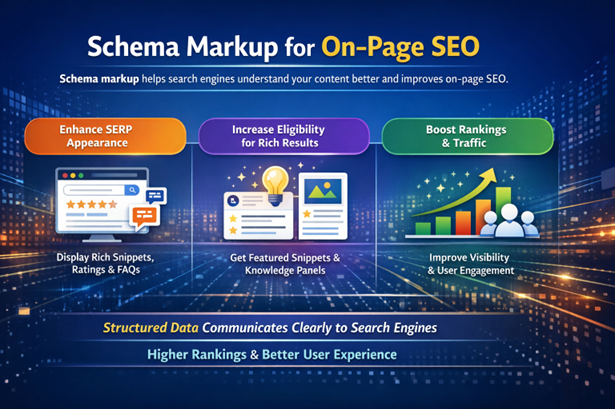
Schema markup helps search engines understand the content and context of your pages more effectively. By adding structured data, you can:
- Enhance SERP Appearance – Display rich snippets, ratings, FAQs, and other visual elements that make your listing more attractive and clickable.
- Increase Eligibility for Rich Results – Improve your chances of appearing in featured snippets, knowledge panels, and other Google enhancements that drive higher visibility and traffic.
Using schema on website ensures that your content communicates clearly to search engines and improving both rankings and user engagement.
18. Image & Media Optimization
Optimizing images and media is basically the only thing that can make your website load faster, improve the experience of users, and gain better SEO scores.
Best Practices:
- Use Modern Formats – Adopt WebP or AVIF for smaller file sizes without losing quality.
- Compression – Reduce image and video file sizes to minimize load times while maintaining clarity.
- Lazy Loading – Load media only when visible on the user’s screen to improve initial page speed and resource efficiency.
19. Core Web Vitals & Page Experience
- Largest Contentful Paint (LCP): Ensure your main content loads quickly so users can see meaningful content without delay. Faster LCP improves both user satisfaction and SEO rankings.
- Cumulative Layout Shift (CLS): Prevent unexpected shifts in page layout that frustrate users. A stable layout enhances readability and builds trust in your site.
- Interaction to Next Paint (INP): Measure and improve responsiveness to user interactions. Faster INP ensures smooth, immediate reactions to clicks, taps, and other inputs.
Why it matters: Strong Core Web Vitals improve search rankings, boost usability, and create a seamless experience that keeps visitors engaged and satisfied.
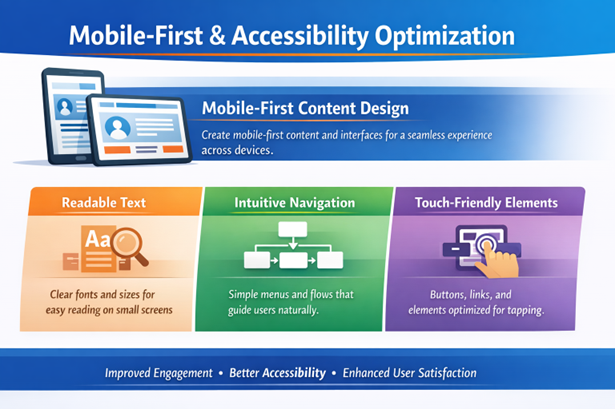
20. Mobile-First & Accessibility Optimization
Mobile-First Content Design
Create mobile first content and interfaces, and make sure the experience is seamless across devices.
Areas to focus on:
- Readable Text: Clear fonts and sizes for easy reading on small screens
- Intuitive Navigation: Simple menus and flows that guide users naturally
- Touch-Friendly Elements: Buttons, links, and interactive elements optimized for tapping
This approach improves engagement, accessibility, and overall user satisfaction while meeting modern web standards.
21. Accessibility & SEO
Websites that are accessible not only serve a wider audience, including users with disabilities, but also improve search engine rankings by enhancing usability and structure.
Key Focus Areas:
- Alt Text: Descriptive alternative text for images improves accessibility and SEO.
- Contrast: High color contrast ensures readability for all users.
- Semantic HTML: Proper use of headings, lists, and tags improves navigation for both users and search engines.
22. On-Page SEO for AI-Powered Search (SGE & Beyond)
Optimizing Content for AI Overviews
AI-driven search engines prioritize content that:
- Directly answers user queries with concise, actionable responses
- Follows a clear, logical structure for easy comprehension
- Provides accurate and trustworthy information from authoritative sources
- Demonstrates expertise with supporting examples, data, or references
Aligning your content with these principles will make it more likely that AI systems, such as Google’s SGE, will find your pages in overview snippets and AI, generated responses.
23. Entity-Based SEO
Entities serve as the foundation elements that can assist search engines in recognizing your content’s authority and relevance. When you distinctly identify concepts, terms, and relationships, you not only demonstrate your topical expertise but also enhance the contextual understanding.
How to leverage entities:
- Use consistent terminology – Stick to the same keywords and phrases to strengthen relevance.
- Include related concepts – Connect your main topic to associated ideas and terms.
- Maintain contextual relevance – Ensure content logically supports and explains the entities you introduce.
24. Common On-Page SEO Mistakes to Avoid in 2026
- Keyword Overuse – Stuffing keywords reduces readability and can hurt rankings. Focus on natural, context-driven keyword usage.
- Shallow Content – Thin content fails to satisfy user intent. Create comprehensive, valuable content that answers real questions.
- Ignoring User Experience (UX) – Poor design, slow pages, or confusing navigation can increase bounce rates and impact SEO.
- Outdated SEO Tactics – Techniques like keyword-only meta tags or exact-match backlinks are no longer effective. Embrace modern strategies like semantic SEO, structured data, and content depth.
25. Tools to Audit On-Page SEO
- Google Search Console – Identify indexing issues, monitor search performance, and track core web vitals.
- PageSpeed Insights – Analyze page load speed and receive actionable recommendations to improve performance.
- Screaming Frog – Crawl your website to detect broken links, duplicate content, and on-page SEO issues.
- Ahrefs / SEMrush – Conduct keyword analysis, track backlinks, and evaluate competitor SEO strategies.
- Content Optimization Tools – Improve readability, keyword usage, and semantic relevance for better search visibility.
Conclusion
On, page SEO has moved beyond keywords only to include making pages that really help users and at the same time explain clearly the value to search engines.
Properly optimized pages increase engagement levels, create a trusting relationship with the audience, and as a result, achieve long, standing higher rankings and greater conversions.
By putting emphasis on the user’s intent, the thoroughness of the content, and having a clear structure, you make sure your website is not only easily found but also very helpful.