
Almost every agency says the same things. More traffic. More leads. Better rankings. Higher sales. Better ROI.
The pitch sounds great in the room. Then three months pass, the invoices add up, and the business looks the same as before.
This happens more often than people admit. And it usually starts with the wrong reason for hiring. A slick presentation. A wall of client logos. The lowest price on the table.
Here is a better way to think about it. Learning how to choose a digital marketing agency is less about the sales meeting and more about one simple test: can this agency connect its work to real business growth? Not clicks. Not likes. Growth you can see in leads, sales, and revenue.
This guide walks you through the whole process, from the buyer’s side. It works whether you run a small business in India, a B2B company in the US, or a growing brand anywhere in North America.
Start With Your Business Goal, Not the Agency’s Service List
Before you look at a single agency, get clear on what you actually need.
Most owners skip this step. They say “we need SEO” or “we need ads” and start shopping. But the service is not the goal. The goal is the outcome behind it.
- Your real goal might be:
- More qualified leads
- More online sales
- A lower cost to acquire each customer
- Better visibility on Google
- More local customers
- Expansion into the US or Canada
- Stronger brand awareness
- Higher conversion rates
Notice that “SEO” is not on that list. SEO is a method. It might be the right one. It might not.
Here is a simple example. A company gets 5,000 visitors a month but only 10 enquiries. More traffic won’t fix that. The website is failing to convert the visitors it already has. Spending more on SEO would waste money. The real work is on the page, the offer, and the calls to action.
Define the outcome first. Then find the agency that fits it.
Decide Whether You Need a Full-Service Agency or a Specialist
Agencies come in different shapes. Knowing the difference saves you money.
- Full-service agency: handles SEO, paid ads, social, content, and more under one roof.
- SEO agency: focused on ranking your site in search results.
- PPC or performance marketing agency: focused on paid ads and measurable returns.
- Social media agency: focused on building and running your social channels.
- Content marketing agency: focused on articles, videos, and other content.
- Consultant: an expert who guides your strategy without doing all the hands-on work.
- Freelancer or in-house team: good for a narrow, ongoing need.
Each makes sense in the right situation. If you only need to fix your Google Ads, a performance agency or specialist beats a large full-service shop. If you need many channels working together, a full-service agency or a strong consultant might fit better.
One clear rule: don’t hire a full-service agency just because it offers the most services. Hire based on the specific capability your business needs right now.
Look for Experience With Your Industry and Target Market
Experience matters, but only the right kind.
An agency that has grown a local restaurant chain may know very little about selling B2B software. The audience, the sales cycle, and the buying behaviour are all different.
- Ask about:
- Industry knowledge
- Understanding of your target audience
- B2B versus B2C
- Long sales cycles versus quick purchases
- Local versus international markets
- India versus North America
Here is why this is not a small point. An agency that runs great lead-generation campaigns in India may not understand how a US B2B buyer researches and decides. The channels can be the same. The message, the trust signals, and the pricing expectations are not.
Example: an Indian company wants to enter the US market. It needs an agency that understands both sides. Cheap, high-volume lead tactics that work at home can quietly burn budget abroad. Look for proof they have done the specific thing you need, not just marketing in general.
Don’t Just Look at Case Studies. Verify the Results
Case studies are marketing too. Read them like a buyer, not a fan.
- For every result an agency shows, ask:
- What was the starting point?
- What changed?
- Over what period?
- What was the budget?
- Was the growth organic or paid?
- How many leads were generated?
- How many were qualified?
- Did revenue actually increase?
- What specific actions produced the result?
Watch out for percentages. They can hide the real picture. “A 500% increase in leads” sounds huge. But going from 2 leads to 12 is very different from going from 200 to 1,200. Same percentage. Very different business.
Ask for examples that are relevant to your situation and that you can verify. A good agency will happily walk you through the details. An agency that only shows big numbers with no context is hoping you won’t ask.
Ask How They Measure Real Business Results
There are two kinds of metrics. Learn to tell them apart.
- Vanity metrics look good but rarely pay the bills:
- Impressions
- Likes
- Followers
- Website traffic
- Clicks
Business metrics actually reflect growth:
- Qualified leads
- Sales opportunities
- Conversion rate
- Cost to acquire a customer
- Cost per qualified lead
- Revenue
- Return on ad spend
- Sales pipeline created
Traffic on its own is not success. If 10,000 new visitors bring no extra enquiries or sales, the money did nothing for the business. This is not a fringe view. In its 2025 report, the IAB noted that ad budgets are shifting toward channels that can tie spending directly to business results. Ask any agency how it does exactly that.
Understand Their Strategy Before You Sign
Ask one question: “What would you do in my first 90 days?”
A good agency can answer clearly. The plan changes by business, but the shape usually looks like this.
- Month 1: research, an audit of your website and accounts, competitor analysis, tracking setup, and a strategy.
- Month 2: implementation. Launching content and campaigns, fixing technical issues, and starting tests.
- Month 3: optimization. Reviewing performance, scaling what works, and cutting what doesn’t.
If an agency can’t explain its early plan without vague promises, that tells you something. You want a partner who thinks in steps, not slogans.
Check How Transparent Their Reporting Is
A monthly report should tell a story, not just show charts.
A useful report answers:
- What was done?
- Why was it done?
- What changed?
- What worked?
- What didn’t work?
- What happens next?
- How did the work affect leads, sales, or revenue?
If a report is just a pile of graphs with no explanation, push back. Numbers without meaning don’t help you make decisions. You are paying for insight, not screenshots.
Ask Who Will Actually Work on Your Account
The people who pitch you are often not the people who do the work.
The sales team is polished and senior. The delivery team is who you deal with every day. Make sure you know them.
Ask:
- Who is my account manager?
- Who handles SEO?
- Who runs the paid campaigns?
- Who creates the content?
- How experienced is the team?
- Will the same team stay on my account?
- How often will we talk?
This matters because a strong pitch means nothing if a junior team runs your account with little supervision. Meet the people who will actually deliver.
Understand Pricing Before Comparing Agencies
There is no single “correct” price. There are different models.
- Monthly retainer: a fixed fee each month.
- Project-based: a set price for a defined piece of work.
- Percentage of ad spend: the fee scales with your ad budget.
- Performance-based: part of the fee is tied to results.
- Hybrid: a mix of the above
The cheapest proposal is often not the cheapest option. Think in terms of value, not just cost.
A simple example. Agency A charges ₹40,000 a month but sends poor-quality leads that rarely close. Agency B charges ₹60,000 a month, sends fewer leads, but a much higher share turn into paying customers. Agency B costs more and delivers more. For a US buyer, swap the numbers: $2,000 a month of weak leads can cost more than $3,500 a month of leads that convert. Judge pricing by what it produces, not just what it says on the invoice.
Make Sure You Own Your Marketing Assets
This is one of the most important sections for protecting yourself.
Before you sign, confirm in writing that you own and can access:
- Your Google Ads account
- Your Meta Business Manager
- Your Google Analytics
- Your Google Search Console
- Your website and domain
- Your CRM data
- Your creative assets
- Your content
- Your tracking accounts
If an agency resists giving you access to your own accounts, treat it as a serious warning. When the relationship ends, you should walk away with your data, your history, and your assets. Some agencies keep control on purpose so leaving is painful. Don’t let that be you.
Watch for These Digital Marketing Agency Red Flags
Some signs should stop you cold:
- Guaranteed #1 Google rankings. No one controls Google’s results. This is a false promise.
- Guaranteed lead numbers with no discovery. They can’t know your numbers before understanding your business.
- Very low prices with big promises. Something is being cut, usually quality.
- No discovery process. If they don’t ask questions, they can’t build a real plan.
- A generic proposal. A template with your name pasted in shows little thought.
- No measurable KPIs. If success isn’t defined, it can’t be checked.
- Refusal to show relevant case studies. They may not have any.
- Only reporting traffic, clicks, or impressions. These hide whether the business grew.
- Long lock-in with unclear exit terms. You want an off-ramp if things go wrong.
- The agency owns all your ad accounts. A trap that costs you later.
- No clear communication process. Silence usually means problems.
- Promises of instant SEO results. Real search growth takes months.
Ask These 10 Questions Before Hiring an Agency
Keep this list handy in every sales meeting.
- What business result do you think you can improve first?
- Have you worked with companies like ours?
- Can you show relevant case studies?
- What would you do in the first 90 days?
- Which KPIs will you report on?
- How do you measure qualified leads and revenue?
- Who will actually work on our account?
- What exactly is included in the monthly fee?
- Who owns our accounts and marketing assets?
- What happens if we decide to leave?
Good agencies answer these directly. Evasive answers are answers too.
How to Compare 3 Digital Marketing Agencies
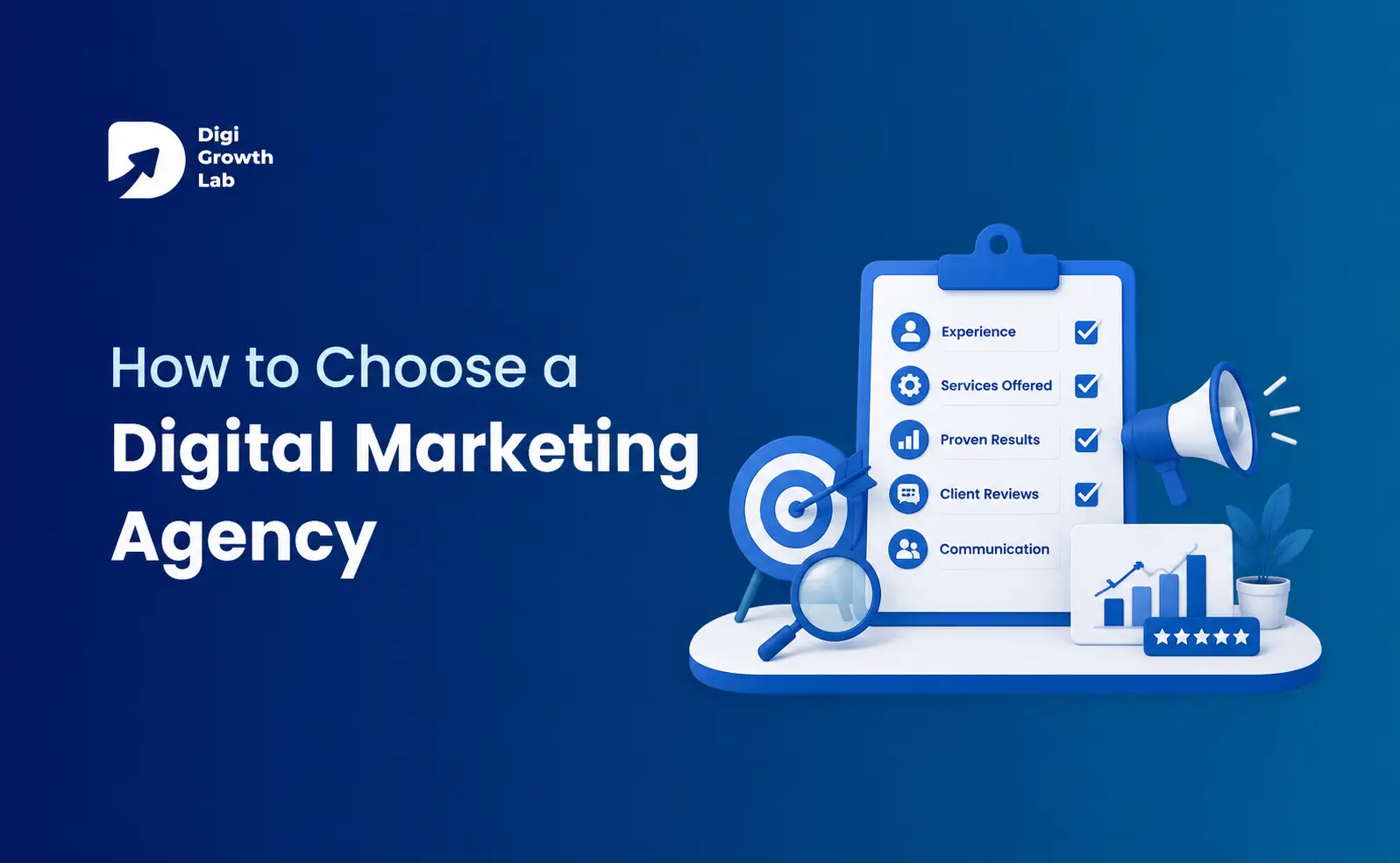
Don’t rely on gut feeling. Use a simple scorecard.
| Factor | What to Evaluate |
|---|---|
| Relevant Experience | Similar industry or market |
| Results | Verified business outcomes |
| Strategy | A clear 90-day plan |
| Team | The actual delivery team |
| Reporting | Revenue-focused reporting |
| Communication | A clear, regular cadence |
| Pricing | Value versus cost |
| Transparency | Account and data access |
| Contract | Fair exit and ownership terms |
| Fit | Real understanding of your business |
India vs North America: What Should Businesses Look For?
The fundamentals of choosing an agency are the same everywhere. The market knowledge is not.
In India, weigh:
- Local and regional market understanding
- Regional languages where relevant
- Cost efficiency
- Lead quality, not just lead volume
- GST and invoicing considerations
- Domestic versus international campaigns
In North America, weigh:
- Higher media and ad costs
- Strong competition in most niches
- Privacy and compliance awareness
- Integration with your CRM and sales team
- Clear revenue attribution
- Deep specialization in your industry
A business expanding from India to the US needs both sets of skills in one partner. Ask directly how they handle the market you are targeting.
What Does the Data Say About Digital Marketing?
A few numbers help explain why the stakes are high, and why measurement matters so much.
India reached about 1.03 billion internet users by late 2025, which is around 70% of the population (DataReportal, Digital 2026 India report). That is an enormous audience, but it also means huge competition for attention. Reaching people is easy. Reaching the right people is the hard part.
In the US, internet advertising revenue hit a record $294.6 billion in 2025, up 13.9% year over year (IAB/PwC Internet Advertising Revenue Report, Full Year 2025). Rising spend means rising costs. Every wasted dollar matters more when the auction gets more crowded.
Within that total, US search advertising alone rose about 11% to $114.2 billion in 2025 (IAB/PwC). Search is still where a large share of buying intent lives, which is why visibility on Google remains central for most businesses.
The point of these numbers is not to impress you. It is to show why a good agency has to prove its work in revenue terms. In a bigger, more expensive market, guessing gets expensive fast.
The Biggest Mistake Businesses Make When Hiring an Agency
The biggest mistake is choosing for the wrong reason.
Owners often pick the agency with the cheapest price, the biggest client list, the flashiest presentation, the boldest guarantee, the highest follower count, or the longest list of services.
None of those predict growth.
The better basis is this: fit, evidence, strategy, transparency, and measurable business outcomes. An agency that scores well on those five will usually outperform the one that just looked good in the pitch.
Final Checklist Before You Sign
Run through this before you commit.
- [ ] Your goals are clearly defined
- [ ] The agency has relevant experience
- [ ] Case studies are verifiable
- [ ] KPIs are tied to business outcomes
- [ ] The 90-day plan is clear
- [ ] Reporting is transparent
- [ ] You know the delivery team
- [ ] Pricing and scope are clear
- [ ] You own your accounts and data
- [ ] The contract has reasonable exit terms
A Note on Search in 2026
Search is changing. People still use Google, but many now get answers from AI-powered search tools and AI-generated summaries too.
A good agency should understand the full picture: traditional SEO, Google search, paid search, social platforms, content, local search, and how your business shows up in AI-generated answers.
Two cautions. First, no agency can guarantee that an AI tool will mention or cite your brand. Anyone who promises that is overselling. Second, don’t get dazzled by buzzwords. Ask them to explain, in plain terms, how they plan to keep you visible as search habits shift.
When You Might Not Need an Agency at All
Honest advice: sometimes hiring an agency is the wrong move.
If your budget is very small, a good freelancer or a single specialist may serve you better. If you have one narrow, ongoing need, an in-house hire might cost less over time. And if you haven’t defined your goal yet, wait. Hiring before you know what you want usually leads to wasted spend and a frustrating exit.
An agency is a tool. Use it when it fits the job.
Conclusion
Choosing well comes down to judgment, not luck. The best digital marketing agency is not necessarily the biggest, the cheapest, or the most famous. It is the one that understands your business, can prove it has solved similar problems, measures the outcomes that matter, communicates honestly, and keeps improving based on results.
Use the goal-first approach, the questions, the red flags, and the scorecard in this guide, and you will know how to choose a digital marketing agency with confidence. Take your time, ask hard questions, and pick the partner whose work you can actually measure.
Are You Getting Real Results From Your Digital Marketing?
If your agency reports traffic and clicks but you can’t see the impact on leads or revenue, it may be time to rethink your strategy.
Frequently Asked Questions
How do I choose a good digital marketing agency?
Start with your business goal, not their service list. Look for relevant experience, verifiable results, a clear 90-day plan, transparent reporting, and pricing that reflects value. Confirm you will own your accounts and data. Then score two or three agencies on the same factors and compare.
How much does a digital marketing agency cost?
It varies widely by scope, market, and channels. Agencies charge monthly retainers, project fees, a percentage of ad spend, performance-based fees, or a mix. The cheapest option is rarely the best value. Judge the price by the quality of leads and revenue it produces, not the invoice alone.
What should I ask a digital marketing agency before hiring?
Ask what result they can improve first, whether they have worked with similar companies, and what they would do in your first 90 days. Ask which KPIs they report, who does the actual work, what the fee includes, who owns your accounts, and what happens if you leave.
How do I know if a digital marketing agency is working?
Track business metrics, not vanity metrics. Watch qualified leads, conversion rate, cost per lead, revenue, and return on ad spend. Traffic and followers alone don’t prove growth. A good report explains what changed, why, and how it affected your sales, not just charts.
Is it better to hire a digital marketing agency or a freelancer?
It depends on scope. A freelancer or specialist suits a single, narrow need and a smaller budget. An agency suits multiple channels working together or faster scaling. If you only need one thing fixed, start small before committing to a full-service retainer.
How long does digital marketing take to produce results?
Paid ads can generate leads within weeks, though they need testing to improve. SEO and content usually take three to six months or more to show real traction. Be cautious of any agency promising instant SEO results, since that is not how search works.