
You start with one SEO agency. Things go well. So you add a PPC specialist. Then someone for social media. A few months later, you have three reports, four WhatsApp groups, and two agencies quietly blaming each other.
And you still cannot answer one simple question. What is actually driving growth?
This is the real problem behind the “one agency vs multiple specialist agencies” debate. It is not about which model is better on paper. It is about which model fits your business, your team, and the way you like to work.
This guide will not tell you that one option always wins. Instead, it will help you make the call for your own situation. We will look at the benefits of each model, the hidden costs most people miss, and a simple test to help you decide.
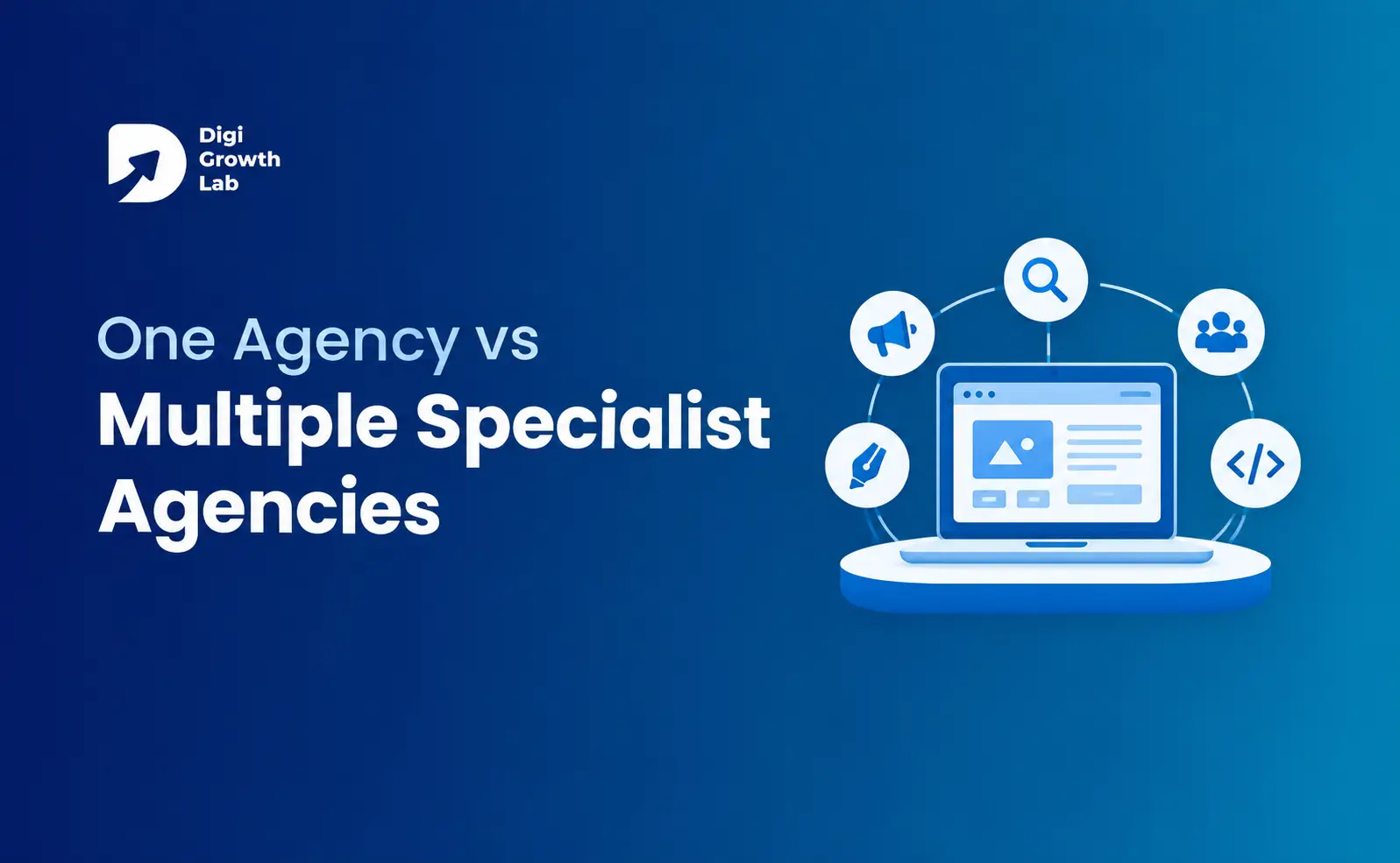
One Agency vs Multiple Agencies: What Are You Actually Choosing?
At the core, you have three real options.
- One full-service agency. One partner handles most or all of your marketing.
- Multiple specialist agencies. Different agencies own different channels. One for SEO, one for ads, one for social, and so on.
- A hybrid model. One lead agency runs the strategy. A few chosen specialists handle specific channels.
Each choice changes something. It changes who owns your strategy. It changes how much time you spend managing people. And it changes how easy it is to see what is working.
So this is not just a vendor decision. It is a decision about how your marketing is run day to day.
What Is a Full-Service Digital Marketing Agency?
A full-service digital marketing agency offers most marketing services under one roof.
That usually includes:
- SEO
- Paid ads (Google and Meta)
- Social media
- Website design and development
- Content and creative
- Reporting and strategy
The idea is simple. One team plans your marketing. The same team also runs it. So your SEO person and your ads person sit in the same building, or at least the same Slack channel.
This model tends to suit small and mid-sized businesses. It also suits companies that want one point of contact and one plan, not five.
What Is a Specialist Marketing Agency?
A specialist agency does one thing. It just does that one thing deeply.
Common specialists include:
- SEO specialists. They live in rankings, technical audits, and content.
- PPC specialists. They focus only on paid search and paid social.
- Social media specialists. They handle content, community, and brand voice.
- Web development specialists. They build fast, stable, well-structured sites.
- CRO specialists. They focus on turning existing traffic into leads and sales.
The benefit here is depth. A good PPC specialist has run hundreds of ad accounts. They have seen what works across many industries. That focus can produce sharper results in one channel.
The trade-off is that you now manage several partners instead of one.
One Marketing Agency vs Multiple Agencies: Key Differences
Here is a balanced view of both models. Neither column is “the winner.” Read it against your own business.
| Factor | One Agency | Multiple Specialist Agencies |
|---|---|---|
| Strategy | One connected strategy across channels | Separate strategies that need to be aligned |
| Communication | One point of contact | Several contacts to coordinate |
| Accountability | Clear. One partner owns the result | Split. Results can be hard to pin down |
| Specialist expertise | Broad, sometimes less deep per channel | Deep in each specific channel |
| Cost management | One retainer, easier to track | Several retainers plus coordination time |
| Reporting | Usually centralised | Multiple reports in different formats |
| Brand consistency | Easier to keep consistent | Needs active effort to stay aligned |
| SEO + PPC coordination | Handled internally | Must be managed by you |
| Internal management | Lower day-to-day load | Higher. Someone must run the group |
| Flexibility | Limited by the agency’s strengths | High. Swap any specialist you want |
| Scalability | Grows with the agency’s capacity | Add specialists as you grow |
| Speed of execution | Faster within one team | Slower when channels must sync |
| Risk of dependency | Higher on a single partner | Spread across several partners |
| Best suited for | Lean teams wanting one plan | Mature teams with strong in-house leadership |
Keep this table in mind as we go deeper. Most of the decision comes down to these rows.
Benefits of Hiring One Marketing Agency
There are real reasons this model stays popular.
One strategy. Your SEO, ads, and social all point in the same direction. Nobody is running their own plan in a corner.
Easier communication. You brief one team. You do not repeat yourself in four meetings.
Better coordination. When your Google Ads and SEO teams talk, they stop bidding against your own free rankings. That kind of overlap is common when channels are split.
Consistent messaging. One team keeps your brand voice steady. This matters more than people think. A widely cited study by Lucidpress (now Marq), first run with Demand Metric in 2016, found that consistent brand presentation across channels was linked to a revenue lift of up to 23%. It is an older figure, so treat it as a signal, not a promise. The point still holds. A consistent brand builds trust, and trust drives sales.
Centralised reporting. You get one dashboard. You see the full picture in one place.
Clearer accountability. If results drop, you know exactly who to call.
Faster execution. A landing page, an ad, and a social post can ship together, not weeks apart.
For a business without a big in-house marketing team, these benefits are hard to beat.
Benefits of Multiple Specialist Agencies
Specialists earn their place too. This model has clear strengths.
Deep expertise. A dedicated SEO agency does nothing but SEO all day. That focus shows in the work.
Flexibility. You are not locked in. If your social agency underperforms, you replace only that piece.
Independent perspectives. Different agencies challenge each other’s thinking. That can sharpen your strategy.
Niche expertise. Some channels need real specialists. Complex technical SEO or advanced paid media are good examples.
Channel-specific optimisation. Each partner pushes their channel as far as it can go.
But there is a catch. Someone has to run this group. Multiple agencies do not coordinate themselves. If nobody owns the whole picture, the pieces drift apart. That management load is the real price of this model, and we will cover it next.
The Hidden Cost of Managing Multiple Digital Marketing Agencies
Most people compare agency models by adding up retainers. That is only half the cost.
Say a growing company hires four partners.
- SEO agency: ₹40,000 per month
- PPC agency: ₹30,000 per month
- Social media agency: ₹25,000 per month
- Web development partner: ₹20,000 per month
The direct cost is ₹1,15,000 per month. Clear and easy to see.
But the real bill does not stop there. Your team also spends time on:
- Weekly calls with each agency
- Writing and sharing briefs
- Reviewing four separate reports
- Sorting out conflicting advice
- Sharing creative files and access
- Tracking which leads came from where
- Coordinating campaigns so they do not clash
- Fixing “who owns this” arguments
This is coordination cost. It is real, even though it never shows up on an invoice.
Picture your marketing manager. They might spend six to eight hours a week just holding this group together. That is a full working day, every week, spent on management instead of growth. (This is an illustration, not a fixed rule. Your number depends on your setup.)
There is also a data cost. When channels are split, measuring results gets harder. In fact, HubSpot’s 2026 State of Marketing report, based on a survey of more than 1,500 marketers, found that measuring marketing ROI is now the single biggest challenge for marketing leaders, named by 33% of them. Split your data across four agencies and four tools, and that challenge only grows.
So when you compare models, add the coordination time and the reporting effort. The cheapest option on paper is not always the cheapest in practice.
Full-Service Agency vs Specialist Agency: What About Expertise?
Here is the fear that stops many people from choosing one agency.
“Can a single agency really be good at everything?”
It is a fair question. And the honest answer is: not all of them are.
Some full-service agencies are strong across the board. Others are strong in one or two areas and thin in the rest. So do not judge by the label. Judge by the evidence.
Before you trust one agency with everything, check:
- Team structure. Do they have actual SEO, PPC, and social specialists on staff?
- Real case studies. Can they show results in each channel, not just one?
- Process. How do they plan and review work across channels?
- Reporting. Do they connect channels in their reports, or just list them?
- Client experience. Will you get a senior team or a junior handler?
- Channel depth. Is their weakest channel still good enough for your needs?
A strong full-service agency behaves like a group of specialists who happen to share a strategy. A weak one is a generalist stretched too thin. Your job is to tell the two apart.
When Multiple Specialist Agencies Make More Sense
Sometimes the specialist model is clearly the right call. Look for these signs.
- You already have strong marketing leadership in-house.
- You have someone whose job is to manage vendors well.
- One channel drives most of your revenue and needs a true expert.
- You operate in complex or multiple markets.
- Your channels are large enough to justify a dedicated partner each.
- You want independent experts who go deep, not wide.
- Each agency has a clear, separate lane with no overlap.
Notice the pattern. This model works best when you have the internal muscle to lead it. Without that, the specialists have no conductor. And an orchestra without a conductor sounds like noise.
What Is the Hybrid Marketing Agency Model?
There is a third path that many growing companies miss. It is often the smartest one.
The hybrid model uses one lead agency plus a few chosen specialists.
It can look like this:
- Lead agency: owns overall strategy and SEO
- PPC specialist: runs paid advertising
- Web development partner: handles technical build and site health
- Internal team: owns brand, approvals, and final decisions
You get the best of both worlds. One partner keeps the whole plan connected. A specialist still gives you depth where you need it most.
But the hybrid model needs rules to work. Someone must own coordination. The lead agency usually plays that role. The specialists share data with them. Everyone reports into one plan, not five.
This model suits businesses that are scaling. You are too big for one generalist, but not yet ready to manage five separate teams. The hybrid model bridges that gap.
How to Choose a Marketing Agency Setup for Your Business
Skip the guesswork. Run this simple 5-question test.
- How many marketing channels do you actively use? Few channels lean towards one agency. Many active channels may justify specialists.
- Does your team have someone who can manage multiple agencies? No dedicated manager points strongly towards one agency or a hybrid model.
- Do your channels depend heavily on each other? If SEO, ads, and your website constantly affect each other, one connected team helps.
- Do you need deep expertise in one specific channel? If one channel is your main growth engine, a specialist there makes sense.
- Who is responsible for the final business outcome? If the answer is “nobody clearly,” you need one accountable partner, not several.
These questions do not add up to a score. There is no magic number. But your answers will point you towards one model. Most lean-team owners land on one agency or a hybrid. Most mature marketing teams land on specialists or a hybrid.
One Agency vs Multiple Agencies: Real Business Examples
Theory only goes so far. Let us look at three common situations.
Example 1: A small local business
Picture a dental clinic in Ahmedabad. The owner wants four things.
- Local SEO to show up in “dentist near me” searches
- Google Ads for quick patient enquiries
- Instagram to build trust and show the clinic
- A better, faster website
The owner is busy treating patients. There is no marketing manager on staff.
Now imagine hiring four separate specialists for this. Four contracts. Four monthly calls. Four people who all need website access. The owner ends up managing agencies instead of running the clinic.
For a business this size, one agency or a small hybrid setup is usually calmer and cheaper in real terms. One team, one plan, one report. That is enough.
Example 2: A growing SaaS company
Now picture a SaaS company. It looks very different.
- It has an internal marketing manager.
- It has a solid CRM setup.
- Its marketing budget is over ₹10 lakh per month.
- It has a dedicated content team.
- It spends heavily on paid media.
Here, specialists start to make sense. The paid budget is big enough to justify a dedicated PPC agency. The content team can brief a specialist SEO partner. And crucially, there is a manager to hold it all together.
This company has the internal leadership that the specialist model needs. So depth beats simplicity for them.
Example 3: An e-commerce company
Now a case where coordination is everything. An online store runs:
- SEO for product and category pages
- Google Ads and Shopping campaigns
- Meta Ads for discovery and retargeting
- CRO to lift conversion rates
- Ongoing website development
Watch how these connect. A website change can break SEO. A CRO test changes what your ads should say. A stockout should pause both SEO pushes and ad spend on that product.
If four separate agencies run these with no shared plan, chaos follows. One agency runs a sale the others never hear about. Ads keep promoting a product the site just removed.
For e-commerce, coordination is not a nice-to-have. It is the difference between profit and waste. This is where a strong lead agency, or a tightly managed hybrid, really earns its fee. Getting your ad structure right matters here too, and a clean Google Ads campaign structure makes coordination far easier.
Questions to Ask Before Hiring One or Multiple Agencies
Before you sign anything, get clear answers to these. This list saves painful surprises later.
- Who owns the overall marketing strategy?
- Who owns the data and analytics?
- How will leads be tracked from click to sale?
- Who owns the ad accounts?
- Who owns the website and its code?
- How will agencies share information with each other?
- Who manages overlapping or competing campaigns?
- How often will reporting happen, and in what format?
- What KPIs will everyone be judged on?
- Who is responsible when two channels conflict?
- Can you leave the agency without losing your accounts and assets?
- What is the plan if performance drops for a few months?
One rule matters most here. You should own your accounts, your data, and your website. Always. Agencies run them. They should not hold them hostage.
Common Mistakes Businesses Make When Hiring Multiple Agencies
These mistakes come up again and again. Avoid them and you avoid most of the pain.
- No central strategy. Every agency runs its own plan. Nothing connects.
- Different KPIs. The SEO agency chases traffic. The ads agency chases clicks. Nobody chases revenue.
- Agencies competing for credit. Each one claims the wins and dodges the losses.
- Duplicate ad targeting. Two partners bid on the same audience and push up your own costs.
- Poor data sharing. Agencies work blind because they cannot see each other’s numbers.
- No clear ownership. When something breaks, everyone points elsewhere.
- Separate reports, no combined view. You get four PDFs and still cannot see the full story.
- Choosing on price alone. The cheapest partner in each slot rarely adds up to a strong whole.
Most of these come from one root cause. There is no single owner of the overall marketing. Fix that, and half these problems disappear.
How to Make Multiple Agencies Work Together
If you do go with several partners, do not just hope they get along. Set it up properly. Here is a practical way to run it.
- Define ownership. Write down who owns strategy, data, ad accounts, and the website. No grey areas.
- Create one shared marketing plan. Every agency works from the same document, not their own.
- Use common KPIs. Point everyone at the same business goals, like qualified leads or revenue.
- Centralise reporting. Pull all channels into one dashboard or one combined report.
- Give agencies the data they need. Share the right access so nobody works blind.
- Set communication rules. Decide how often partners talk and where. One shared channel beats four private ones.
- Prevent channel overlap. Make sure two agencies are not targeting the same keywords or audiences.
- Appoint one coordinator. One person, in-house or at your lead agency, owns the whole picture.
That last step is the glue. Without a coordinator, even good agencies drift apart. With one, several specialists can move as a team. It also helps to agree on shared reporting rules early, especially for softer channels where it pays to measure social media ROI the same way everyone else measures results.
One more note on specialists. A specialist does not always mean a big agency. Sometimes it is a skilled freelancer. Both can work, but they carry different risks around capacity and continuity. If you are weighing that choice, this look at freelancer vs agency is worth a read.
Final Takeaway
So, one agency or multiple specialist agencies? By now the honest answer is clear. It depends.
It depends on your:
- Business size
- Budget
- Internal team
- Marketing complexity
- Need for deep expertise
- How much your channels depend on each other
- Ability to manage several partners
- Growth stage
A lean local business often thrives with one agency. A large team with strong leadership often does better with specialists. Many growing companies find the hybrid model fits best of all.
But here is the thought to hold on to. The number of agencies is not the real question.
The real question is simpler. Is everyone working on your marketing moving toward the same business goal? Get that right, and almost any model can work. Get it wrong, and no model will save you.
Wondering if one agency or several is right for you?
We will review your current setup and reporting, then tell you plainly what is working and what is not.
Frequently Asked Questions
Is it better to hire one marketing agency or multiple agencies?
Neither is better for everyone. One agency suits lean teams that want a single plan and one point of contact. Multiple specialists suit larger teams with strong in-house leadership and deep channel needs. Match the model to your resources, not to a trend.
What are the disadvantages of using multiple marketing agencies?
The main ones are higher coordination time, split accountability, harder reporting, and the risk of channels working against each other. These grow worse when no single person owns the overall strategy.
Are specialist agencies better than full-service agencies?
Specialists offer more depth in one channel. Full-service agencies offer more coordination across channels. “Better” depends on whether your bigger problem is depth or alignment.
Can one digital marketing agency handle SEO, PPC, and social media?
Yes, many can, but quality varies. Check that the agency has real specialists on staff, case studies in each channel, and reporting that connects the channels rather than listing them separately.
When should a business use multiple digital marketing agencies?
When you have strong internal marketing leadership, a large budget per channel, and the time to coordinate partners. It also fits when one channel is so important that it needs a dedicated expert.
What is a hybrid marketing agency model
It is one lead agency plus a few chosen specialists. The lead agency owns strategy and coordination. Specialists add depth in specific channels. It works well for scaling businesses that need both a connected plan and expert focus.