
Building a website in 2026 is about more than looks. It is about speed, trust, and whether the site actually brings in business month after month. The tools have changed, the expectations have changed, and so has the way smart businesses build their online presence.
Which brings most owners to the same crossroads:
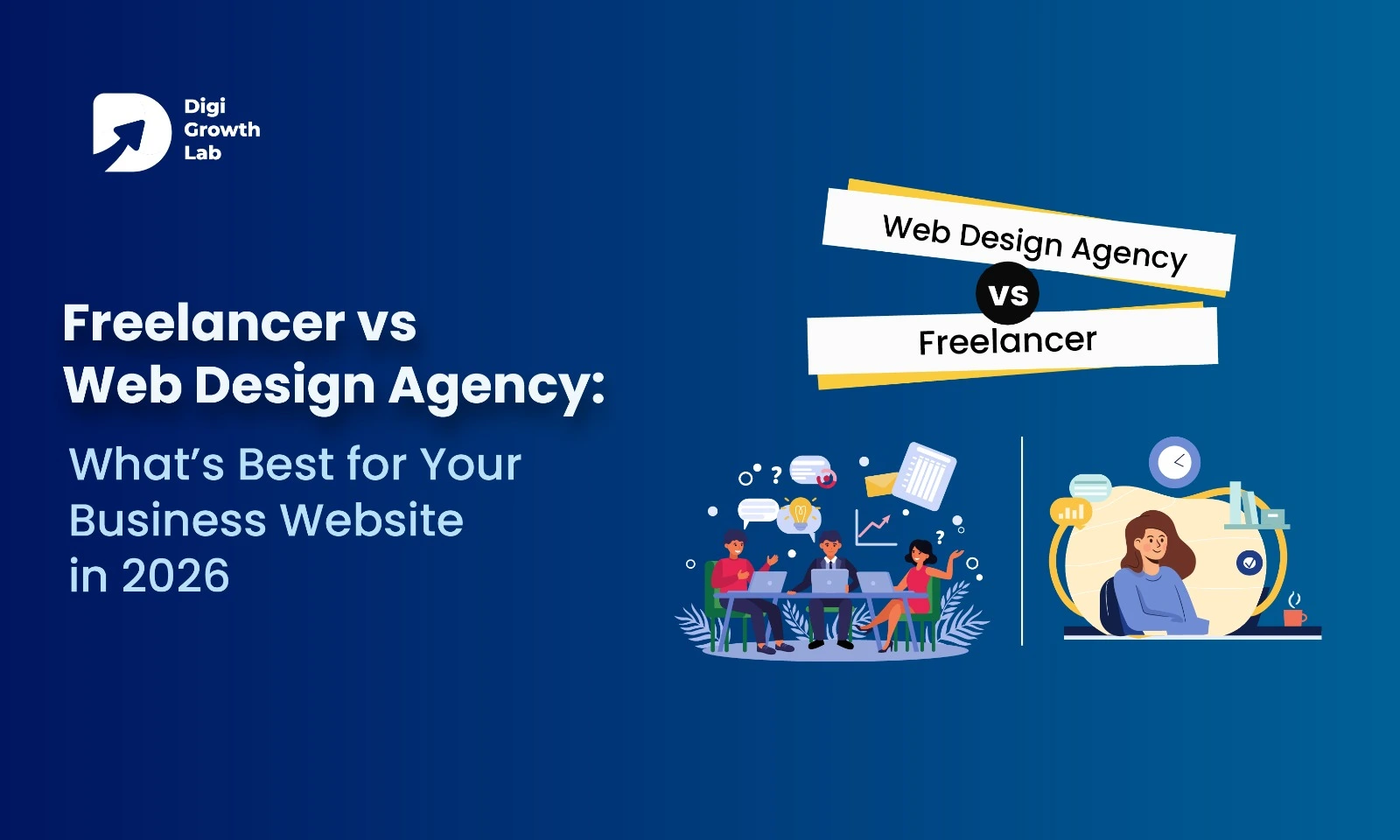
Should I hire a freelancer or a website design and development agency?
Both sound right until you look closer. Freelancers can be quick and affordable for smaller jobs. Agencies bring structure, strategy, and support that lasts past launch day. The right answer depends on your goals, how fast you plan to grow, and the kind of experience you want your customers to have.
This guide takes you past the usual price comparison so you can make a smarter, longer-term call for your website in 2026.
Key Takeaways: Freelancer vs. Agency in 2026
- Choose a freelancer if you have a simple, well-defined project, a tight budget, and the time to manage the work yourself.
- Choose an agency if you need a complex or connected system, plan to grow, and want long-term support, stability, and clear accountability.
- The real shift: In 2026 the decision is less about a one-time build and more about choosing a partner who reduces future headaches and keeps your site running and growing.
Why This Decision Matters More Than Ever in 2026
The web in 2026 looks nothing like it did in 2019 or even 2022. Back then, most small businesses just wanted a decent site that worked on mobile and did not cost a fortune.
Now the expectations are higher. Owners want their website to generate leads, connect to tools like HubSpot or Shopify, and show measurable returns within months. That jump in expectation is exactly what makes the freelancer vs. agency choice harder today.
Here is what actually changed.
Websites became systems, not one-time builds. A modern site keeps evolving with new products, content, and campaigns. You do not just launch it and walk away. You maintain it, test it, and improve it every few weeks.
First impressions got faster and more brutal. People decide whether they trust a website in about 50 milliseconds, faster than a blink, according to Google’s UX research. Speed matters just as much: Google found that 53% of mobile visitors leave a page that takes longer than three seconds to load. A build that ignores design polish and performance is quietly costing you customers before they read a single word. This is where a strong web development partner earns its fee.
Freelancers got faster but narrower. Many now use AI-assisted tools and templates to cut delivery time. That works fine for simple builds. But once a project needs strategy, SEO setup, or automation across tools, most solo freelancers pause, hand it off, or hit their limit.
Costs shifted because demand did. A small site that ran $2,000 to $3,000 a few years ago can cost more now, not because agencies got greedy, but because clients now ask for strategy, data, testing, and conversion tracking as part of the package.
So when you compare a freelancer and an agency in 2026, you are not just picking a service. You are choosing between a quick build and a growth partnership.
What Really Separates Freelancers and Agencies in 2026
Both can be excellent. A skilled freelancer can ship a landing page overnight. A good agency will refine wireframes for weeks before touching code. The question in 2026 is not who is better. It is which one fits the business you actually run.
Here is what is happening in the real world.
Stability now matters more than the sticker price. When one person controls hosting, plugins, and CMS access and then moves on to new clients or switches platforms, your site can go dark or stall. Agencies split those roles across a team, so one person’s absence does not stop your business.
The “single point of failure” problem is real. Plenty of businesses learned this the hard way when a solo developer disappeared and took the only working knowledge of their site with them. Agencies keep backups, documentation, and more than one person who understands the build.
Speed is not just about how fast someone codes. Freelancers win on small, clear jobs. Agencies win when several skills overlap at once, such as copywriting, conversion design, branding, and technical SEO. Specialists work in parallel, so decisions land in days instead of weeks.
Pricing has become more predictable with agencies. Most US freelancers still bill by the hour, roughly $50 to $150 depending on experience, which can be hard to forecast. Many agencies now offer fixed website “sprints” with set timelines and defined outcomes. For a small business, that predictability often means staying inside budget instead of watching hours pile up.
Support is where most people miscalculate. After launch, forms fail, plugins expire, and updates clash. A freelancer usually fixes it when they are free. A good agency sets response times, keeps backup developers, and tracks uptime. At that point you are not paying for design. You are paying for continuity.
Freelancer vs. Agency at a Glance
| What matters | Freelancer | Website design agency |
|---|---|---|
| Best for | Simple builds, clear scope, smaller needs | Complex projects, growth plans, long-term support |
| Typical cost | Hourly ($50 to $150), less predictable | Fixed sprints or retainers, easier to budget |
| Support | Ad hoc, fixed “when free” | Set response times, maintenance plans, backup developers |
| Structure | One person, a single point of failure | A team of specialists working in parallel |
| Key risk | The person may move on or become unavailable | Higher upfront cost for a fuller service |
| Scalability | Great for today, can struggle to add features later | Architecture planned for future growth from day one |
| Project management | You manage timelines and testing | They manage it, you approve milestones |
If you are deciding in 2026, worry less about who builds your site and more about who will still be around to keep it running six months later. That is where most projects quietly succeed or fail.
The Real Decision Factors That Matter in 2026
When owners ask us which way to go, we do not start with budget or portfolios. We start with risk, reliability, and growth plans, because those are the filters that separate a smart short-term project from a lasting business asset.
How often does your business change? If you update offers, add products, or run seasonal campaigns, you will outgrow a single-person setup fast. Most freelancers build and hand over. That is fine until your business shifts. A team building with change in mind uses modular pages, reusable layouts, and hosting that scales, so you are not starting from scratch every time you pivot. Our custom website development work is built around exactly this problem.
Who owns accountability after launch? Every website works on day one. The gap shows up in month six, when updates, integrations, or SEO fixes come due. A freelancer may get to it when free. An agency assigns a named account manager, developer, and quality check. If your leads depend on the site, that structure decides your return more than the design does.
How complex will your tech stack get? Even small businesses now run on a stack of connected tools: booking systems, CRMs, payment gateways, email, and analytics. The more you need to connect, the less a solo setup makes sense. Freelancers can wire up a few tools. An agency plans the whole data flow, where customer information goes, how it syncs, and how you track conversions. If you see your stack growing this year, it is cheaper to build it right than to rebuild it later.
How comfortable are you managing people? Working with a freelancer means you are the project manager. You set deadlines, test, review, and follow up. Some owners love that control. Others do not have the hours. Agencies carry that load for you and deliver a finished product with fewer back-and-forths. So ask yourself: do I want to run the work, or just approve the milestones? Your answer points straight to your fit.
What is your tolerance for risk? Freelancers can disappear. Agencies can underdeliver. Both risks exist, just at different scales. If losing one person’s availability could hurt your business, lean toward an agency. If you can handle a short delay or you have internal tech support, a freelancer can be a perfectly good call for a smaller build.
When a Freelancer Is the Smarter Choice
The single-point-of-failure risk is real, but it does not apply to every project. For plenty of businesses, a freelancer is not a compromise. It is the right answer. That is usually true when:
- Your project is well defined and static. You need a five-page site, a portfolio, or one landing page with no complex integrations or frequent major updates.
- You are ready to manage the project. You have the time and comfort to set deadlines and handle testing yourself instead of paying an agency to do it.
- Budget is the hard constraint. You have a fixed number and are willing to trade long-term, scalable support for a lower upfront cost.
- You need one specific skill. You do not need a full team of strategists. You need one strong developer for a clearly defined task.
The catch is year two. In 2026, sites need ongoing updates, speed tuning, and accessibility checks. Agencies fold that into retainers. Freelancers usually charge for it case by case. So think past launch: the real cost of a site is not what you pay today, but what it takes to keep it performing next year.
Bottom Line
Choosing between a freelancer and an agency is not about who is cheaper or faster anymore. It is about who reduces your future headaches.
Ask yourself three questions:
- Will my site stay stable if one person disappears?
- Can I scale without rebuilding from scratch?
- Who is responsible when something breaks at 2 a.m.?
Your honest answers will tell you exactly who to hire. If you want a wider view of how to vet any partner, our guide on how to choose a digital marketing agency walks through the same thinking for the whole marketing picture.
Why Businesses Choose Digi Growth Lab
Whether you hire a freelancer or an agency, the goal is the same: a website that helps your business grow without constant fixing and chasing support.
That is how we work at Digi Growth Lab. We are a small, focused team that treats every project like it is our own business. Our designers, developers, and strategists work together from day one, so your site does not just function, it performs. We build sites that are easy to manage, quick to update, and ready to scale as you grow. And we do not disappear after launch. We stay involved to make sure the site keeps delivering. You can see the kind of results that come out of that approach on our case studies page.
Ready to build a website that keeps performing after launch?
Tell us where your current site is losing leads, and we will show you what to fix first.
Frequently Asked Questions
Will I still own my website and have full access, whether I hire an agency or a freelancer?
Yes, but you have to confirm it up front. Some freelancers and agencies build sites on their own hosting, CMS, and domain accounts, which leaves you dependent on them. A reliable partner makes sure you register and own your domain, hold your hosting credentials, keep regular backups, and retain full rights to your content and code. Without that, you are handing over your digital asset and may face a costly migration later.
How does scalability differ between a freelancer and a web development company?
A freelancer can deliver a perfect five-page site today. The gap shows up in 6 to 12 months, when you want e-commerce, memberships, or regional versions and the original build cannot stretch to fit. A mature web development company plans architecture, CMS flexibility, and integrations from the start. That may cost a little more early, but it saves you from rebuilding when your needs grow.
What ongoing costs should I expect with website design and development?
Plan for content updates, plugin and hosting upgrades, security patches, speed tuning, and the occasional redesign as browsers and trends change. Freelancers usually handle these case by case. An agency typically bundles them into a maintenance plan or retainer. If you do not budget for year two, a cheap upfront build can get expensive fast. The right question to ask any partner is simple: what will this cost me in year two and year three?
How do I judge whether a partner can build something that lasts?
Skip the buzzwords and ask for proof. Ask to see a site they built that later added new features without a full rebuild, a project where they moved a client to a newer platform with minimal disruption, and how they handled mobile, speed, and SEO on recent work. If a partner only offers template builds and promises to “update it when you need,” treat that as a warning sign. Real custom development anticipates change and builds room for it.
What should I expect after launch from an agency versus a freelancer?
With a freelancer, you often get the site live and are then on your own. An agency usually includes scheduled check-ins, analytics reviews, conversion tracking, and a defined support scope. The question that separates the two is this: who is responsible if a plugin breaks, a form stops submitting, or Google flags a speed issue 30 days from now? A clear support plan means you are never left chasing an answer.
How long does a website take to build with a freelancer versus an agency?
For a straightforward marketing site, both can deliver in a few weeks to a couple of months, mostly depending on how ready your content is. The difference shows up on bigger builds. A freelancer works in sequence, one task after another, so a complex site with e-commerce or custom features can stretch out if they are juggling other clients at the same time. An agency runs tasks in parallel across a team, which usually keeps larger projects on a tighter, more predictable schedule. The honest variable in either case is you. Projects slow down most often when copy, images, and approvals are not ready, not because of who is doing the building.