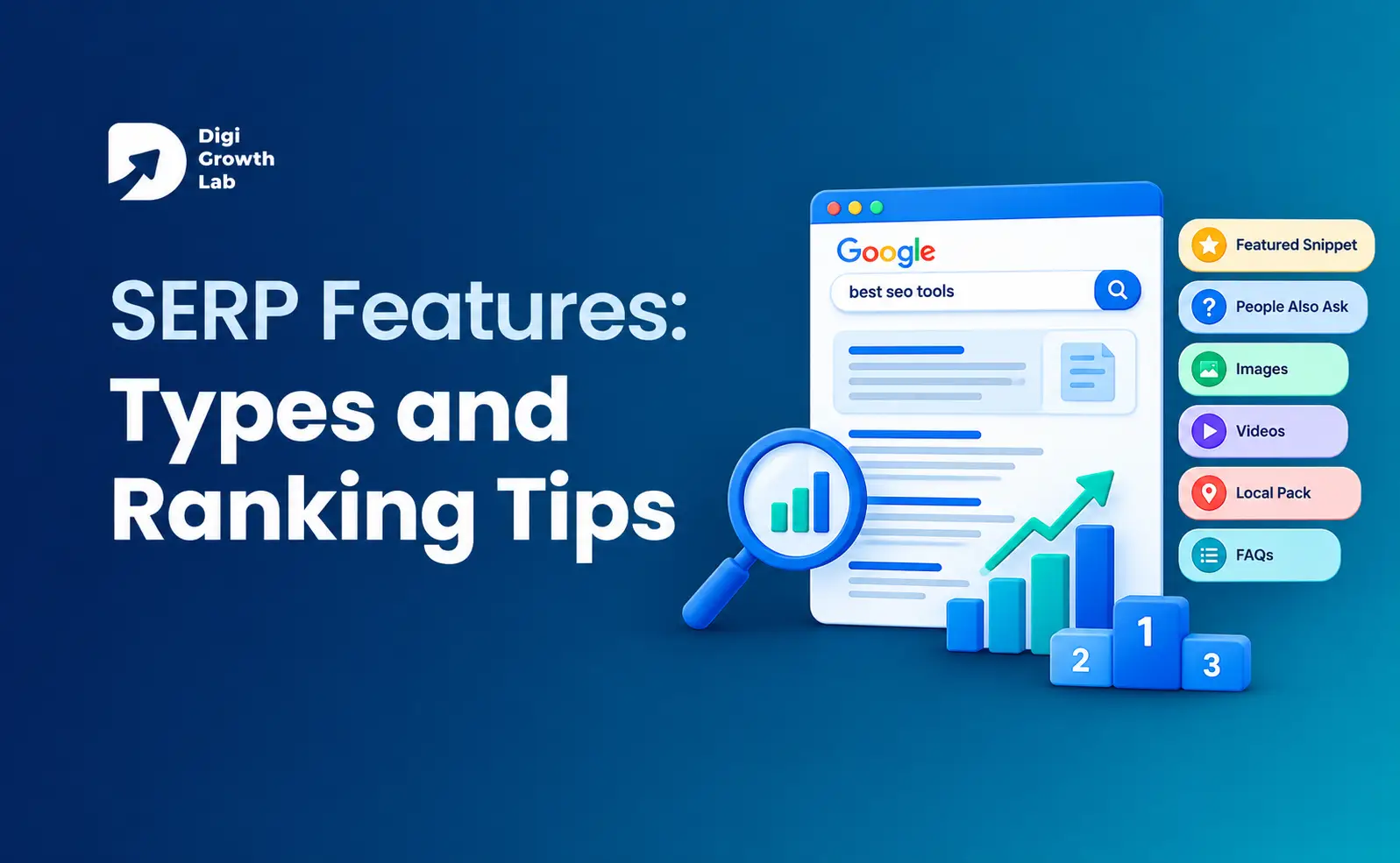
SERP features are the parts of a Google results page that sit outside the usual blue links. AI Overviews, featured snippets, People Also Ask boxes, local packs, image packs and more. They answer a query faster and keep the searcher on the page.
For your business, that changes the game. One feature can push the top organic result far down the screen. To protect your SEO Visibility, you have to think about the whole page, not one ranking spot. This guide shows you how, and it ends with fixes for the real problems most guides ignore.
What are SERP features?
For years a results page was ten blue links. Not now. Type almost any query and the page fills with boxes, maps, answers and carousels.
A SERP feature is any of those extra elements. SERP stands for Search Engine Results Page. A feature is anything that is not a standard organic listing with a title, a link and a description.
Some features pull from websites, like a featured snippet. Some come from Google’s own data, like a knowledge panel. A few are paid, like search ads. Across Ahrefs’ large United States keyword set, only a tiny share of results show no feature at all. That is one dataset, not a rule for every query, so treat it as a strong pattern, not a law.
SERP Features, Rich Results and AI search: How They Differ
Three terms get mixed up. They overlap, but they are not the same.
| Term | What It Means | Example |
|---|---|---|
| SERP feature | Any element that is not a standard organic listing | Local pack, People Also Ask, AI Overview |
| Rich result | An organic result shown with extra detail from structured data | Product price and rating, recipe time |
| AI search feature | A result built by generative AI | AI Overviews, AI Mode |
A rich result is one kind of SERP feature. Structured data can make an eligible page qualify for one, though Google does not guarantee it appears. An AI search feature is another kind, built by Google’s AI. Most features need no special markup. Knowing the difference tells you what you can influence and how.
Why SERP features matter
A good SEO Ranking used to mean a top spot and a steady flow of clicks. Now a feature can sit above you and answer the question before anyone reaches your link.
Features hit you in three ways. They push your result down the page, so fewer people see it. They answer the query outright, so fewer people need a click. Or they open a new route to you, through a citation, a map listing or a video, that an ordinary blue link never offered. The same feature can help one business and hurt another, so you weigh each one against your own goals.
The data shows the cost. In a 2026 study, Ahrefs estimated that when an AI Overview appears, the top organic result sees around 58 percent fewer clicks. That is an average across keyword groups in its data, not a loss every site will see, since the effect varies by query and page. AI Overviews have spread fast too. Ahrefs analysed 232.8 million United States desktop results collected between July and September 2026, and in September found AI Overviews in 73.3 percent of branded and 78.3 percent of non branded keyword results in that dataset. Those figures describe that dataset, not every Google search.
Zero click search is now normal. Using clickstream panel data, SparkToro found that about 68 percent of United States Google searches in early 2026 ended with no click to the open web, rising to roughly 77 percent on mobile. That is one panel, not a fixed rate for every country or query.
Here is the takeaway. Do not judge a page by clicks alone. A page quoted in an AI Overview or holding a featured snippet is still working for your brand, even when the traffic report looks flat. Track your presence in features next to your visits.
Types of Google SERP features
There are many features. Grouped by what they do, they are easy to hold in your head.
AI driven. AI Overviews are AI written summaries at the top of the page, with citation links. They reach over 2.5 billion people a month, per Google’s I/O event in May 2026. AI Mode is a separate tab that works like a conversation, and Google reported it passed one billion monthly users in 2026.
Text and answers. A featured snippet lifts a few lines from a page to the top. People Also Ask shows related questions that expand when clicked. Sitelinks add inner links under a result, usually for brand searches, and they reward a clear site structure and smart internal linking.
Visual. An image pack is a row of images. A video carousel is a strip of videos, most from YouTube, shown when watching beats reading.
Local. The local pack is a map with three business listings, shown for local intent, like a search for an SEO company in Ahmedabad. For any business with a location, this is often the single best target.
Shopping. Popular products and organic shopping cards show items with images, prices and ratings for product searches.
Knowledge. A knowledge panel describes an entity like a company or a person, pulled from Google’s Knowledge Graph rather than one page.
Discussion and news. The discussions and forums feature surfaces Reddit and Quora threads. Top stories shows recent news relevant to a trending query.
Paid. Search ads and shopping ads sit above and below the results. You pay for these, so they are an ads decision, not organic SEO.
Beyond these, Google runs narrow features for jobs, events, recipes, flights, hotels and more. You will not chase them all. It helps to know they exist.
What changed in 2026
Two shifts matter. First, AI Overviews moved from mostly informational queries to a near constant presence on commercial and branded ones. A Semrush study published in October 2026 tracked 400 commercial keywords in banking, software and ecommerce. By August 2026, AI Overviews showed for 82 to 96 percent of searches across the five modifier groups it studied.
Second, in May 2026 Google expanded Preferred Sources to AI Overviews and AI Mode. Searchers can pick sites they want to see more of, and those sites get a Preferred label in AI Overviews and Top Stories. Google says people are about twice as likely to click a Preferred Source. You can ask your own readers to add you. This is a new way to earn visibility, and it sits at the heart of modern AI SEO Services.
Which features can you win, and which matter for you?
Not every feature is a target. Before you spend effort, check four things. Presence: does it show for your keyword? Eligibility: can your page or business qualify? Ownership: are you the source inside it? Performance: does it bring clicks or leads? If a feature fails the first three, walk away.
This table shows how much control you have, and what to do.
| Feature | Can You Influence It? | Action |
|---|---|---|
| Featured snippet, PAA | Yes, with content | Answer the query directly, match the format |
| Image pack, video | Yes, with content | Use original images and helpful video |
| Local pack | Yes, if you qualify | Build your Google Business Profile, earn reviews |
| Product, shopping | Yes, if you qualify | Keep a Merchant Center feed and product schema |
| Review, recipe results | Yes, with schema | Add supported structured data, then validate |
| AI Overview, knowledge panel | Indirect only | Strong SEO, trust and clear entity signals |
| Top stories | Only if you publish news | Publish original, timely news, follow Google policies |
| Search, shopping ads | Paid only | Run Google Ads |
Your best targets also depend on your business.
| Business Type | Target First | Why |
|---|---|---|
| Local service | Local pack, reviews | Buyers search nearby and act fast |
| Ecommerce | Product, shopping, images | Shoppers compare on the page |
| Manufacturer or B2B | Snippets, PAA, AI Overviews | Buyers research before they enquire |
| Healthcare | Local pack, AI Overviews | Patients want local, trusted answers |
Find your row, start there, and leave the rest.
How to Find and Track Opportunities for Free
You do not need a paid tool to start. Two free sources do most of the work.
First, the live results. Search your top ten keywords in an incognito window, set to your country. An incognito window reduces some personalisation, but it does not remove your location or give a neutral result, so check the market you are targeting. Note every feature, who holds it, and whether you are inside it. A pattern shows fast: features you own, features a rival owns, and features nobody has locked down. That third group is your opening. Read the People Also Ask questions while you are there, since each is a heading your content can answer.
Second, Google Search Console. Open Performance, then the Search appearance tab. It lists the supported result types your pages already show in, like Videos, Review snippet and Recipe. It does not report every SERP feature, so pair it with your own checks. Then sort your queries by impressions. A query with high impressions, a strong position and a low click through rate is often one where a feature sits above you, though a low rate alone does not prove it. Those queries are still your best targets, because you already rank. Say a guide ranks third for a strong term and pulls plenty of impressions, yet its click through rate sits well below your other page one results. That gap is the signal. Compare similar date ranges, open the live result, and see what sits above it.
For ongoing tracking, keep a short log. A spreadsheet with the keyword, the date, the features on the page and whether you hold each one. Fill a row a month. After three months you have a trend no dashboard gave you. For AI Overviews, check your money queries by hand, since no tool reads them with full accuracy yet.
Check mobile as well as desktop. The two pages are not the same. Mobile results can place more features above the first organic result, and click behaviour can differ from desktop, so a feature that barely affects you on desktop may be taking more of your clicks on a phone. Search your key terms on a mobile device, or use your browser’s mobile view, before you decide a feature does not matter.
Past a few dozen keywords, a paid tool like Semrush, Ahrefs or SE Ranking saves time by watching features daily. The reason to pay is scale, not the method, since the free steps find the same openings. If you would rather hand this over, our team runs it across your full list as part of our Professional SEO Services.
How to Optimise For the Features Worth Winning
Each feature rewards a specific kind of content. Here is what moves the needle.
Study the result that already won. Is the snippet a paragraph, a list or a table? Match that format, then make yours clearer and more complete. If a how to query returns a numbered snippet, a wall of paragraphs will not win it, however good the writing. The live result is your brief.
Write an answer a machine can lift. Name the topic in the first sentence, then answer in a short, self contained block under a heading that matches the question. Use a numbered list for steps and a real HTML table for data. Google sets no word count, and no format guarantees a spot. A clean answer makes the page easy to read and easy to quote, which helps your chances at snippets, People Also Ask and AI Overviews. Our On-Page SEO Services build this into every page.
Add what the answer lacks. Original information and a fresh angle can strengthen a page, where a copy of what is already shown cannot. Add your own data, a worked example, a step others skipped, or a local angle for your market. A page on local SEO that shows a real before and after from your own work beats ten pages that only define the term. A page that repeats the overview gives Google little reason to cite it.
Keep the page accurate. Review your top pages on a schedule and update them when the facts, data, screenshots or reader needs change. Freshness helps for fast moving topics, but changing a date without changing the content is not a ranking trick, so update for a real reason.
Back your claims with named sources. A claim with a study, a date and a figure reads as more reliable, to people and to AI systems. Credible sourcing does not guarantee a citation, but it is one of the signals that makes a page worth quoting.
Use the schema Google still supports. Add Article and Breadcrumb markup to content, Product and Review to shop pages, Recipe to recipes, and VideoObject to video. Skip FAQ and HowTo markup as a feature play, since Google no longer turns them into rich results. Validate each one. Getting this right across a large site is a job for proper Technical SEO Services.
Climb the People Also Ask ladder. Click a question in the box and Google adds more beneath it. Map that chain before you write. Open the box, click through, and note the follow ups. Then answer the main question and its follow ups on one page, each under its own clear heading. You cover the whole chain instead of one link in it.
Win the local pack with signals, not just a profile. Pick the right category, write real location pages, earn genuine reviews, reply to them, and keep your business details accurate. Google ranks local results on relevance, distance and prominence, so treat these as sound practice, not a guaranteed way to move up.
Real Problems People Search for, and How to Fix Them
Here are common SEO problems people run into, that most guides never answer well. If your blog solves these, it earns the trust that ranks.
My rankings held, but my clicks dropped. How do I find the cause?
A steady position with falling clicks does not prove a feature is to blame. Work through it in order. First, in Search Console, compare clicks, impressions, CTR and position across two similar periods, and find which queries, pages or devices lost the clicks. Second, search those queries in your target market and look for a new AI Overview, snippet, ad block or local pack above your result. Third, check your own title and meta, since a weak snippet loses clicks on its own. Then act on what the evidence shows. If a feature is taking the attention, work to win it or sharpen your snippet. If impressions fell too, the cause is demand or ranking, not page layout. Change one thing, then watch the same metrics to see if it helped.
My FAQ rich results vanished. How do I get them back?
You cannot, and it is not your fault. Google phased out FAQ rich results and ended them in 2026. HowTo rich results went earlier, in 2023. Advice that tells you to add FAQ schema to earn FAQ dropdowns is out of date. Keep your FAQ content for readers, since it still helps them and can feed People Also Ask, but do not expect a rich result from the markup. Put your schema effort into the types Google still shows, like Product, Review and Recipe.
Should I delete the FAQ schema from my pages now?
No need to rush. Unsupported markup will not earn a rich result, but it does not harm your ranking either. Google ignores it. Leave it if removing it is a hassle, since some tools and other search engines still read it. If you are cleaning up the code anyway, take it out to keep things tidy. Spend the freed up time on markup Google still rewards, like Product and Review.
I added schema, but no rich result shows. What went wrong?
Valid schema makes a page eligible. It does not guarantee the result. Three things commonly block it. The markup describes content that is not visible on the page, which breaks Google’s rules. The page’s quality or trust is not yet enough for Google to show the enhancement. Or the result type is one Google has retired. Run the page through the Rich Results Test to confirm eligibility, make sure the marked up content is on the page for users to see, and keep building the page’s authority. Schema is a signal, not a switch.
Why does Reddit rank above my article, and how can I compete?
Google leans on first hand experience, and forum threads are full of it. You will not outrank every Reddit thread, so work two angles. Read the thread that ranks and note what it gives the searcher: real opinions, specific examples, a back and forth between people who have done the thing. Then add what a forum cannot to your own page: your own tests, named numbers, a clear point of view, and a direct answer near the top. Take part in the relevant threads too, with honest answers that mention your brand where it fits, since those pages show in search. The aim is to match the usefulness of the thread, not to copy it.
Why is my competitor cited in Google’s AI Overview but my page is not?
There is no button for it. AI Overviews pull from pages Google already trusts for that query. Find the cited page and read it against yours. Look for what it does that yours may not: a clearer direct answer, named sources, broader coverage of the question, or stronger signs of real experience. Close those gaps on your page, strengthen your site’s overall authority, and keep the page crawlable and current. A citation is earned over time, not switched on, so treat this as steady work, not a one time fix.
Is it even worth chasing AI Overviews if they cut clicks?
Fair question, and the answer is yes, with eyes open. An AI Overview can lower clicks, but being the cited source inside it still puts your brand in front of the searcher. Those visits can be valuable, though you should measure your own referrals and conversions rather than assume a citation pays off. Ignore the feature, and you hand that space to a rival. The smart move is to split your goals. Chase AI Overview citations for visibility and trust, and chase clicks on the queries where no overview appears. Measure both, and judge each page by the goal you set for it, not by raw traffic alone.
How do I become a Preferred Source in Google?
This is new in 2026, and few guides cover it. Google lets searchers pick the sites they want to see more of, and those picks get a Preferred label in Top Stories, AI Overviews and AI Mode. First, check eligibility. Search for your site in Google’s source preferences tool. If it does not appear there, a button will not fix that. Only full domains and subdomains qualify, not subfolders. Second, add Google’s own Preferred Sources button to your site, or link to the source preferences page, so a reader can add you in a tap. Then ask your real audience to do it, in your newsletter, your posts and your footer. Publishing often helps you stay visible, but frequency alone is not the eligibility rule, so check the tool first.
My Google Business Profile dropped in the local pack. What should I check first?
Local rankings move for reasons the rest of SEO does not share. Check the basics first. A change to your Google Business Profile, a new category, edited hours, or a suspended or flagged listing can all shake your spot. Then look wider. Google ranks local results on relevance, distance and prominence, so a competitor’s new content, reviews or citations can shift the order, and your own location changes what you see. Confirm your profile is complete and accurate, keep earning genuine reviews and reply to them, and check your rank from your customers’ area, not just your screen. Treat these as sound practice, not a guaranteed way back to the top.
See what your SEO quote really buys
Send us your two quotes. We will walk you through them line by line, show you what each one really buys, and tell you which one fits your goals.
Frequently Asked Questions
Are SERP features free to appear in?
Most are. Snippets, People Also Ask, image packs and the local pack cost nothing to earn. Only ads require payment. No site can guarantee an organic feature, though.
Do I need schema for every feature?
No. AI Overviews, featured snippets and the local pack need no schema. Schema matters for rich results like products, reviews and recipes. Add it where it fits your content.
Can a small business win SERP features?
Yes. Many features reward clear, useful content over raw domain strength. A focused page can win a snippet or a People Also Ask slot. For local firms, the local pack is often the best opportunity, and it rewards effort over size.
How do SERP features affect my SEO Ranking?
They change what a ranking is worth. A top spot still helps, but a feature above it can take the attention first. Track the full page, not only your position, and work to own both.