
Almost every purchase now begins the same way. Someone opens Google and types what they need. They read a few results, compare options, and pick who to trust. If your business is not there, you never get a chance.
That is what SEO fixes.
This guide keeps it simple. We will walk through what SEO is, how it actually works, and why it earns its place in your marketing. No jargon, no filler. By the end, you could explain the whole thing to a friend over coffee.
What is SEO?
SEO (Search Engine Optimization) is the work of shaping your website so search engines show it to the right people at the right moment. When someone searches for what you sell, good SEO helps you turn up near the top.
A few things drive it. Content that genuinely helps. A site that loads fast and is easy to use. A smooth experience for everyone who lands on it. Get those right, and the visitors you attract are already interested in what you do, which makes them far more likely to buy.
The best part is what happens over time. Paid ads switch off the second you stop paying. SEO does not. Once your site earns some trust and authority, it keeps pulling in traffic, leads, and attention long after the work is done.
If you would rather have a team handle this, our SEO services are built around slow, steady, measurable growth.
How search engines work
It helps to understand how a search engine thinks before you try to please one.
You can glance at a web page and know what it is in a second. A search engine cannot. It relies on software to find, read, and score billions of pages at once, in the blink of an eye.
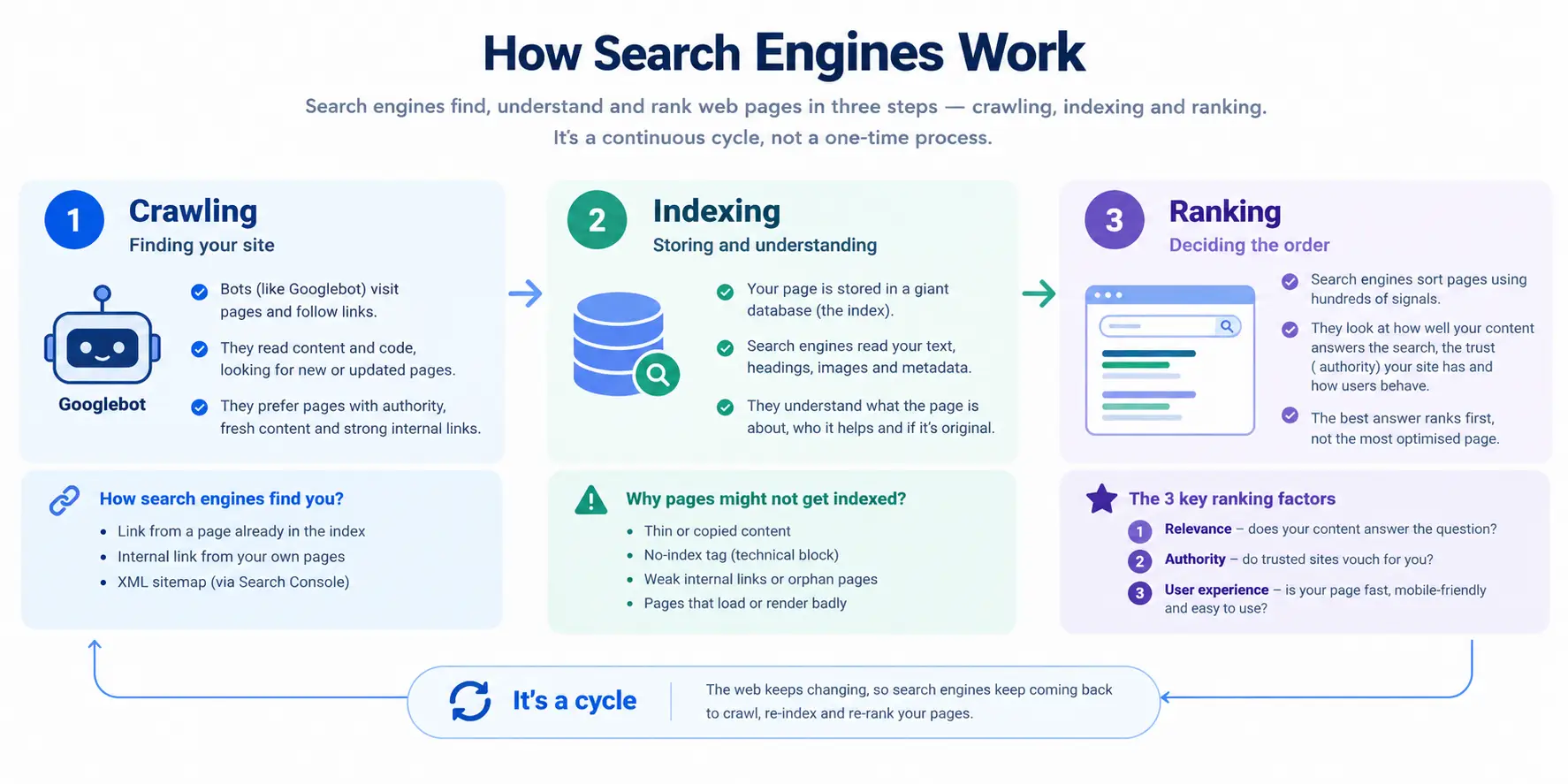
That software runs three jobs on a loop: crawling, indexing, and ranking. It is a cycle, not a one-off. The web keeps changing, so search engines keep coming back to check.
Crawling: how search engines find your site
Everything starts with crawling. If a search engine cannot crawl your site, none of your pages can show up. Full stop.
Search engines send out automated programs called bots, spiders, or crawlers. Googlebot is the famous one. These bots hop from page to page by following links, the same way you click your way around a website.
A bot visits your pages, reads the words and the code behind them, and follows every link to find anything new or updated. It leans toward pages that already have some authority, look fresh, and are well connected inside your site.
So how does a search engine find you in the first place? Usually through one of three routes: a link from a page already in the index, an internal link pointing from one of your pages to another, or an XML sitemap you hand over through a tool like Search Console.
A site with no links and no sitemap is almost impossible to find. This is where internal linking quietly does a lot of work. Internal links act like trails that lead bots around your site, and a sitemap hands them a clean map of the pages you care about most. Together they make sure your deeper and newer pages actually get seen.
Indexing: how pages get stored and understood
Once a page is crawled, it can be indexed. Indexing is simply the search engine filing your page away in a giant database called the index.
Picture a vast digital library. Every page gets shelved by topic, keywords, media, and context, ready to be pulled up when someone searches.
While indexing, the search engine reads your text, headings, images, and metadata. It works out what the page is about, who it helps, and whether the content is good and original. Only pages that make it into the index can ever appear in results.
Not every crawled page gets in, though. The usual reasons a page is left out are thin or copied content, a technical block like a no-index tag, weak internal links or an orphan page with nothing pointing to it, and pages that load or render badly. A page that never gets indexed is invisible, and no amount of brilliant writing can rescue it.
This is why a clean site structure pays off. When your navigation is simple, your categories make sense, and your URLs stay tidy, search engines find it easy to see how your pages connect, spot the important ones, and index even a large site properly.
Ranking: how search engines decide the order
Ranking is where it gets competitive. When you search, the engine does not just dump every matching page on the screen. It sorts them using hundreds of signals, all aimed at one thing: putting the most useful answer first.
To decide the order, it weighs how well your content answers the search, how much the wider web trusts your site, and how real people behave once they land on your page. The winner is the best answer, not the most heavily optimised page.
Three things carry the most weight. Relevance, which is whether your content actually answers the question. Authority, which is whether other trusted sites vouch for you. And user experience, which is whether your page is fast, works on a phone, and is easy to use. Rankings climb when all three pull in the same direction, not when one is polished and the rest are ignored.
And rankings never sit still. They move when Google updates its algorithm, when a rival publishes something better, when what people want shifts, or when something breaks on your site. That constant motion is exactly why SEO is a habit, not a one-time job.
The three pillars of SEO
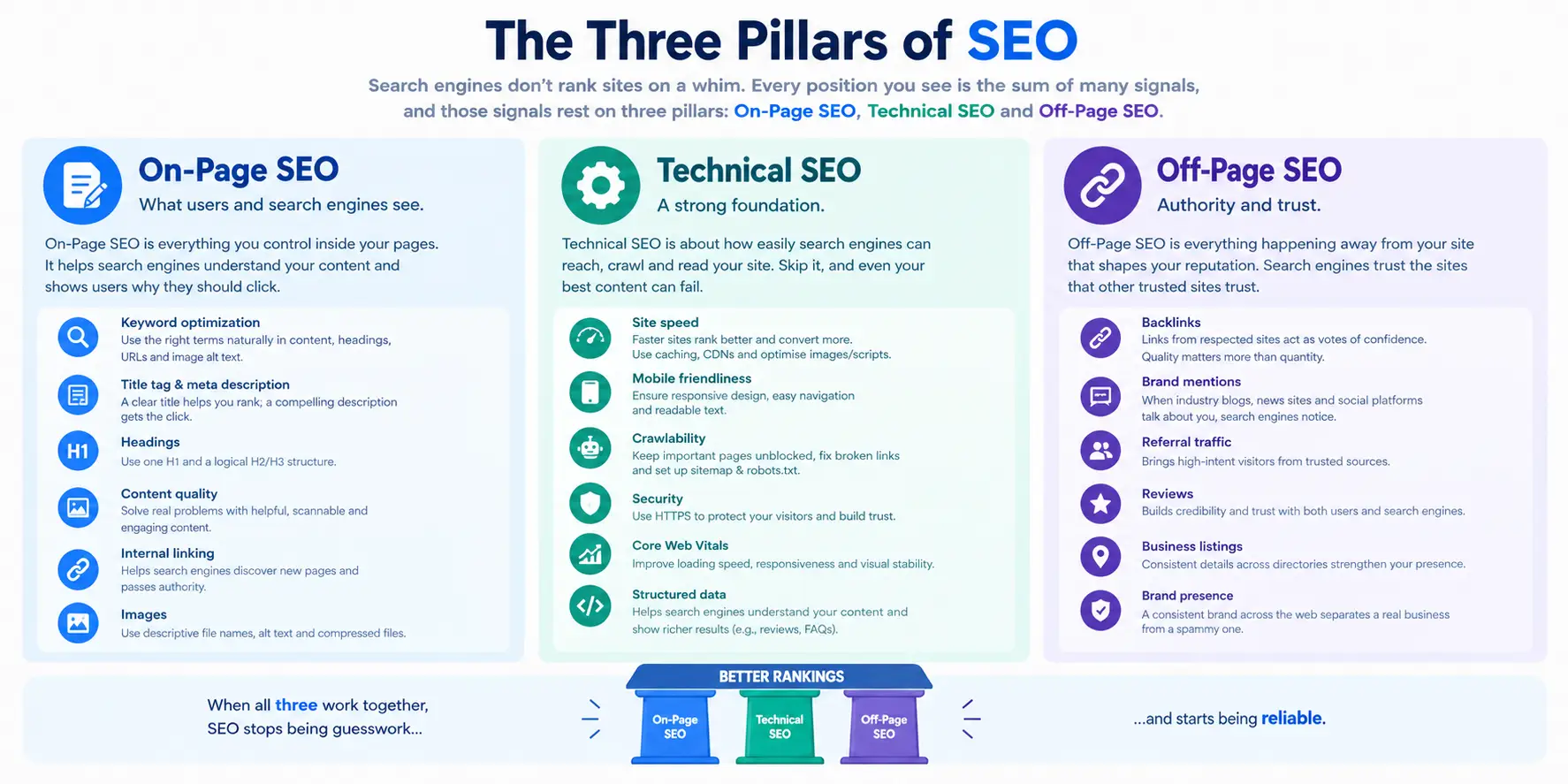
Search engines do not rank sites on a whim. Every position you see is the sum of many signals stacked together. Strip it back, and those signals rest on three pillars: On-Page SEO, Technical SEO, and Off-Page SEO.
A quick way to picture it. On-Page SEO tells search engines what your content is about. Technical SEO makes sure they can reach and read your site. Off-Page SEO shows the rest of the web trusts you. When all three work together, SEO stops being guesswork and starts being reliable.
On-Page SEO: what users and search engines see
On-Page SEO is everything you control inside your pages. Your job is to answer the reader’s question and make the topic obvious to search engines at the same time.
It starts with keyword optimization, and that means understanding what your audience actually types, not stuffing a phrase in ten times. Work your main and related terms naturally into your content, headings, URLs, and image alt text, and keep everything clear enough for a search engine to follow.
Your title tag and meta description are your first impression in the results. A sharp title tag helps you rank; a tempting meta description earns the click. Say what the page is, include the right terms, and give people a reason to choose you. The best content in the world still loses if nobody clicks it.
Headings give your page a shape, for readers and search engines alike. Keep one clear H1, use H2s and H3s in a logical order, and let keywords sit in them naturally rather than forcing them.
Then there is content quality, which is really the heart of it. High-ranking pages solve a real problem. They answer the question in full, use plain and scannable language, add examples and visuals, and hold the reader’s attention. When people stay and scroll, search engines take the hint.
Internal linking is the underrated one. Links between your own pages help search engines discover new content and pass authority around your site, and they help readers find their way too. A little care here goes a long way.
Finally, do not forget your images. A search engine cannot see an image the way you can, so give it help: descriptive file names, useful alt text, and compressed files that load quickly.
Technical SEO: a strong foundation
Technical SEO is about how easily search engines can reach, crawl, and read your site. Skip it, and even your best content can quietly fail. Our technical SEO checklist covers the details, but here is the shape of it.
Speed comes first, because fast sites rank better and convert more. Trim your server response time, clean up heavy images and scripts, and lean on caching and a content delivery network.
Then mobile. Google mostly judges the mobile version of your site now, so it needs a responsive design, easy navigation, and text you can read without pinching and zooming. A clunky mobile site can cost you rankings.
Crawlability matters too. Keep your important pages unblocked, fix broken links, and set up your sitemap and robots file properly, so search engines spend their time on the pages that count.
Security is part of the picture as well. Moving to HTTPS protects your visitors’ data, earns trust, and keeps those “not secure” browser warnings away.
Two more worth knowing. Core Web Vitals measure how your page feels in real use: how fast it loads, how quickly it responds, and whether things jump around as it loads. Smooth, steady pages get rewarded. And structured data helps search engines understand your content well enough to show richer results, like review stars or FAQs. It will not hand you the top spot, but it can help you stand out and pull in more clicks.
Off-Page SEO: authority and trust
Off-Page SEO is everything happening away from your own site that shapes your reputation. Search engines trust the sites that other trusted sites trust. Our guide to off-page SEO digs in further.
Backlinks are the big one. Think of each link from a respected site as a vote of confidence. And here quality beats quantity every time; a handful of relevant, trusted links will do more for you than a pile of weak ones.
Brand mentions count even without a link. When industry blogs, news sites, and social platforms talk about you, search engines notice. So does referral traffic, which shows people are finding you through sources they already trust, often bringing high-intent visitors along with them.
There are quieter trust signals too: your reviews, your business listings, a brand presence that stays consistent across the web. Together they separate a real business from a spammy one.
How SEO works, step by step
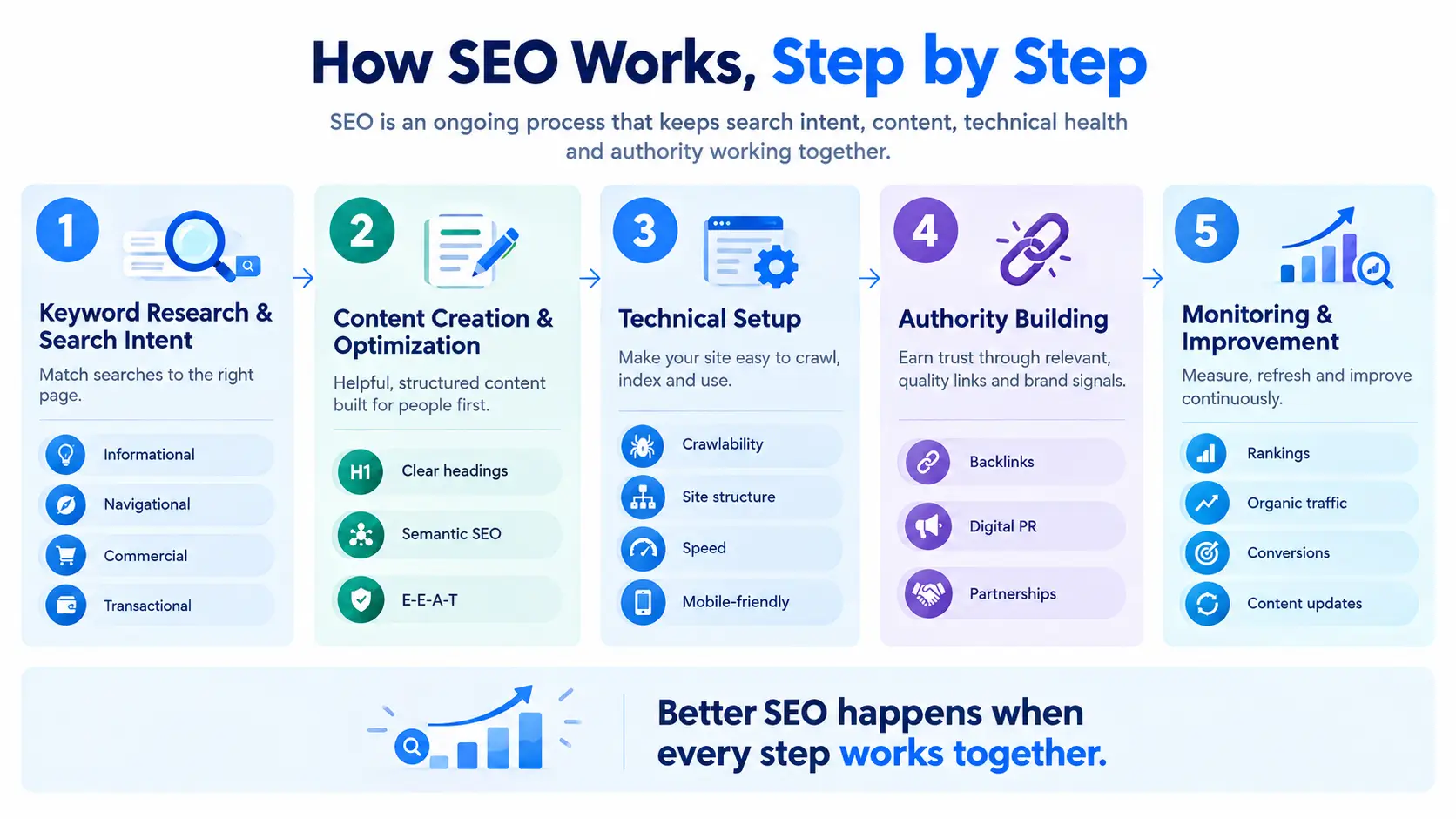
SEO is not a single task you tick off. It is an ongoing process that keeps four things in sync: what people are searching for, how good your content is, how healthy your site is, and how much authority you have earned. Here is how that plays out in practice.
1. Keyword research and search intent
These days, SEO does not start with a keyword. It starts with a question: why is this person searching at all? Every search carries an intent, and search engines reward the page that matches it best.
There are four broad types. Some searches are informational, where people just want answers (“what is SEO”, “how does SEO work”). Some are navigational, aimed at a specific brand or tool (“Digi Growth Lab website”, “Google Search Console login”). Some are commercial, where people are weighing options before they commit (“best SEO agency for SaaS”, “SEO services pricing”). And some are transactional, where they are ready to act (“hire SEO agency”, “SEO services near me”).
Here is why intent matters more than the keyword itself. Two pages can chase the exact same term, and only the one that fits the intent will rank. A service page will never rank for a “how to” search, no matter how polished it is, because it answers the wrong need.
The fix is to send each type of keyword to the right kind of page. Informational terms belong on blog posts and guides. Commercial terms belong on comparison or solution pages. Transactional terms belong on your service and conversion pages. Do that, and your site stays clean, with no two pages fighting over the same term.
2. Content creation and optimization
Good content is written for people first and tuned for search engines second, never the other way around.
Start by solving something real. Answer the actual questions your audience has, speak to their sticking points, and give them steps they can use, not padding. The aim is to leave the reader satisfied, so they never bounce back to Google for a better answer.
Structure carries a lot of the load. Break your content up with clear headings and short paragraphs, move from the basics toward the advanced, and back your points with examples and lists. That kind of structure keeps people reading and helps search engines follow along.
There is also semantic SEO, which is a plainer way of saying search engines now understand topics, not just exact words. Cover a subject properly, including the related questions and subtopics, and you signal real depth, which helps you rank for a whole cluster of related searches.
Underneath all of it sits E-E-A-T: Experience, Expertise, Authority, and Trust. Search engines lean toward content that shows real hands-on insight, gets the details right, comes from a credible brand, and stays honest. For business, tech, and service sites, this is not optional.
3. Technical setup
Even brilliant content falls flat if a search engine cannot reach it.
So the groundwork is making sure your key pages can be crawled, your low-value pages are not dragging you down, and indexing happens on purpose rather than by accident. On top of that, a sensible site architecture, with logical URLs and clear internal links, helps both search engines and visitors find their way. And because search engines increasingly judge experience, a fast, stable, mobile-friendly site is a direct advantage, not a nice extra.
4. Authority building
To a search engine, authority is a vote of confidence from the rest of the web.
You earn it mostly through backlinks, and again, quality and relevance beat sheer volume; one strong link can outweigh dozens of weak ones. The most durable links come from content worth referencing, like in-depth guides, original insight, and genuinely useful resources. When something is that helpful, links tend to arrive on their own. Digital PR and partnerships help too, building the kind of brand trust that keeps rankings steady. Modern SEO is as much about brand as it is about optimisation.
5. Monitoring and improvement
SEO is never set it and forget it. It keeps moving, and so should you.
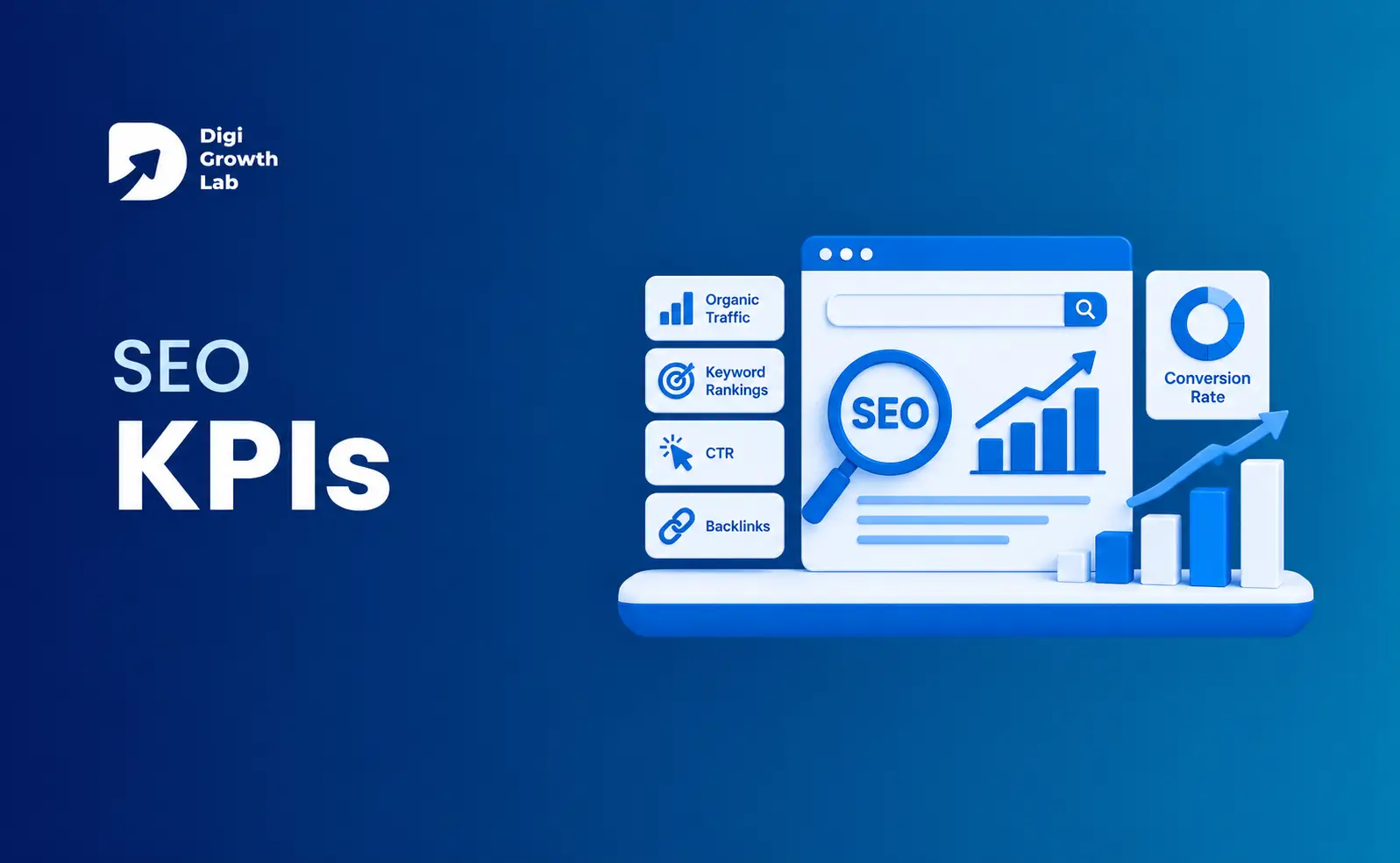
Keep an eye on the numbers that matter: keyword rankings, organic traffic, how people behave on your pages, and conversions. Refresh your content regularly so it stays accurate and current. And when an algorithm update lands, do not panic; sites built on quality, real users, and solid technical health tend to ride out changes without chasing every tweak.
Advanced SEO concepts
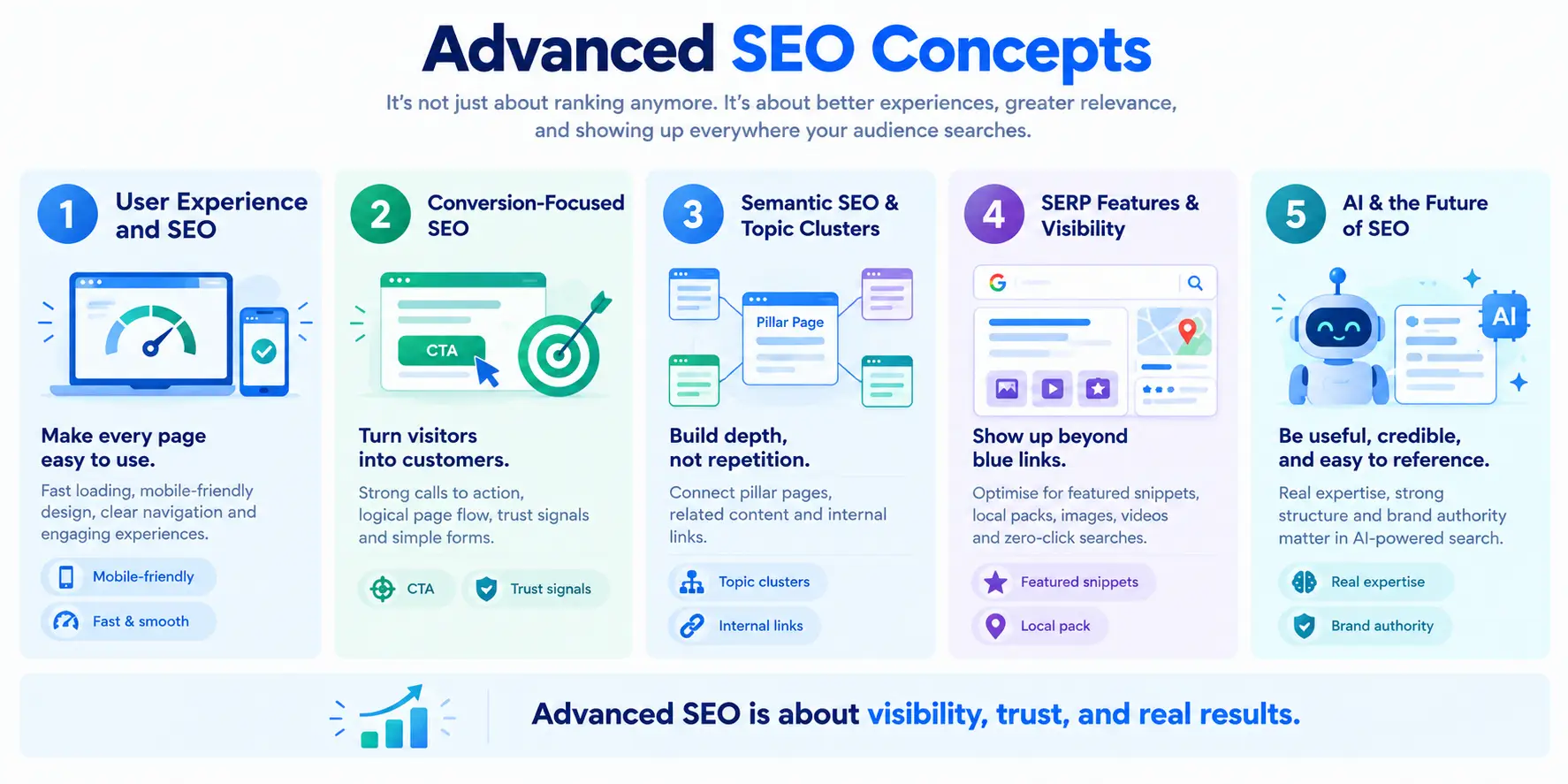
SEO in 2026 is a long way from ranking one keyword on one page. Search engines now weigh how people behave, how deep your content goes, how well it fits the context, and whether it delivers real value. Advanced SEO is really about the experience on your site and how well your content meets a need across every format people search in.
User experience and SEO
Search engines pay close attention to how people use your pages. If someone clicks, bounces straight back, never scrolls, and never interacts, that tells Google the page missed the mark. When people stay, scroll, click around, and finish what they came to do, a page can climb over time, even from a modest start.
Page experience feeds into this too. Google cares how a page feels, not just what it says, which means mobile usability, quick loading, visual stability, secure browsing, and not shoving pop-ups in people’s faces. Fast, smooth pages beat heavy, awkward ones almost every time.
Conversion-focused SEO
Ranking without conversions is just expensive visibility. So advanced SEO lines your content up with a clear call to action, a logical flow down the page, trust elements like reviews and case studies, and forms that are easy to fill in. The question stops being “does this page rank” and becomes “does this page move someone to the next step”.
Semantic SEO and topic clusters
Search engines read for meaning now, not matching words. So instead of building one page per keyword, you group a main term with its variations, the questions around it, and the phrases people naturally use. A single page about “SEO services” can end up ranking for “SEO company”, “search engine optimization services”, and “SEO agency near me”, without repeating itself once.
You build topical authority the same way: a pillar page on a broad topic, several deeper articles around it, and smart internal links tying them together. It tells search engines your site genuinely knows the subject. And that is why one strong page can rank for hundreds of terms; it answers many intents, reads naturally, and covers the subtopics properly. The goal is coverage, not repetition.
SERP features and zero-click searches
Search results stopped being ten blue links a long time ago.
Featured snippets lift a direct answer straight out of your content, so clear subheadings, concise answers, and tidy lists give you a shot at them. Local packs, the little map with three businesses, run on your Google Business Profile, your reviews, consistent contact details, and how close you are to the searcher, and they often convert faster than the standard listings. Search also surfaces image carousels and short videos now, so optimising your images, alt text, file names, and video details widens your reach.
Add it all up, and the goal in 2026 shifts from ranking to presence. What counts is how often your brand shows up, across how many formats, at how many points in a buyer’s decision. Showing up in a lot of places beats ranking first in one, and that is exactly what we mean by SEO visibility.
AI and the future of SEO
AI has changed how search engines answer questions. It has not killed SEO; if anything, it raised the bar.
Search engines now summarise several sources, write a direct answer, and keep surfacing the same trusted brands. Thin content vanishes in that world, and generic AI-written pages struggle. Real expertise is what survives.
So how do you show up inside an AI answer? The tools reach for content that is clear, well-organised, and easy to quote, and they favour brands with genuine authority and third-party mentions. In other words, the work that gets you cited by AI is the same core SEO done well: straight answers, strong structure, and a credible brand. Our AI SEO services focus on exactly that, getting your business referenced across AI-powered search.
A word on AI-written content, since everyone asks. AI can help you draft, but it cannot fake real experience, original thinking, industry context, or business relevance. Search engines reward content that feels helpful, credible, and human-backed, and they filter out the hollow stuff faster than ever.
Where is all this heading? Toward search presence over raw rankings, traffic quality over traffic volume, and useful content over sheer quantity. The businesses that win will lean on brand authority, trust, connected content, and people working alongside AI rather than handing everything to it.
Benefits of SEO for businesses
SEO builds visibility, trust, and long-term growth in a way no short-term channel can match. Here is what you actually get.
- Bring in traffic with real intent. SEO puts you in front of people already looking for what you offer, at the moment they are looking, so far more of that traffic converts.
- Get higher-quality leads. When you match search intent, you attract people who already have a need, which means fewer time-wasting enquiries and quicker decisions.
- Build credibility and trust. Landing on page one signals authority. People trust Google, so showing up there consistently makes your brand look established.
- Earn better ROI than paid ads. Ads stop the day the budget stops. SEO keeps working, and your cost per lead usually falls over time.
- Create a long-term asset. Every optimised page adds lasting value. SEO compounds, slowly turning your content into an asset that keeps bringing in traffic and leads.
Common SEO mistakes to avoid
Most SEO does not fail because of some mysterious algorithm. It fails on avoidable mistakes.
- Chasing the wrong keywords. High-volume terms with the wrong intent bring traffic that never buys. Go for relevance, not just big numbers.
- Ignoring technical SEO. A slow site, mobile problems, and crawl errors can bury even great content.
- Publishing weak content. Copied or generic pages bore readers and signal low value to search engines.
- Building low-quality links. Spammy links drag down trust and rankings. Relevance wins.
- Not tracking anything. Without data, you are guessing. Measuring is how you improve.
- Expecting overnight results. SEO takes time, and chasing quick wins means missing the bigger, compounding payoff.
If your site is not showing up at all, it is usually a fixable mix of these, and a good SEO company can spot and fix them quickly.
Common SEO myths
SEO collects half-truths like nothing else. A few worth putting to rest:
- “SEO is a one-time task.” It needs steady work, because users, rivals, and algorithms never stop shifting.
- “SEO gets results overnight.” Real results come from time and consistency.
- “Ranking first guarantees sales.” A top spot gets you seen. Your content, experience, and trust close the deal.
- “More keywords mean better rankings.” Stuffing does not work. Relevance and clarity do.
- “More backlinks always win.” A few strong, relevant links beat hundreds of weak ones.
- “Paid ads boost your organic rankings.” They do not. Ads are a separate channel.
- “AI content ranks on its own.” Search engines reward original, helpful, human-backed writing.
- “SEO is dead.” SEO is alive and simply changing. Quality, intent, and experience now lead.
SEO tools that help
The right tools give you the data to make good calls instead of guesses.
- Google Search Console shows your search performance, indexing, and technical issues straight from Google.
- Google Analytics tracks how people behave, where they come from, and what they convert on.
- Keyword research tools reveal what people are searching for and where your openings are.
- Technical SEO tools check your site’s health, speed, crawlability, and mobile performance.
- Backlink analysis tools measure link quality and point you toward new ways to build trust.
How long does SEO take?
SEO runs on trust, relevance, and consistency, not a fixed calendar. Small wins can turn up early, but the bigger results build over months.
Realistically, you will often see early improvements in three to four months, with stronger traffic and leads usually landing around six to nine months. How fast you get there depends on your competition, your keywords, your content, your technical health, your links, and how consistent you stay. New sites take longer, because they are still earning trust, while established sites tend to move quicker. Either way, patience pays; steady SEO buys you lasting visibility, lower costs, and growth that keeps compounding.
SEO vs PPC: which should you choose?
People treat SEO and PPC like rivals, but they really solve different problems, and the right pick comes down to your goals and your timeline. Plenty of businesses run both, and our PPC management services sit nicely alongside a long-term SEO plan.
| Factor | SEO | PPC (paid ads) |
|---|---|---|
| Cost | No cost per click; you invest in long-term work | You pay for every click |
| Time to results | Slower (three to six months or more) | Immediate |
| Traffic longevity | Long-term and compounding | Stops when the budget ends |
| Lead quality | High-intent, trust-driven | High-intent but transactional |
| Scalability | Grows without linear cost | Scales only with more spend |
| Credibility | Builds strong brand trust | Seen as promotional |
| Control | Less immediate control | Full control over targeting and timing |
| Best for | Long-term growth and cost efficiency | Quick wins, launches, and promotions |
Conclusion
SEO does far more than lift rankings. It builds lasting visibility, real trust, and a steady stream of the right people finding you.
Get the strategy right, and your website starts to behave like a growth engine, bringing in quality leads and leaning less on paid ads with every passing month. It asks for patience. But what you are left with is a strong, long-term asset that keeps on producing.
Ready to grow with SEO?
Let us build an SEO plan around your goals and your customers. Clear strategy, honest reporting, real results.
Frequently Asked Questions
Is SEO worth the investment for a small business?
Yes, SEO can be a worthwhile long-term investment for businesses that want consistent organic traffic and qualified leads. Unlike paid advertising, SEO can continue generating traffic from optimized pages after the initial work is completed. However, results depend on factors such as competition, search demand, website quality, content, authority, and how consistently SEO is managed.
How long does it take for SEO to generate leads?
SEO can start showing early improvements within three to four months, but stronger traffic and lead growth often takes around six to nine months. The timeline varies based on competition, keyword difficulty, content quality, technical SEO, backlinks, and the existing authority of the website. New websites may need more time to build trust.
Can SEO reduce my dependence on paid advertising?
SEO can reduce reliance on paid advertising by building a steady source of organic traffic. Once pages gain visibility and authority, they can continue attracting visitors without paying for every click. However, SEO does not necessarily replace PPC. Businesses can use SEO for long-term growth while using paid ads for immediate traffic, launches, and promotions.
What kind of businesses benefit most from SEO?
SEO can benefit businesses that have customers actively searching online for their products, services, or solutions. It is particularly useful when a business wants to build long-term visibility, attract high-intent visitors, establish credibility, and generate leads through organic search rather than relying only on paid campaigns.
How much should a business invest in SEO?
There is no fixed SEO budget that works for every business. The investment depends on factors such as market competition, the number of keywords and pages being targeted, website condition, content requirements, and the level of authority building needed. Businesses should evaluate SEO based on the potential traffic, leads, customers, and long-term value it can generate rather than simply the monthly cost.
How do I know if my SEO investment is actually working?
Track business outcomes, not just keyword rankings. Important SEO metrics include organic traffic, relevant keyword visibility, leads, conversions, and user behavior on your website. Reviewing these metrics over time helps determine whether SEO is attracting the right audience and contributing to business growth.