

Here is a number that should change how you think about content. Ahrefs studied around fourteen billion web pages and found that 96.55% of them get zero traffic from Google. Most of those pages were not badly written. They just targeted the wrong keywords, or no clear keyword at all.
That gap is what a keyword strategy closes. Most websites have a list of keywords. Very few have a strategy. A list tells you what people search for. A strategy tells you which of those searches you can actually win, in what order, and on which page.
This guide shows you how to build that plan from scratch. You will follow one real example the whole way through: a small plumbing company in the United States trying to get found online. No filler. Just the method, the free tools that do the job, and the moves most guides leave out.
What is a Keyword Strategy?
A keyword strategy is a plan for choosing the search terms you want your website to rank for, deciding how you will target them, and prioritizing them based on what your business actually needs.
In plain terms, it answers three questions. Which searches are worth chasing? Which page should target each one? And which ones come first?
A keyword strategy is one part of a wider SEO effort. It decides what to target. Other work, like Technical SEO, makes sure search engines can crawl and understand your pages so that targeting can pay off. Get the strategy wrong, and no amount of technical work saves you.
Keyword Strategy vs Keyword Research
People mix these up constantly, but they are not the same thing.
Keyword research is the fact-finding. You gather data on what people search for, how often, and how hard each term is to rank for. Strategy is what you do with that data. It is the set of decisions you make after the research is done.
Here is a simple test. If you are collecting keywords, that is research. If you are deciding which ones to ignore, that is strategy. A good strategy is as much about what you leave out as what you chase.
How to Build Keyword Strategy, Step by Step
Building a keyword strategy comes down to five steps. Set a goal, find the keywords, group and map them, match them to intent, then prioritize. Here is each step, worked through with our plumbing company.
Step 1: Start With a Goal, Not a Keyword
Start with the outcome you want, not the keywords. Keywords are a means to an end, and that end is a business result.
Our plumber does not want traffic. He wants booked jobs. That single fact changes which keywords matter.
Someone searching “how does a water heater work” is curious. Someone searching “water heater repair near me” is ready to call a plumber. Same topic, very different value. The goal points you straight at the second group.
So before you open a single tool, write down what a win looks like. More calls, more quotes, more jobs. Then ask who is behind that search, and what they are trying to do.
Step 2: Find Keywords With Free Tools That Actually Work
You do not need paid tools to build a strong keyword list. The best free tools come straight from Google, and the data is accurate because it is Google’s own.
Start with seed keywords. These are your obvious core terms. For the plumber, that means “plumber,” “drain cleaning,” “water heater repair,” and “leak repair.”
Then expand and check demand with the tools below.
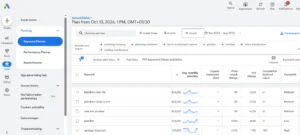
Google Keyword Planner is free with a Google Ads account. It shows average monthly searches, the three-month change, and the year-over-year change for each term, so you can see demand that is rising or fading. Look at the screenshot below. “Plumber” pulls huge volume, yet its competition reads Low. That is the catch most people miss. The competition column counts how many advertisers bid on a term, not how hard it is to rank in organic results. Use the tool for volume and trends, and judge organic difficulty yourself.
the United States. Note the three-month and year-over-year change columns, and that the competition column reflects advertiser demand, not organic ranking difficulty.
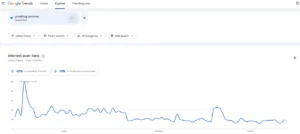
Google Trends is where most guides stop short. It shows whether interest in a topic is rising or falling, reveals seasonal spikes, and lists related queries breaking out right now. You can filter to the United States, or even a single state, which is ideal when your traffic is US-focused. Check “plumbing services” and you can read the recent direction of demand and its seasonal peaks at a glance. Search “frozen pipe repair” and you will see it climb every winter, a clear signal to publish that page before the cold arrives.
Google Trends for “plumbing services” in the United States, past three months. It shows interest over time, seasonal spikes, and the change versus the previous period.
Google autocomplete and People Also Ask cost nothing and come straight from real users. Type a seed term into Google, read the autocomplete suggestions, then scroll to the “People also ask” box and the related searches at the bottom. These are the exact phrasings people use.
Google Search Console is the one to reach for if your site already gets some traffic. Open the Performance report and find queries where you rank in positions 11 to 20. These are “striking distance” keywords. You already sit on page two, so a small improvement to the existing page can push it onto page one. It is often the fastest win available, and almost no beginner guide mentions it.
Now add long-tail keywords, the longer and more specific phrases like “water heater leaking from the bottom.” They look tiny on their own. In fact, Ahrefs found that about 93% of all keywords in its US database get fewer than ten searches a month. That is exactly why they matter for a smaller site. The competition is thin, and the people typing them know what they want.
Step 3: Group Keywords and Map Them to Pages
Now organize your list. Group related keywords, then decide which page each group belongs to. This is where most strategies fall apart, and where most guides go quiet.
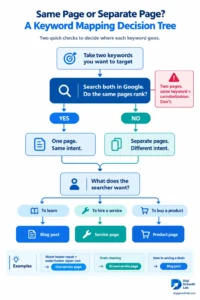
The core rule: one main search intent gets one page. Keywords that mean the same thing share a page. Keywords that mean something different get their own.
But how do you know if two keywords mean the same thing? Do not guess. Use the SERP overlap test. Search both terms in Google and compare the top results. If the same pages rank for both, Google sees them as one intent, so one page can target both. If the results are mostly different pages, they need separate pages.
For the plumber, “water heater repair” and “water heater repair cost” show nearly the same results, so they live on one service page. “Drain cleaning” shows completely different results, so it earns its own page. “How to unclog a drain yourself” is a how-to, so it becomes a blog post, not a service page.
Placing the right keywords on the right page is the heart of On-Page SEO. This step also prevents the single most common self-inflicted SEO problem, which we will get to shortly.
Why group at all, instead of chasing big single keywords? Because the long tail is where the volume actually hides. Backlinko analyzed 306 million keywords and found that 91.8% of all searches are long-tail queries, though each one is small on its own. Group enough related long-tail terms onto one strong page, and their traffic adds up to something real.
Step 4: Match Each Keyword to Search Intent
Search intent is the reason behind a search. Match it and you can rank. Ignore it and you will not, no matter how good your content is.
There are four main types:
- Informational: the user wants to learn. “How to stop a faucet from dripping.”
- Navigational: the user wants a specific brand or site. “Roto-Rooter reviews.”
- Commercial: the user is comparing options before buying. “Best tankless water heaters.”
- Transactional: the user is ready to act. “Book a plumber near me.”
Here is the part other guides skip. Do not assume the intent. Confirm it by searching the term and reading the results page.
If the page is full of product listings and ads, the intent is transactional, and a blog post will not rank there. If it is full of how-to articles, the intent is informational, and a sales page will lose. While you are there, note what sits above the organic results. Ads, a map pack, or an AI Overview all push the first real result down the page, which affects how much traffic a top ranking will actually send. Factor that into whether the keyword is worth the effort.
Step 5: Prioritize With a Simple Score
You cannot target everything at once. Most guides tell you to “balance volume and difficulty” and leave it there. Here is a method you can use today.
Score each keyword from one to five on three things:
- Relevance: how closely does it match your goal?
- Winnability: how realistic is it that you can rank for it right now?
- Effort: how much work is the content? Score this in reverse, so less effort scores higher.
Add the three numbers, sort from highest to lowest, and work from the top down.
For a new plumbing site, “emergency plumber in Austin” might score high on relevance and winnability, so it goes first. “Best tankless water heaters” might score high on relevance but low on winnability, so it waits until the site has more authority. The method is simple, repeatable, and honest about what you can win now.
How to Build a Keyword Strategy for a New or Low-Authority Website
If your website is new, you will not rank for big, competitive keywords yet. That is not pessimism. It is how Google works, and facing it early is what separates sites that grow from sites that stall.
New sites have low authority, so Google trusts them less and ranks them lower for competitive terms. The answer is not to fight the giants head-on. It is to go around them.
Start with long-tail keywords that carry lower competition, and win those first. Each ranking page and each visitor builds a little authority. Over time, that authority lets you reach for harder terms.
Build in clusters, too. A group of related pages that link to each other tells Google you cover a topic in depth. Ten connected pages on plumbing topics do more for your authority than ten scattered pages on ten unrelated things.
There is also a moving target to plan for. Google has said that 15% of the searches it sees every day are brand new, never searched before. New phrasings appear all the time, and many of them are long-tail. A site that keeps adding specific, helpful pages keeps catching that fresh demand.
Whether you do this yourself or hire an SEO Company to help, the path is the same. Start small, earn wins, then climb. Anyone promising first-page rankings overnight is selling something.
What Is Keyword Cannibalization, and How Do You Fix It?
Keyword cannibalization happens when two or more pages on your site target the same keyword and end up competing against each other in search results.
It sounds harmless. It is not. Instead of one strong page ranking well, you get two weaker pages splitting the clicks, the links, and the ranking signals between them. You compete with yourself, and both pages lose.
Most guides name the problem and stop. Here is how to actually find and fix it.
Find it. Open Google Search Console and go to the Performance report. Filter by a single query, then open the Pages tab. If several of your URLs show impressions for that same query, you have overlap. You can double-check by searching site:yourdomain.com followed by the keyword and seeing how many of your pages Google returns.
Fix it. Pick the one page you want to rank, then choose the right repair:
- Merge and redirect. If two pages cover the same ground, move the useful parts of the weaker page into the stronger one, then set a 301 redirect from the weaker URL to the stronger one. This combines their ranking power into a single page.
- Re-point your internal links. Make the internal links that use that keyword point to the page you want to rank. Consistent internal linking tells Google which page is the right answer.
- Differentiate them. If both pages need to exist and serve different intents, rewrite each to target a different keyword, and change the titles and headings to match.
- De-optimize the loser. On the page you do not want ranking, remove the competing keyword from the title and main headings so it stops fighting the primary page.
This is also exactly why Step 3, mapping keywords to pages, matters so much. Clean mapping prevents cannibalization before it starts.
How Search Has Changed, and What It Means for Your Keywords
Search does not work the way it did five years ago, and your keyword strategy has to account for that.
Two shifts matter most. First, AI Overviews now sit at the top of many results pages. One analysis of 500,000 buying-intent prompts found that AI Overviews appeared on about 86.7% of those searches in April 2026, up from 56.9% a year earlier. Second, more searches end without a click at all. SparkToro reports that in 2026, less than one-third of US Google searches still send a click to a website.
What does this mean for your keywords? Three things. Write answers clearly and early on the page, since that is what AI Overviews pull from. Target real questions people ask, not just short head terms. And measure visibility, not clicks alone, because your brand can be seen in an AI Overview even when no one clicks through.
Common Keyword Strategy Mistakes to Avoid
Even seasoned marketers make these. Avoid them and you are ahead of most competitors.
- Chasing high-volume head terms too early. Big keywords feel exciting, but a new site cannot rank for them. Start specific.
- Ignoring search intent. The right keyword on the wrong type of page never ranks.
- Targeting one keyword with several pages. That is cannibalization. One intent, one page.
- Writing for search engines instead of people. Keyword stuffing reads badly, and Google sees through it. Write for the reader first.
- Setting the strategy once and forgetting it. Search behavior shifts. A list you never revisit goes stale within a year.
How to Measure If Your Keyword Strategy Is Working
Track your results, or you are only guessing. The most useful tool is free.
Google Search Console shows which keywords you rank for, how many people click, how often you appear, and whether your positions are climbing or slipping. Check it monthly, not daily. Watch impressions as well as clicks, because in a search world full of AI Overviews and zero-click results, being seen has value even without the click.
But rankings alone do not pay the bills. The real question is whether those keywords bring enquiries and sales. This is where SEO KPIs come in. The numbers worth watching run past position, all the way to clicks, conversions, and the leads your pages actually generate.
If a keyword ranks but brings no business, it was the wrong keyword. Drop it, and move that effort to one that converts.
Final Thoughts
A keyword strategy is not about collecting the most keywords. It is about choosing the right ones, in the right order, for the right pages.
Start with your goal. Pick terms you can actually win. Map them cleanly, match them to intent, fix any overlap, and track what truly moves the business. If your site is new, start small and build from there.
Do that, and your content stops being a gamble and becomes a plan. If you would rather have specialists handle it, professional Search Engine Optimization Services can take it off your plate. Either way, the method above is yours to use.
Ready to Climb the Rankings?
Rankings reward the businesses that do the fundamentals well and keep at it. If you want a clear plan and a team to run it, we can help.
Frequently Asked Questions
Does keyword research still matter now that AI answers so many questions?
Yes, and probably more than before. AI Overviews do not pull answers out of thin air. They quote pages that already rank well, so the content still has to exist and still has to target what people search for. What has stopped working is chasing big, generic terms for the sake of volume. Those simple questions now get answered right on the results page. The searches still worth winning are the specific, high-intent ones, and keyword research is how you find them.
Should I go after the keywords with the highest search volume?
Usually not. Big numbers are tempting, but high volume almost always brings heavy competition and fuzzy intent. “Plumbing” gets searched a ton and tells you nothing about what the person wants. “Water heater pilot light won’t stay lit” has far fewer searches, but the person behind it has a clear problem and you have a real shot at ranking. For most sites, a set of specific keywords beats one giant one.
How long does it take to rank for a keyword?
It depends on the keyword and your site, so be honest with yourself. A low-competition long-tail term on a healthy site can rank in a few weeks to a few months. A competitive term, or any term on a brand-new site, can take six months to a year, sometimes more. Fresh pages also tend to drift for a while before Google settles on where they belong. Ranking is a slow build, not a switch you flip.
How do I find the keywords my competitors are ranking for?
Paid tools like Ahrefs or Semrush are the fast way. Enter a competitor’s domain and you see the terms they rank for, then hunt for gaps you can fill. On no budget, you can still get far. Search your main topics, see which sites keep appearing, then open their pages and read the titles and subheadings. Those usually spell out the exact keywords they are going after.
How many keywords should one page target?
One primary keyword, plus a few close variations that share the same meaning. A page on “water heater repair” can also cover “water heater repair cost” and “fix water heater,” since they all point to one intent. What kills a page is stuffing unrelated keywords onto it. Split the focus, and it tends to rank for none of them.