
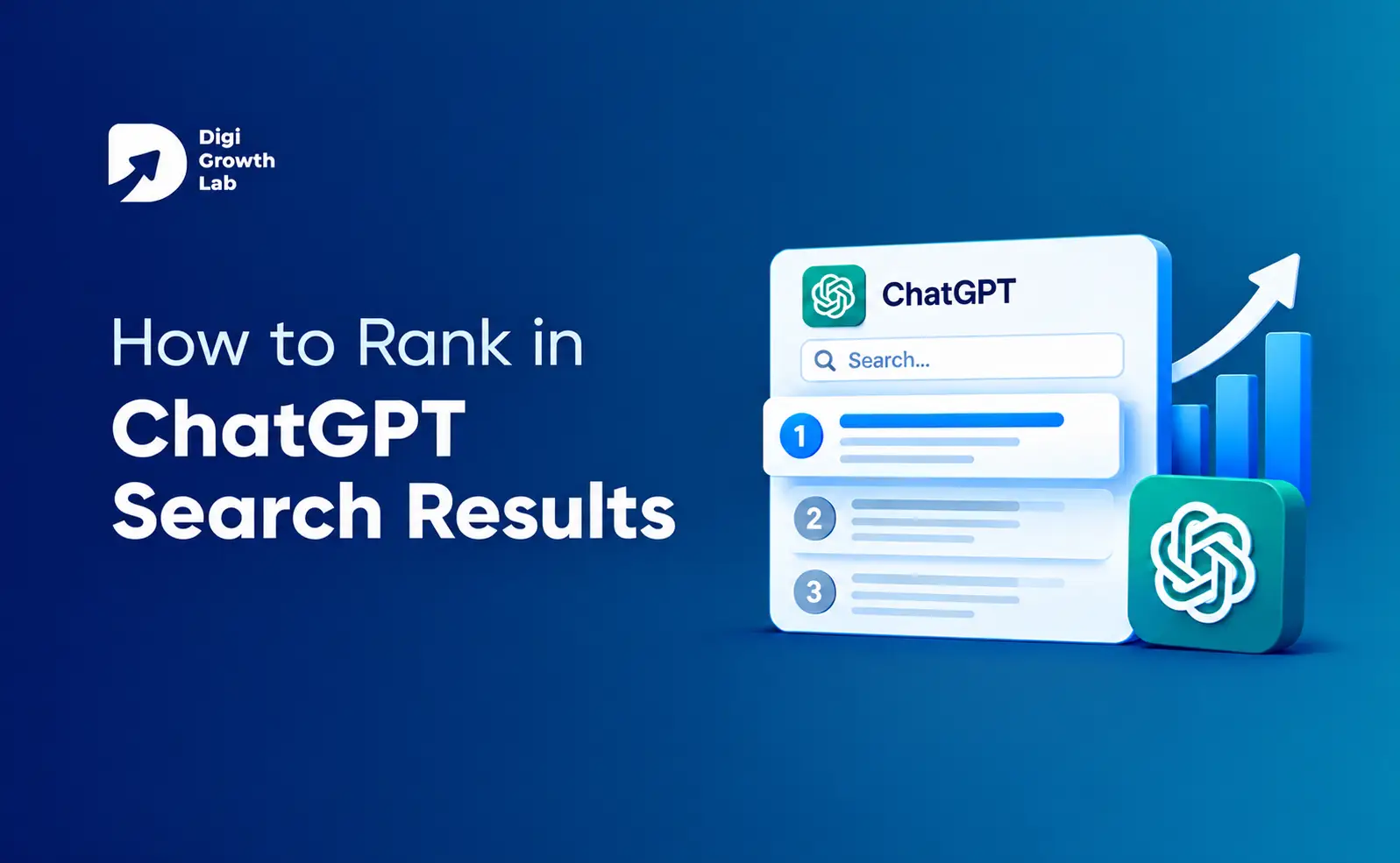
People used to type “SEO agency Ahmedabad.” Now many of them ask, “Which SEO agency in Ahmedabad is good for a small manufacturing company?” Then they read the answer and click a source or two.
That shift is big. OpenAI reported more than 900 million weekly ChatGPT users in February 2026. In the same month, Sam Altman said India alone had 100 million weekly users, second only to the US.
So how do you get your business into those answers? This guide explains how to rank in ChatGPT search results in plain words. No tricks. No guarantees. Just what OpenAI actually says, what the research suggests, and what you can do this month.
Can You Actually Rank in ChatGPT Search?
Not in the way you rank on Google. There is no fixed list of ten blue links. ChatGPT writes an answer and may pull from several sources to do it.
So “ranking” in ChatGPT really means showing up inside the answer. That can happen in a few ways:
| Type of Visibility | What It Looks Like |
|---|---|
| Mentioned | Your brand name appears in the answer |
| Cited | Your page is linked as a source |
| Recommended | ChatGPT suggests your business for the user’s need |
| Compared | You appear in a “X vs Y” or “top options” answer |
| Used as a Source | Your facts shape the answer, with a link in the Sources panel |
Here is the simplest way to think about it.
On Google, you compete for a position on a results page.
In ChatGPT Search, your goal is to be useful, easy to find, easy to understand and trustworthy enough to be used as a source.
A mention without a link still matters. It builds awareness. A citation matters more, because the user can click through to you.
How ChatGPT Search Finds and Uses Web Content
OpenAI has not published a full ranking formula. But it has shared enough to explain the basics.
What OpenAI officially documents:
- When ChatGPT searches the web, it can show answers with citations and a Sources panel.
- At launch in October 2024, OpenAI said ChatGPT search uses third-party search providers, plus content from its partners.
- OpenAI uses a crawler called OAI-SearchBot to surface websites in ChatGPT’s search features.
- Its help center says results are ranked using multiple factors meant to find relevant, reliable information. It also says placement is not guaranteed.
In simple steps, the process looks like this:
- A user asks a question.
- ChatGPT decides whether it needs fresh web information. Not every answer uses search.
- If it searches, it looks for relevant pages from search indexes and its own crawled data.
- It reads the useful parts of those pages.
- It writes one answer and links some of the sources it used.
What industry research suggests: Many SEO studies report a strong overlap between ChatGPT citations and Bing results. That makes Bing indexing worth your time. But OpenAI has not confirmed exactly which providers it uses or how much weight each one gets. Treat Bing as important, not as the whole story.
10 Practical Ways to Improve Your Visibility in ChatGPT Search
1. Make Sure OpenAI’s Search Crawler Can Reach Your Site
This is step one. If ChatGPT cannot read your pages, it cannot cite them properly.
OpenAI’s crawler documentation lists different bots with different jobs:
| Bot | What It Does | What Blocking It Means |
|---|---|---|
| OAI-SearchBot | Surfaces sites in ChatGPT search | Your pages will not appear in search answers, except as plain navigational links |
| GPTBot | Collects content that may train future models | Your content should not be used for training |
| ChatGPT-User | Visits pages when a user action asks it to | OpenAI says robots.txt rules may not apply, and it does not decide search inclusion |
These settings are separate. You can allow OAI-SearchBot and still block GPTBot. Many businesses do exactly that.
Check three things:
- Your robots.txt does not block OAI-SearchBot.
- Your firewall or CDN (like Cloudflare) is not blocking OpenAI’s published IP ranges.
- Important pages are not hidden behind logins or heavy scripts.
OpenAI notes that changes to ro
2. Build a Strong Traditional SEO Foundation
ChatGPT visibility sits on top of normal SEO. It does not replace it.
Your pages still need to be crawlable, indexed, fast and well organized. If a page is not in the search indexes ChatGPT draws from, it is hard to be found.
Start here:
- Submit your sitemap to Google Search Console and Bing Webmaster Tools.
- Fix broken pages, redirect chains and “noindex” mistakes.
- Keep a clear site structure with sensible internal links.
A proper technical SEO check often finds problems that block both Google and ChatGPT at the same time.
bots.txt can take about 24 hours to reflect in search.
3. Create Answer-First Content
People ask ChatGPT full questions. Your page should answer them quickly.
Put the direct answer in the first one or two sentences of a section. Then explain.
Weak opening: “SEO pricing depends on many factors, and there is no single answer, so let us explore…”
Answer-first opening: “Most small businesses in India pay a monthly retainer for SEO. The amount depends on scope, competition and the number of pages involved.”
The second version is clear. It can be used as a source without rewriting. Good on-page SEO now includes writing like this.
4. Write Sections That Make Sense on Their Own
ChatGPT may use one part of your page, not the whole thing. So each section should stand alone.
Tips that help:
- Use clear headings that match real questions.
- Keep one main idea per section.
- Name the thing you are talking about. Write “our Ahmedabad office” instead of “there.”
- Use tables for comparisons and lists for steps.
If someone read just that one section, would it still make sense? If yes, it is easy to quote.
5. Make Your Brand Easy to Understand
ChatGPT needs to know who you are before it can recommend you. Make these facts clear and consistent:
- Who you are: legal name, brand name, founding year
- What you do: your main services or products
- Where you operate: cities, states or countries you serve
- Who you serve: industries and company sizes
- What you specialize in: the one or two things you are known for
Put this on your About page, service pages and footer. Then make sure the same facts appear on your Google Business Profile, LinkedIn page and key directories. Conflicting details make you harder to trust.
6. Publish Original Information and Evidence
Generic content is everywhere. ChatGPT has no reason to cite a page that says what a hundred others say.
Give it something new:
- First-party data: what you have seen across your own clients or projects
- Case studies: real problems, real steps, real results, shared with permission
- Original research: small surveys or tests with a clear method
- Expert commentary: named people with real experience
- Real examples: screenshots, before and after comparisons, process details
Always explain where a number came from. A number with a clear source is easier to trust. Strong content marketing is built on this kind of evidence.
7. Earn Mentions on Relevant Third-Party Sites
What others say about you matters, not just what you say about yourself.
Useful places to be mentioned:
- Industry publications and trade media
- Trusted business directories (Clutch, GoodFirms, G2 or local chambers of commerce)
- News coverage of real company news
- Professional associations you belong to
- Customer reviews on Google and relevant platforms
- Helpful answers in genuine communities, like Reddit or Quora, where you add value first
Avoid fake reviews, paid link farms and self-written “best of” lists that rank yourself first. They may look like shortcuts. They damage trust.
8. Use Structured Data Where It Makes Sense
Structured data (schema) is code that labels your content for machines. It can say “this is our company,” “this is a product” or “this is a person.”
Useful types include Organization, LocalBusiness, Product, Article and Person.
Schema can help machines understand your site. It does not guarantee ChatGPT citations. Use it to support what is already on the page, never to describe content you do not show.
9. Keep Important Content Updated
Old information makes a page less useful. That matters when ChatGPT is choosing sources for current questions.
Review these regularly:
- Prices and packages
- Statistics and their years
- Product features and specs
- Laws and regulations
- Team, office and contact details
Show a “last updated” date when you make real changes. Do not just change the date without updating the content.
10. Measure Your AI Search Visibility
ChatGPT has no rank report. So you need a simple tracking system.
| What to Track | How to Track It |
|---|---|
| Referral Traffic | In GA4, look for the source chatgpt.com. OpenAI says ChatGPT adds utm_source=chatgpt.com to referral links. |
| Prompt Visibility | Test a fixed list of 20 to 30 buyer questions every month. |
| Brand Mentions | Note whether your brand appears and how it is described. |
| Citations | Open the Sources panel and log which URLs are cited. |
| Competitor Mentions | Record which competitors appear for the same prompts. |
| Recommendations | Note when ChatGPT suggests you for a buying question. |
| Crawler Activity | Check server logs for OAI-SearchBot visits. |
| Changes Over Time | Keep one sheet and compare month to month. |
Answers can change from one day to the next. So look for trends over months, not single results. Paid AI visibility tools can automate this if manual testing gets too slow. Also add a “How did you hear about us?” field to your contact form. Some leads will say ChatGPT.
Traditional SEO vs ChatGPT Search Visibility
These are not separate worlds. Think of ChatGPT visibility as a new layer on top of SEO.
| Traditional SEO | ChatGPT Search Visibility |
|---|---|
| Google rankings | Mentions and citations |
| Keywords | Questions and topics |
| SERP positions | Inclusion in generated answers |
| Backlinks | Relevant authority and mentions |
| Click-through rate | Citations, referrals and brand visibility |
| Search queries | Conversational prompts |
Crawlability, useful content, authority and trust still sit at the center of both.
Real Examples: What to Publish
India: “best digital marketing agency in Ahmedabad”
Imagine an agency wants to show up for this question. A vague homepage will not help much. ChatGPT needs clear facts to work with.
A useful service page or set of pages would cover:
- Services: SEO, Google Ads, social media and web development, each explained plainly
- Industries served: manufacturing, healthcare, real estate or ecommerce
- Location: full Ahmedabad address, plus areas served in Gujarat and beyond
- Pricing approach: retainer or project based, and what affects cost
- Case studies: real client work with measured results, shared with permission
- Expertise: team size, years in business, certifications
- Reviews: a link to the Google Business Profile with genuine reviews
- FAQs: “How long does SEO take?” or “Do you work with small businesses?”
- Comparison help: when to choose an agency vs a freelancer vs an in-house hire
This also supports local SEO, because the same clear facts help Google Maps and local search.
North America: “best SEO agency for SaaS companies in the US”
Here, the buyer is often a marketing head at a funded startup. They want proof of SaaS experience.
Information that makes an agency easier to evaluate:
- The SaaS stages it works with, like early-stage or growth-stage
- Clear services such as product-led content, technical SEO and comparison pages
- How it measures success, like trials, demos or pipeline, not just traffic
- SaaS case studies with real numbers and time frames
- Pricing model in US dollars, plus typical engagement length
- Team location and time zone coverage
- Reviews on platforms like Clutch or G2
Each of these gives ChatGPT a concrete reason to include the agency in a comparison. Our SaaS SEO work follows the same principle.
What Most Businesses Get Wrong About ChatGPT SEO
- Thinking Google rankings are enough. They help, but they do not guarantee ChatGPT visibility.
- Publishing generic AI-written content. If it adds nothing new, there is little reason to cite it.
- Stuffing keywords. ChatGPT reads meaning. Repetition does not help.
- Creating hundreds of thin pages. Fifty weak city pages rarely beat one strong, useful page.
- Blocking the wrong crawler. Some sites block all OpenAI bots to stop training and lose search visibility too.
- Ignoring Bing. Many businesses have never opened Bing Webmaster Tools.
- Inconsistent business details. Different names, addresses or phone numbers across sites create doubt.
- Making unsupported claims. “No. 1 agency in India” with no proof makes a page less trustworthy.
- Chasing any backlink. Irrelevant links add little. Relevant mentions matter more.
- Never testing their own brand. Many owners have never asked ChatGPT about their business.
- Not tracking competitors. If a rival keeps showing up, study what their pages do better.
30-Day ChatGPT Search Visibility Plan
This plan fits a small or mid-sized business with limited time.
Week 1: Technical and crawlability checks
- Check robots.txt for OAI-SearchBot and GPTBot rules. Decide on each one separately.
- Ask your developer or host to confirm the firewall allows OpenAI’s IP ranges.
- Verify your site in Google Search Console and Bing Webmaster Tools.
- Submit your XML sitemap to both.
- Fix major indexing errors and broken pages.
Week 2: Content and answer optimization
- List the 20 to 30 questions your buyers ask most.
- Pick your five most important service or product pages.
- Add a clear, answer-first opening to each one.
- Add a short FAQ section based on real customer questions.
- Update old prices, stats and dates.
Week 3: Brand and authority improvements
- Write one clear description of your business. Use it everywhere.
- Update your About page, Google Business Profile and LinkedIn.
- Fix mismatched details on key directories.
- Publish or refresh one strong case study.
- Ask three happy clients for genuine reviews.
Week 4: Measurement, testing and refinement
- Test your question list in ChatGPT. Log mentions, citations and competitors.
- Set up a GA4 view for chatgpt.com referral traffic.
- Add “How did you hear about us?” to your contact form.
- Compare your pages with the pages ChatGPT cites instead.
- Plan next month’s fixes based on what you found.
Repeat the testing every month. Real change usually takes a few months, not a few weeks.
The Bottom Line
There is no secret switch for ChatGPT visibility. The businesses that show up tend to do the same things well.
A strong SEO foundation + useful content + clear brand information + credible third-party presence + technical access for search crawlers + steady measurement.
None of these guarantee a citation. Together, they give ChatGPT good reasons to use you as a source. They also make your website stronger for Google and for your customers.
If you want help putting this into practice, our AI SEO services cover AI search visibility, entity optimization, citation strategy and ongoing monitoring.
Want to Know How ChatGPT Sees Your Business?
We will test your key buyer questions, check crawler access and show you where competitors are showing up instead of you.
Frequently Asked Questions
How does ChatGPT choose websites to cite?
OpenAI says it ranks results using multiple factors to find relevant, reliable information. It has not published the full formula. In practice, clear, accessible, trustworthy pages that directly answer the question have a better chance.
Does Google ranking help with ChatGPT visibility?
It helps, but it is not a guarantee. Strong SEO usually means your pages are crawlable, useful and trusted. Those qualities support ChatGPT visibility too.
Do backlinks help with ChatGPT visibility?
Relevant links and mentions can help build trust. Random or paid links add little and can harm you. Focus on real mentions from sources your buyers respect.
How long does it take to improve ChatGPT visibility?
There is no fixed timeline. OpenAI says robots.txt changes can take about 24 hours to reflect in search. Content, brand and authority improvements usually take a few months to show steady results. Track your progress monthly, not weekly.
What is the difference between SEO, AEO and GEO?
They overlap, but each has a different focus. SEO helps your pages rank in search engines like Google and Bing. AEO (answer engine optimization) helps your content answer questions directly. GEO (generative engine optimization) helps your brand get mentioned and cited in AI answers like ChatGPT. Strong SEO is the base for all three.
How can I tell if ChatGPT is sending traffic to my website?
Check your GA4 referral traffic for the source chatgpt.com. OpenAI adds utm_source=chatgpt.com to links clicked from ChatGPT search answers. You won’t see every mention this way, only clicks. So also test your key questions in ChatGPT and ask new leads how they found you.