
You can sit on the first page of Google, watch your traffic climb, and still have no honest answer to the one question that matters: is any of this making money? That gap between activity and proof is exactly what SEO KPIs are built to close.
Search still carries most of the buying journey. BrightEdge’s 2025 analysis found that organic search remained the primary driver of traffic and delivered the majority of conversions across the sites it studied, while AI search, for all the noise around it, accounted for less than one percent of referral traffic. Measuring your organic performance well is not a nice-to-have.
The trouble is that most reports measure the wrong things. They export every number a tool can produce and bury the two or three that predict revenue. This guide covers the twelve SEO KPIs worth your attention, what a good score looks like in 2026, and what to do when one of them moves in the wrong direction.
What Are SEO KPIs, and How Are They Different From Metrics?
SEO KPIs are the small set of search metrics you track because each one ties to a business goal you would act on. Common examples include SEO visibility, non-branded organic traffic, organic conversions, and revenue from search.
The distinction that trips people up is KPI versus metric. A metric is any number sitting in a report. A KPI is a metric you have chosen on purpose because it maps to a goal. Every KPI is a metric, but very few metrics deserve to be called KPIs.
Here is the test we use. If a number changes and your honest reaction is to shrug, it is a metric. If it changes and you would go and do something about it, it is a KPI.
One more idea worth holding on to is the difference between leading and lagging indicators. Leading indicators, such as impressions and rankings, move first and hint at what is coming. Lagging indicators, such as conversions and revenue, confirm what already happened. A report that carries both lets you catch problems early and prove results later.
How to Tell a Real KPI From a Vanity Metric
Plenty of numbers look impressive on a slide and mean nothing for the business. Before you promote any metric to a KPI, run it through three quick questions.
Does it connect to a business goal? Would a change in it make you do something different? Could it mislead you if you read it on its own?
Two examples make the point. Impressions climbing while clicks stay flat feels like progress, but it usually means Google is showing you for terms nobody finds relevant. Ranking number one for a keyword with no buying intent looks great in a screenshot and adds nothing to the sales pipeline.
Vanity metrics are not worthless. They are the supporting cast that explains why a real KPI moved. Just keep them out of the headline of your report.
The 12 SEO KPIs That Prove Your SEO Is Working
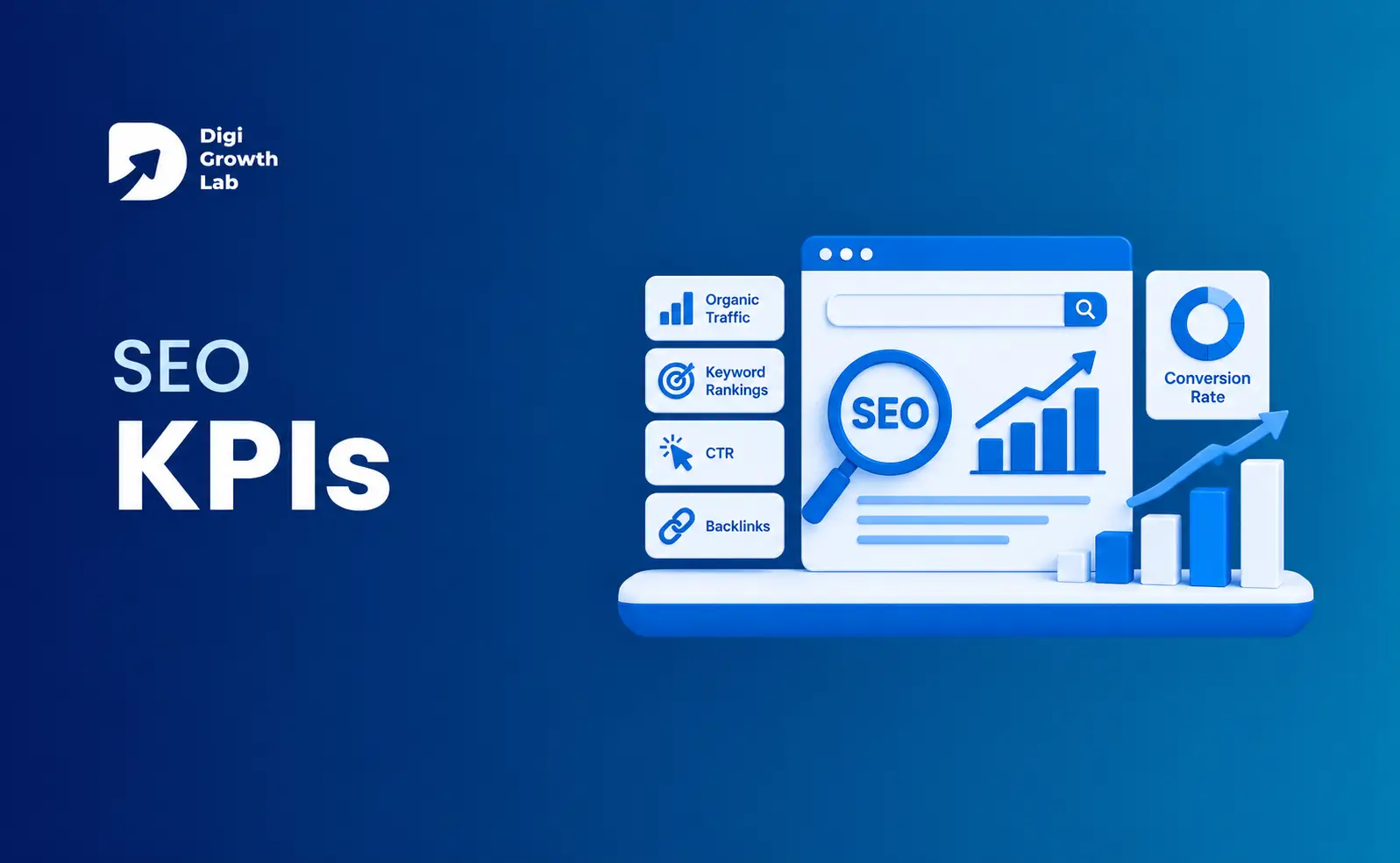
We have grouped these by the question each one answers, so you can go straight to the stage of performance you care about most. Here is the full set at a glance before the detail.
| SEO KPI | What it measures | Where to track it |
|---|---|---|
| SEO visibility | Share of the possible clicks your keywords could win | Search Console, Performance report |
| Keyword rankings | Your position for commercial and informational terms | Search Console; a rank tracker |
| Impressions | How often you appear in search results | Search Console, Performance report |
| Organic traffic | Visits from unpaid search | GA4, Traffic acquisition (Organic Search) |
| Non-branded organic traffic | Demand from people who did not search your brand name | Search Console, with brand terms filtered out |
| Organic click-through rate | Share of impressions that become clicks | Search Console, Performance report |
| Engagement rate and bounce rate | Whether visits are active or empty | GA4, Engagement reports |
| Average engagement time and pages per session | How deeply each visit engages with your website | GA4, Engagement overview |
| Backlinks and referring domains | Quality endorsements and links from other websites | Search Console Links report; Ahrefs or Semrush |
| Organic conversions, rate, and ROI | Business outcomes generated through organic search | GA4, Key events |
| Core Web Vitals and index coverage | Page experience, crawlability, and indexing health | Search Console, Core Web Vitals and Pages reports |
| AI visibility, citations, and referral traffic | Presence in AI answers and the traffic those platforms send | GA4 referral traffic; manual checks in AI tools |
Visibility
1. SEO visibility. This is the share of the possible clicks your target keywords could win across every result you appear in, including snippets and People Also Ask boxes. It matters more than any single ranking because it captures your whole footprint at once. The stakes are high near the top: the first three organic results still pull roughly 68.7 percent of all clicks on a clean results page, so small movements in visibility carry real traffic. You will find the raw numbers in Search Console under Performance, filtered to the queries you care about. Our guide to SEO visibility covers how to read it and lift it.
2. Keyword rankings. Your position for a search term still counts, but treat commercial terms as the priority over informational ones. A single page now ranks for many related queries because Google matches meaning, not just exact wording, so watch clusters of terms rather than one keyword in isolation. A jump from twelve to five only counts if people actually search and buy on that term.
3. Impressions. How often you appear in results. Read this as a leading indicator that Google is starting to test your pages for new queries. On its own it tells you almost nothing, which is why it only makes sense next to click-through rate.
Traffic
4. Organic traffic. Visits from unpaid search. The mistake most people make is reading it as one big number. Break it down by landing page and by intent instead, since that is where the story lives. Note that GA4 now folds visits from AI Overviews and AI Mode into the Organic Search channel, so the figure already includes some of your AI search activity.
5. Non-branded organic traffic. Traffic from searches that do not contain your company name. This is the cleanest signal that your SEO is pulling in fresh demand rather than collecting people who were always going to find you, so a rise here means you are reaching buyers who did not know you existed.
6. Organic click-through rate. The share of impressions that turn into clicks, worked out as clicks divided by impressions, times one hundred. A strong rate points to titles and descriptions that earn attention, which is the core of On-page SEO. This one has shifted hard: a 2025 study of more than 200,000 keywords found that click-through rate for position one fell from 28 percent to 19 percent in a single year as AI Overviews spread across the results page. Our on-page SEO checklist covers the levers that move it back up.
Engagement
7. Engagement rate and bounce rate. Use GA4’s engagement rate, the share of visits that lasted longer than ten seconds, triggered a conversion, or included at least two page views. A weak rate usually means the content missed the intent behind the search rather than anything being broken on the page. It is a content problem far more often than a technical one.
8. Average engagement time and pages per session. Together these show whether people actually read your pages and travel deeper into the site. Strong numbers tend to follow good Internal Linking, because relevant links give a reader an obvious next step. Our internal linking guide explains how to build those paths deliberately.
Authority
9. Backlinks and referring domains. Links from other sites work like endorsements. Count referring domains and weigh quality far above raw totals, since one link from a trusted publication outperforms fifty from thin directories. This is the heart of Off-Page SEO, which we cover in what off-page SEO is. Keep in mind that domain authority and domain rating are third-party scores invented by tool makers, not numbers Google publishes.
Conversion and business impact
10. Organic conversions, conversion rate, and ROI. This is the point where SEO stops being a theory and starts being a business case. Track the actions that matter, whether that is sign-ups, calls, or sales, then measure return as revenue from SEO minus the cost of SEO, divided by the cost of SEO, times one hundred. A rising conversion rate on flat traffic is often a bigger win than a traffic spike, because it means you are attracting the right people. In GA4 these sit under Key events, the report Google renamed from Conversions in 2024, so set your sign-ups, calls, or purchases as key events and segment them by the Organic Search channel.
Technical
11. Core Web Vitals and index coverage. Google’s page experience metrics are LCP, INP, and CLS. INP replaced FID in March 2024, so any guide still listing FID is out of date. These are not abstract: Google and Deloitte’s Milliseconds Make Millions study found that a 0.1 second improvement in mobile load time lifted retail conversions by 8.4 percent. Read them in Search Console under the Core Web Vitals report, which uses real Chrome user data rather than a one-off lab score, and check indexed pages and crawl errors in the Pages report, because a page Google cannot crawl cannot rank at all. Fixing these sits inside Technical SEO, and our technical SEO checklist walks through each one.
AI search
12. AI visibility, citations, and referral traffic. The newest layer, and the one competitors are slowest to measure. This tracks how often your brand shows up in and is cited by AI answers, plus the traffic those answers send you. The traffic is small today but the visits are valuable: Semrush reported that the average AI search visitor was around four times as valuable as a traditional organic visitor by conversion rate. You can read AI referral traffic in GA4 and prepare your pages using our guide on getting recommended by AI.
Which SEO KPIs Should You Track for Your Business?
None of these twelve deserves equal weight. The right shortlist depends entirely on what you sell and who you sell it to.
Manufacturing and industrial B2B. Focus on non-branded SEO visibility, rankings for commercial terms, and qualified enquiries over raw traffic. A thousand visits from students and job seekers mean nothing if no procurement manager picks up the phone. Our notes on SEO for the manufacturing industry go further on this.
Healthcare. Prioritise visibility for symptom and service searches, local pack presence, trust signals, and conversions into booked appointments. Healthcare also runs on organic more than most sectors, since advertising rules limit paid options. See SEO for healthcare services for the detail.
SaaS and software. Non-branded traffic, sign-ups and demos, and how many organic leads become qualified opportunities. Our piece on how SEO helps SaaS companies increase sign-ups shows the full path from search to trial.
Ecommerce. Organic revenue, product and category rankings, conversion rate, and Core Web Vitals, since page speed maps directly to sales in retail.
Local and service businesses. Google Business Profile actions, local rankings, calls, and direction requests, which usually carry the highest intent of any traffic you get.
What Does It Mean When an SEO KPI Moves?
A number changing is only useful if you know what to do about it. These are the patterns we see most, with the first move for each.
Rankings up but traffic flat. You are probably ranking for low-volume or low-intent terms. Shift your keyword focus toward the searches buyers actually run.
Impressions up but CTR down. Your titles are losing the click, often to an AI Overview or another SERP feature sitting above you. Rewrite titles and descriptions to give people a reason to choose your result.
Traffic up but conversions flat. Either the visitors are the wrong fit or the landing page is not doing its job. Check the search intent behind the traffic and the page experience before you publish anything new.
Sudden traffic drop. Look for an algorithm update, an indexing issue, or plain seasonality before you assume the worst. Our guide on why a small business website is not ranking on Google runs through the usual causes.
SEO KPI Benchmarks: What Counts as Good in 2026
Treat these as a starting line, not a finish line. Your own history is always the more honest baseline, and targets should be ranges rather than single fixed numbers.
For Core Web Vitals, Google grades each metric on real visits measured across the slowest quarter of your users. Here are the current thresholds.
| Core Web Vital | Good | Needs Improvement | Poor |
|---|---|---|---|
| LCP (Loading) | 2.5 seconds or less | 2.5 to 4 seconds | Over 4 seconds |
| INP (Responsiveness) | 200 milliseconds or less | 200 to 500 milliseconds | Over 500 milliseconds |
| CLS (Visual Stability) | 0.1 or less | 0.1 to 0.25 | Over 0.25 |
Clearing all three at once is rarer than most teams assume, which makes it a genuine competitive edge in a tight niche.
On speed, Google’s own research found that 53 percent of mobile visits are abandoned when a page takes longer than three seconds to load, so anything above that ceiling is quietly costing you traffic before a visitor ever sees your content.
On click-through rate, resist the old charts promising 30 percent or more at position one. With AI Overviews now common, the top spot often sits in the high teens to low twenties. Measure your own rate in Search Console rather than trusting a generic table.
How Do You Choose the Right SEO KPIs?
Pick one lagging KPI that equals your goal, then two or three leading KPIs that predict it. That is the whole method.
Say your goal is more leads. Organic conversions becomes your lagging KPI, the number that confirms success after the fact. Non-branded traffic and rankings for commercial terms become your leading KPIs, the early signs that tell you whether you are on pace long before the leads arrive.
A short, honest set of KPIs beats a crowded dashboard every time, because it forces agreement on what winning looks like.
How to Track and Report Your SEO KPIs
Start with the free tools. Google Search Console gives you impressions, clicks, average position, and index coverage. GA4 handles traffic, engagement, and conversions. Between them you can track most of this list without paying for anything.
Paid platforms like Ahrefs and Semrush earn their place once you scale, mainly for faster rank tracking, backlink data, and competitor comparison. Whatever stack you use, report monthly, tie every number back to the goal it serves, and drop the metrics that do not earn their spot.
Turn Your SEO KPIs Into Results
Knowing the twelve SEO KPIs is the easy part. Building the tracking, reading it honestly, and acting on what it shows is where the growth actually comes from.
If you would rather hand that to a team that does it every day, our professional SEO Services cover the full picture, from Technical SEO Services and On-Page SEO Services through to AI SEO Services shaped around how people search now.
Your SEO KPIs Should Prove Growth, Not Just Track It
Watching the numbers is the easy part. Knowing which ones to act on, and turning them into leads and revenue, is where our team comes in.
Frequently Asked Questions
How many SEO KPIs should I track?
Track three to five that ladder up to a single business goal. Any more than that splits your attention and hides the numbers that actually matter.
What is the difference between an SEO KPI and a metric?
A metric is any number in a report. A KPI is a metric tied to a goal you would act on. Every KPI is a metric, but only a handful of metrics deserve to be KPIs.
Which SEO KPI matters most?
The one closest to revenue for your business, which is usually organic conversions. Rankings and traffic only count because they feed it.
Are keyword rankings still a good KPI in 2026?
Yes, but only for commercial terms tied to real demand. A top ranking for a keyword nobody buys on is a vanity number, especially now that AI Overviews absorb clicks on informational searches.
How do I measure SEO performance in AI search?
Track how often your brand is cited in AI answers and the referral traffic those answers send, which now shows up in GA4. A good SEO company reports this next to your classic organic metrics rather than treating it as separate.
How often should I check my SEO KPIs?
Review most of them monthly, since SEO moves slowly and weekly swings are usually noise. Keep a shorter watch on rankings and index coverage, where a sudden drop signals a problem worth catching early.