
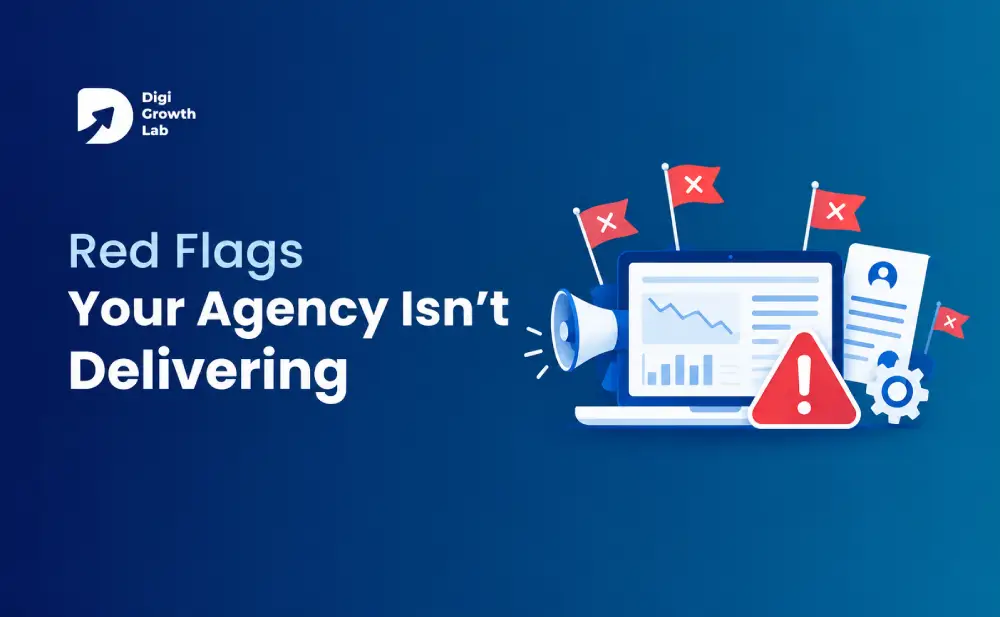
You pay an agency every month. The reports keep arriving. The dashboards look busy. But something feels off, and you cannot quite put your finger on it.
That gap between activity and actual business growth is where most agency relationships quietly go wrong. When a marketing agency is not delivering results, the warning signs are usually visible for months before anyone acts on them. The trouble is that they hide behind numbers that look impressive at a glance.
This guide walks through the five clearest digital marketing agency red flags, how to check each one yourself, and how to tell the difference between a temporary dip and an agency that has stopped earning its fee.
- Quick answer: A good agency ties its work to leads, qualified leads, and revenue, explains why performance moved, keeps testing, and gives you full access to your own accounts. If your agency reports only traffic, clicks, and impressions, never changes its approach, and cannot explain results in plain language, those are the clearest signs of a marketing agency not delivering results.
What “Not Delivering Results” Actually Means
Results are not the same thing as activity. An agency can publish blogs, run ads, post on social, and send a thick monthly report while your sales pipeline stays completely flat.
The honest test is simple. Has the marketing produced more qualified enquiries, more customers, or more revenue than it costs? If nobody can answer that clearly, you have a measurement problem, an agency problem, or both.
To be fair, measuring this is genuinely hard, even for large in-house teams. In a 2025 survey by Perion and Advertiser Perceptions, only 22% of marketers strongly agreed they had the insight needed to justify marketing’s value to their finance leaders. So before you judge your agency, it helps to know what a fair judgement looks at.
There is a money angle too. Budgets are tight almost everywhere. Gartner’s 2025 CMO Spend Survey found marketing budgets flat at 7.7% of company revenue, with 59% of leaders saying they did not have enough to execute their plans. When money is limited, waste from a coasting agency hurts more. That is exactly why these red flags are worth catching early.
5 Red Flags Your Marketing Agency May Be Underperforming
Red Flag 1: Reports Are Full of Activity but Empty of Business Results
What it looks like: Your monthly report is packed with impressions, reach, clicks, followers, and rankings. What it does not contain is leads, qualified leads, cost per acquisition, or revenue.
Why it is a problem: These surface numbers are vanity metrics. They can climb for months while your actual customer count stays flat. If the report never connects marketing to money, you cannot tell whether your budget is working at all.
How to verify it: Open your last three reports. Count how many numbers describe business outcomes (enquiries, qualified leads, sales, cost per lead) against how many describe activity (impressions, clicks, reach). If the outcomes column is thin, that is your answer.
A realistic example: An agency proudly reports that organic traffic climbed 40% this quarter. You check your enquiry inbox and nothing has changed. The traffic grew, but for pages that attract readers, not buyers. The same trap shows up in paid campaigns, where a business gets 300 leads from Google Ads and the sales team says almost none are worth calling. Volume looks great on a slide and means little in the pipeline. If that sounds familiar, our breakdown of why Google Ads get clicks but no leads covers the usual causes. Social media has its own version: followers and engagement rise, yet website actions and enquiries do not move. Engagement matters when it leads somewhere, which is the whole point of measuring social media ROI properly.
- What a good agency does instead: It leads the report with the metrics tied to your goals, then uses the activity numbers only to explain them.
- What to ask: “Can you show me leads and qualified leads by channel for the last three months, next to what we spent?”
Red Flag 2: Nothing in Your Campaigns Ever Changes
What it looks like: You log into your ad account or content plan and it looks identical to three months ago. Same keywords, same ad copy, same landing pages, same posting pattern.
Why it is a problem: Markets shift, competitors bid differently, and customer behaviour changes. A campaign left untouched slowly drifts out of date and quietly wastes spend. Static work is a clear sign of poor marketing agency performance.
How to verify it: Ask for a change log. Real optimisation leaves a trail: paused keywords, new ad variations, adjusted bids, updated audiences, refreshed content. If the settings have not moved since your last review, the account is on autopilot, and that is often where Google Ads budget gets wasted.
A realistic example: A company runs the same five ad creatives and keyword list for six months. Cost per lead creeps up every month. The agency calls it “the market getting more expensive,” but never tested a single new angle to fight back.
- What a good agency does instead: It treats campaigns as running experiments, testing new creatives, keywords, and pages on a set schedule, and reports what it learned each time.
- What to ask: “What did you test last month, and what are you testing next month?”
Red Flag 3: They Cannot Explain Why Performance Went Up or Down
What it looks like: Results move, but the explanation is always vague or external. Good months are “our great work.” Bad months are “Google’s algorithm,” “the season,” “the competition,” or just “the market.”
Why it is a problem: An agency that cannot explain cause and effect cannot repeat its wins or fix its losses. Constant blame-shifting is one of the more telling marketing agency red flags, because it signals that no real diagnosis is happening. Accountability is part of the job you are paying for.
How to verify it: After the next swing in results, ask for the specific reason and the evidence behind it. A capable team points to concrete causes: a landing page change, a seasonal search pattern in the data, a competitor’s new offer, a tracking gap. A weak team offers a general excuse.
A realistic example: Leads drop 30% in a month. One agency shrugs and says “traffic is just down.” Another shows that a key page lost rankings after a site update, names the fix, and gives a timeline. Same drop, very different partner.
- What a good agency does instead: It explains performance in plain English, owns its part honestly, and separates what it controls from what it does not.
- What to ask: “What specifically caused this change, and how do you know?”
Red Flag 4: The Definition of Success Keeps Changing
What it looks like: You agreed on a goal, say qualified leads or cost per acquisition. The target gets missed. Next report, the headline metric has quietly changed to something easier, like reach or engagement.
Why it is a problem: Moving goalposts hide underperformance. When the KPIs shift every time a target is missed, you lose the ability to hold anyone to account, and you never find out whether the strategy actually works.
How to verify it: Compare the metrics highlighted in your reports over the last six months. If the “hero” number keeps changing, and always in a flattering direction, that is a choice, not a coincidence.
A realistic example: The contract promised a lower cost per qualified lead. Three months in, cost per lead is up, so the report suddenly leads with brand awareness and impressions instead. The original promise is never mentioned again.
- What a good agency does instead: It keeps the same core KPIs, reports them honestly even in a bad month, and only changes a target with a clear, agreed reason.
- What to ask: “Are we still measuring the goals we set at the start, and how are we doing against them?”
Red Flag 5: You Do Not Control Your Own Accounts and Data
What it looks like: Your Google Ads, Google Analytics, Search Console, business manager, or even your website sit under the agency’s ownership. You cannot log in without asking, and you are not sure you could take your data with you if you left.
Why it is a problem: Your accounts and history are business assets. If the agency owns them, you are locked in, you cannot verify their reports independently, and a bad breakup could cost you years of data. This is one of the most practical digital marketing agency red flags to check today.
How to verify it: Try to log into each account directly as an owner or admin. Confirm that Google Ads, Analytics, and Search Console are registered under your business, with the agency added as a user, and not the other way round.
A realistic example: A business decides to switch agencies and discovers the ad account, the analytics history, and even the domain were all under the old agency’s control. Moving on means starting again from zero.
- What a good agency does instead: It sets up every account in your name from day one and adds itself as a user, so ownership always stays with you.
- What to ask: “Are all my marketing accounts registered under my business, with admin access for me?”
Vanity Metrics vs Real Marketing Results
Most reporting problems come down to one habit: showing numbers that look good instead of numbers that matter. Here is a simple way to read the difference.
| Vanity metric | More useful business metric |
|---|---|
| Impressions | Qualified traffic and leads |
| Followers | Relevant engagement and enquiries |
| Clicks | Conversions |
| Website traffic | Qualified organic traffic |
| Leads | Qualified leads |
| Cost per lead | Cost per qualified lead |
| Ranking position | Relevant organic traffic and conversions |
| Engagement rate | Business actions and revenue |
Vanity metrics are not useless. They work as early signals. Rising impressions can show your reach is growing, and climbing engagement can hint that your message is landing. The problem starts when these numbers become the whole story and quietly replace the metrics that pay the bills. A useful report shows both, and always links the supporting numbers back to leads and revenue.
How to Check Your Marketing Agency’s Performance
Run through this quick checklist. Answer each one with a simple yes or no.
- Can your agency clearly state your business goals for the quarter?
- Do reports show leads, qualified leads, or sales, not just traffic and engagement?
- Can they explain why performance went up or down, with evidence?
- Are they testing new ideas on a regular basis?
- Do they show the work that was actually completed each month?
- Do they recommend clear next steps, not just past numbers?
- Do you have admin access to your own Google Ads, Analytics, and Search Console?
- Does the strategy change when the data says it should?
- Are the KPIs the same ones you agreed at the start?
- Can they connect marketing activity to real business outcomes?
How to read your score: Eight to ten yes answers means your agency is likely doing its job. Five to seven points to real gaps worth a direct conversation. Four or fewer is a strong signal that something needs to change, whether that is the strategy, the communication, or the agency itself.
Not Every Drop in Performance Means Your Agency Is Failing
Before you blame the agency, rule out the causes it does not fully control. Marketing results are shaped by plenty of things that sit outside any single campaign:
- Seasonality and normal demand cycles
- Budget cuts or sudden budget changes
- New competitors or aggressive competitor pricing
- Website problems, slow pages, or a confusing checkout
- Weak landing pages or an unclear offer
- Slow or inconsistent sales follow-up
- Falling market demand
- Broken tracking or gaps in analytics
- Google or Meta algorithm and platform changes
A drop caused by a broken enquiry form, or a sales team that takes three days to call back, is not an agency failure, even when it shows up in the marketing numbers.
Timing matters too. Different channels prove themselves on different clocks. Paid ads can show signal within weeks. Social media usually needs a few months of consistent posting. SEO is the slowest of the three. Google’s own guidance, from former search expert Maile Ohye, is that SEO typically needs four months to a year to show meaningful benefit. Judging an SEO campaign at week six is unfair to the work and to your own investment. If your site is newer or in a competitive space, patience is part of the plan, and it is worth understanding why a small business website may not be ranking yet before you point the finger.
When Should You Consider Switching Marketing Agencies?
Switching makes sense when the problems are consistent and nobody has a credible plan to fix them. Consider a change when:
- The same issues repeat with no corrective plan
- The agency still cannot explain performance after you ask
- Reporting stays vague no matter how often you request clarity
- The strategy never changes, even when results stall
- Agreed deliverables are missed again and again
- Lead quality stays poor with no real optimisation
- Communication is consistently slow or evasive
- The definition of success keeps moving
- You still do not control your own accounts and data
Switching is not always the answer, though. If your agency can name the problem clearly, communicate openly, show the work it has done, and hand you a specific improvement plan with dates on it, fixing the relationship is often faster and cheaper than starting over. A new agency also needs ramp-up time, so change for a real reason, not out of frustration. Our take on when it makes sense to switch PPC agencies walks through the same decision for paid campaigns.
Before you renew any contract, ask three questions. What did we achieve against the goals we set? What will you do differently next quarter? And what do you need from us to succeed? The quality of those answers tells you almost everything.
What a Results-Focused Marketing Partner Should Look Like
If several of these red flags feel familiar, you may well be dealing with a marketing agency not delivering results, and it is worth acting on. Strip away the jargon, and a good partner is easy to describe. It sets clear goals, reports transparently, and focuses on business KPIs rather than decoration. It optimises regularly, tests new ideas, communicates honestly in good months and bad, delivers what it promised, and keeps the focus on qualified leads and growth. And you always own your accounts and data.
That is the standard we hold ourselves to at Digi Growth Lab. Working with businesses in Ahmedabad and beyond, we build SEO, PPC, and social media campaigns around outcomes you can measure, with reporting that connects the work to real enquiries and revenue. For teams thinking about how AI is reshaping search, our AI-driven SEO approach helps you stay visible where buyers now look.
Wondering whether your marketing is actually working?
We will review your current campaigns and reporting, then show you plainly what is delivering and what is not.
Frequently Asked Questions
How do I know if my marketing agency is doing a good job?
good agency connects its work to business outcomes. If it can show leads, qualified leads, and revenue by channel, explain why performance changed, and confirm that you own your accounts, it is likely doing its job. Reports built only on traffic, clicks, and followers are the warning sign.
How long should I give a marketing agency to show results?
It depends on the channel. Paid ads can show early signal in a few weeks. Social media usually needs a few months of consistent work. SEO typically takes four months to a year, according to Google’s own guidance. Judge each channel on its own timeline, not all at once
Why is my marketing agency generating traffic but no leads?
Usually the traffic is not qualified. The pages may target keywords that attract readers rather than buyers, or the landing page and offer may not match what visitors actually want. More traffic only helps when it brings the right people to a page built to convert.
What should a marketing agency report every month?
At a minimum: spend by channel, leads and qualified leads, cost per lead, conversions or sales where you can track them, the work completed that month, what was tested, and clear next steps. Impressions and clicks can appear as context, not as the headline
When should I switch marketing agencies?
Switch when problems repeat with no plan to fix them, reporting stays vague, the strategy never changes, or you do not control your own data. If the agency can explain the problem and give you a credible improvement plan, fixing the relationship is often the better move.
How can I tell if my SEO agency is working?
Look past rankings to qualified organic traffic and enquiries. Ask what was changed on the site, what content was published and why, and how those changes map to the keywords your buyers actually use. Steady growth in relevant traffic and leads matters far more than a single ranking position.