
Most guides on SEO best practices hand you a long list of tips and leave you to guess which ones matter. That is the real problem. You end up busy, not ranked.
This guide fixes that. It puts the practices in the order they actually count, so you know what to do first, second, and last. No filler. No thirty-item checklist you will never finish.
Whether you are building a new site or sharpening an old one, start at the top and work down. Every section tells you what to do and why it moves the needle.
What Ranking Higher Means today
Ranking is no longer just about hitting position one on Google.
People now find answers inside AI Overviews, ChatGPT, Gemini, and Perplexity. A searcher may get what they need without clicking a single blue link. That changes the game.
Here is the good news. The same habits that help you rank on Google also help you show up in AI answers. Clear writing, real expertise, and a trustworthy site feed both systems at once.
So you do not need a separate playbook for AI. You need the fundamentals done well. If you want to go deeper on the AI side later, we cover it in our guide on how to rank in ChatGPT search results.
The rest of this post walks through the practices in three stages. First, get your site into the race. Then, give search engines and AI a reason to pick you. Finally, keep it all working.
Stage One: Get Your Site into the Race
These are the basics. Skip them and nothing else you do will matter.
Start with Search Intent, Not Keywords
Before you write a word, understand why someone is searching.
That reason is called search intent, and it decides whether your page fits the query. Most searches fall into four buckets.
- Informational: the person wants to learn something, like “what is on-page SEO.”
- Navigational: they are looking for a specific site or brand.
- Commercial: they are comparing options before buying, like “best SEO tools.”
- Transactional: they are ready to act, like “hire an SEO agency.”
Match your page to the right bucket. A how-to guide will not rank for a buying query, and a sales page will not rank for a learning query.
Here is a step most beginner guides skip. Before you write, type your target phrase into Google and study the results. The pages already ranking show you exactly what Google thinks the searcher wants. Copy the intent, not the content.
One more thing. People phrase questions to AI tools in longer, fuller sentences than they type into Google. Write the way your audience actually talks, and your content fits both.
Publish Content That Proves Real Experience
Good content is still the biggest driver of rankings. That has not changed, and it will not.
What has changed is the bar. AI can now produce endless average articles. To stand out, your content has to show something a machine cannot fake: real experience and real expertise.
Google calls this E-E-A-T, which stands for experience, expertise, authoritativeness, and trustworthiness. It comes straight from Google’s Search Quality Rater Guidelines. In plain terms, it means prove you have done the thing, prove you know the subject, and give readers a reason to trust you.
Try this simple test on any page you publish. Could a competitor swap in their name and lose nothing?
If the answer is yes, your content is generic. Add real examples, specific numbers, firsthand lessons, or original insight. That is what earns the ranking and the citation.
Structure matters here too. Keep paragraphs short and make each point stand on its own. When an AI system quotes a single line from your page, it should still make sense without the rest.
Get the Technical Basics Right
Search engines cannot rank a page they cannot read. Technical SEO is the floor everything else stands on.
You do not need to be a developer. You need these basics covered.
- Your important pages can be crawled and indexed.
- Your site loads fast.
- It works well on phones.
- It runs on a secure connection, which is HTTPS. Google confirmed years ago that HTTPS is a ranking signal.
Speed deserves a closer look, because this is where many guides are out of date. Google measures speed and responsiveness through three Core Web Vitals: LCP, INP, and CLS.
Note the middle one. On March 12, 2024, Google replaced the old FID metric with INP, which stands for Interaction to Next Paint. If a guide still lists FID as a Core Web Vital, it has not been updated. You can read Google’s own announcement on the web.dev blog.
Technical work moves real numbers. For an HVAC equipment manufacturer with a messy site structure and slow product pages, restructuring the site and fixing the technical faults lifted its average ranking position by nearly 45 percent.
One honest caveat. A fast, crawlable page still needs strong content. The technical work gets you into the race. It does not win it.
This guide is about what to do. If you also want to understand the machine underneath it, how rankings are decided and why they shift, our SEO ranking guide explains it.
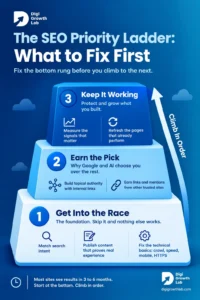
Stage Two: Give Search and Ai a Reason to Pick You
Once your page can compete, you need to stand above the others saying the same thing.
Build Authority on Your Topic
Covering one subject deeply tells Google and AI systems that you are a real source on it. This is called topical authority, and it is how smaller sites beat bigger ones.
The method is simple. Pick a core topic. Write one strong main page on it. Then write supporting pages on the smaller questions around it. Link them all together so readers and search engines can move between them.
This is not about volume. A handful of connected, genuinely useful pages beats a hundred thin ones. We saw this directly with a nonprofit whose site was full of shallow pages. After we rebuilt the content with real depth and fixed the structure, organic traffic grew 104 percent, and clicks from search rose 160 percent over six months.
Internal links do the quiet work here. They pass authority between your pages and help search engines understand how your content connects. For example, if you measure your progress, our guide on SEO visibility explains how to track your presence across search.
If this starts to feel like a lot to manage, that is often the point where businesses bring in a team that offers Search Engine Optimization Services to handle the structure for them.
Earn Authority Beyond Your Own Site
Search engines and AI do not only look at your site. They look at what other trusted sites say about you.
Mentions and links from reputable sources act like votes of confidence. They matter for Google rankings, and they matter even more for AI, which often pulls from third-party pages when it builds an answer.
You do not need a big budget to earn them. Try these realistic routes.
- Create something genuinely useful that people want to reference.
- Get listed in directories and roundups relevant to your industry.
- Answer real questions in communities, under your own name, where your input actually helps.
- Reclaim mentions. If a site names your brand without linking, ask them to add the link.
A warning. Avoid spammy shortcuts like reciprocal link swaps, where two sites agree to link to each other just to game the system. These have crept back in, and they still carry risk. One strong link from a respected site is worth more than fifty cheap ones.
Stage Three: Keep It Working
SEO is not a one-time project. These last habits keep your rankings alive.
Measure the Right Things
Tracking everything proves nothing. Track the signals that tell you what to do next.
Rankings and traffic still matter, but they no longer tell the full story. An AI answer can satisfy a searcher with no click at all, which means a mention can have value even without a visit.
Watch a focused set of signals instead.
- Your rankings for the keywords that matter to your business.
- Your overall visibility across search.
- Mentions and citations in AI answers.
- Engagement and conversions from the traffic you do get.
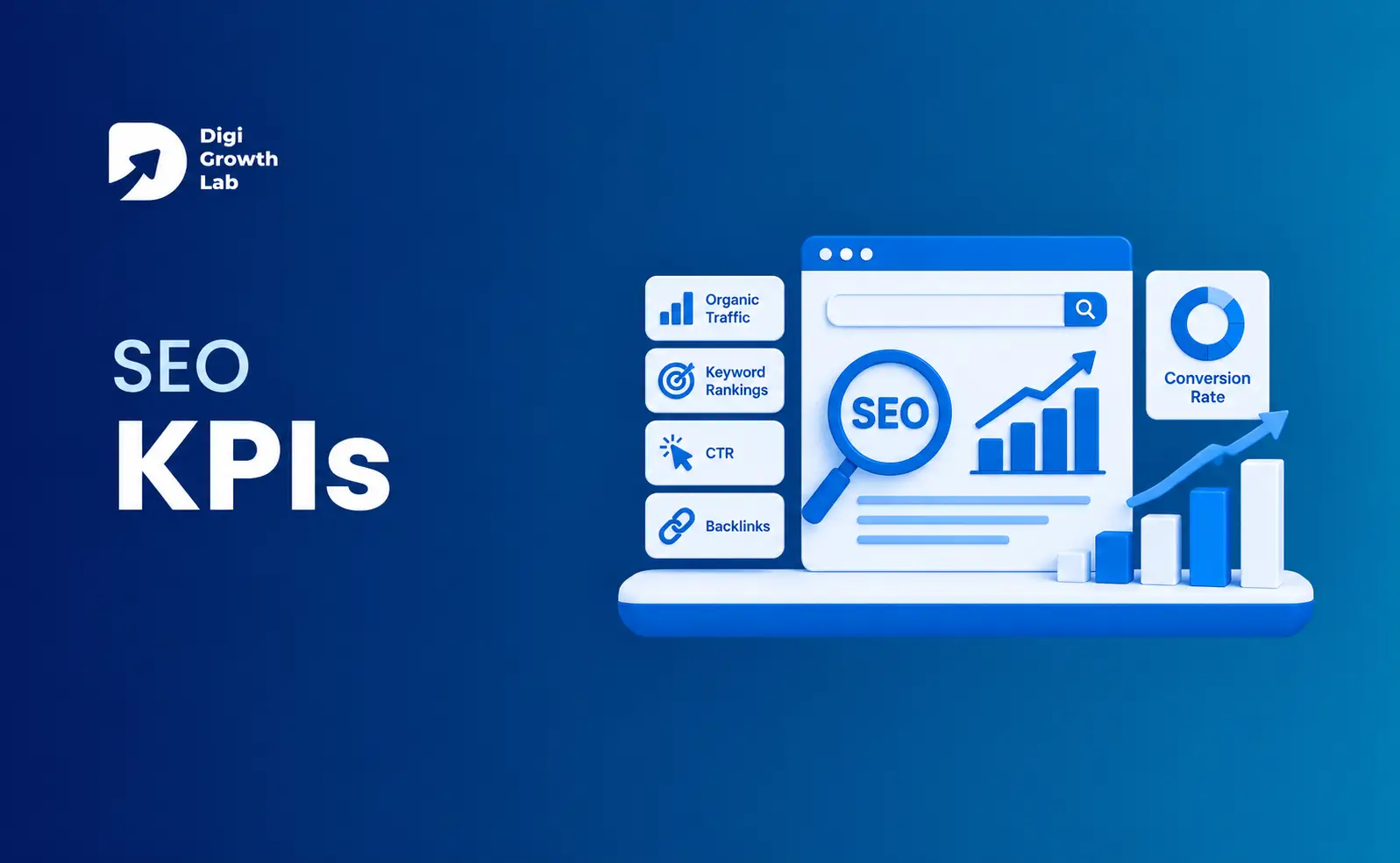
The point of tracking is direction, not decoration. These signals tell you whether your work is paying off and where to put effort next. For the full set of metrics worth watching, and what a good number looks like, see our SEO KPIs guide.
Keep your content fresh too. A real update means adding new value, not just changing the date. Start with pages that already rank or earn traffic, since small improvements there pay off fastest.
How Long Before You See Results
This is the question every guide dodges, so here is a straight answer.
SEO takes time. For a newer site with low authority, expect the first signs of movement in roughly three to six months. Meaningful results usually come later, often six months to a year in.
Why so long? Google has to crawl your pages, judge their quality, and watch how searchers respond. Trust is earned, not switched on.
What does a healthy early sign look like? Your pages start appearing in search, even on page two or three. Impressions rise before clicks do. That upward drift means you are on the right path, so keep going.
A real example makes this concrete. For an orthopedic clinic, a steady mix of on-page work, new content, and technical fixes grew organic traffic about 32 percent in six months, and search impressions climbed 77 percent. The impressions moved first, which is exactly the early signal to watch for.
If someone promises you page-one rankings in thirty days, be careful. Fast, guaranteed results usually mean risky tactics that cost you later.
The one idea to remember
You will not beat a giant with a longer article. You beat them by being clearer, more accurate, and more useful.
Get the foundations right. Match intent, publish content that proves real experience, and fix the technical basics. Then build authority on and off your site, measure what matters, and give it time.
Pick one weak spot from this guide and fix it this week. That single step is how every strong ranking begins.
Ready to Climb the Rankings?
Rankings reward the businesses that do the fundamentals well and keep at it. If you want a clear plan and a team to run it, we can help.
Frequently Asked Questions
How long does it take to rank higher on Google?
Most sites see early movement in three to six months, and meaningful results between six months and a year. A new site with low authority sits at the slower end, because Google needs time to crawl, judge, and trust it. Rising impressions are the first good sign, usually before clicks grow.
Can a new website outrank established competitors?
Not on the biggest keywords, and not right away. A new site with low authority cannot beat a major brand on a broad term from the start. What works is targeting longer, more specific queries, building real depth on one topic, and earning trust over time. Win the smaller searches first, then climb.
Do these best practices help with Google AI Overviews?
Yes. The same fundamentals that rank you on Google help you appear in AI Overviews and tools like ChatGPT. Clear structure, short self-contained answers, real expertise, and trust from other sites all make your content easier for AI systems to quote.
Is longer content better for SEO?
No. Length alone does not improve rankings. Google rewards the page that best answers the query, not the longest one. A clear, accurate, well-organized page beats a padded one every time. Write enough to answer fully, then stop.
What is the difference between on-page SEO and technical SEO?
On-Page SEO covers what is on the page: the words, headings, title, and how well they match search intent. Technical SEO covers the site underneath: crawling, indexing, speed, mobile, and security. On-page SEO helps Google understand your page. Technical SEO lets Google reach it at all. You need both.
Do SEO best practices actually improve traffic?
Yes, when applied consistently. Results vary by site and effort. Following these fundamentals, an orthopedic clinic grew organic traffic about 32 percent in six months, an HVAC manufacturer improved its average ranking position by nearly 45 percent, and a nonprofit more than doubled its organic traffic. The basics done well, not any single trick, drove each one.