
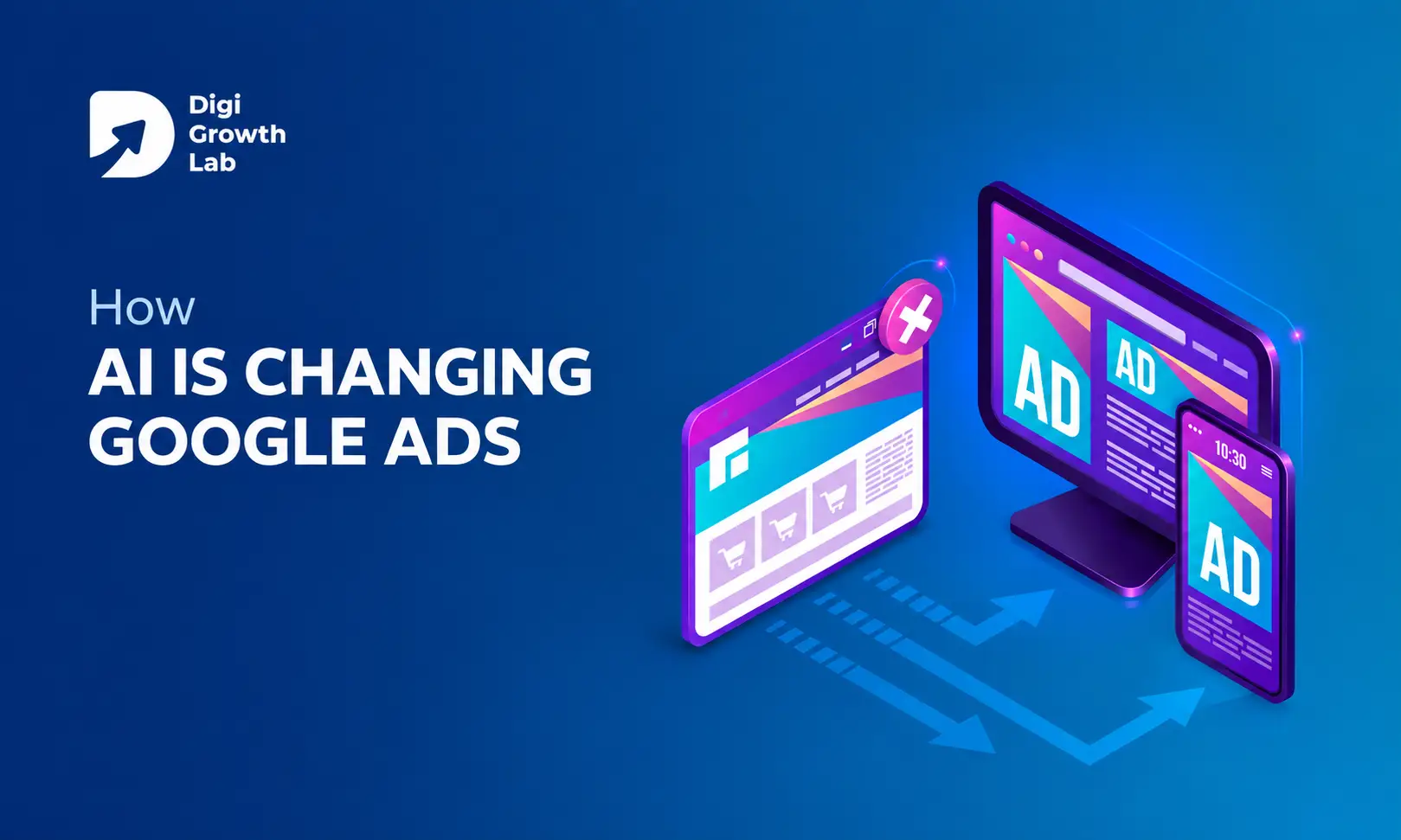
Artificial intelligence has moved from a talking point to the engine running most of Google Ads.
It now shapes how ads are written, who sees them, how much you bid, and how conversions get counted.
For any business paying for PPC management, that shift cuts both ways. Campaigns feel less hands-on than they used to. At the same time, the same technology can put your ads in front of the right people at the right moment with more accuracy than manual settings ever managed.
The difference between those two outcomes comes down to how well you guide the AI.
Here are six ways AI is changing Google Ads right now, the real numbers behind them, and how to get more out of each one.
AI in Google Ads is more than automation
Most people still picture AI in Google Ads as automated bidding. That is a small part of it.
Behind every auction, Google’s systems predict which ad is most likely to convert, in real time, across billions of searches.
They test creative combinations on the fly, read patterns across industries, and estimate outcomes even when user data is missing. Bidding is only the visible layer.
Treating AI as auto-bidding and nothing more is why some accounts underperform. AI now touches creative, bidding, targeting, and measurement, and the advertisers who win feed each stage the inputs it needs.
Smarter ad creative, not only smarter bids
Ad creation itself has changed.
With Responsive Search Ads, now the standard search ad format, you supply a set of headlines and descriptions. Google’s AI then assembles the combination it thinks each user is most likely to respond to. Your ads are no longer fixed. They adapt from one person to the next.
Google Ads can also draft headlines and descriptions, and even generate images, from your website and a short prompt. It is a fast way to fill gaps, but the output still needs a human eye.
The catch is simple: the AI can only work with what you give it. Generic inputs produce generic ads.
How to guide it:
- Write headlines in your customer’s language, not marketing jargon.
- Lead with at least one clear value, such as free delivery, next-day support, or a free trial.
- Use AI to brainstorm variations, then edit the final copy yourself.
- Check any AI-generated image or line before it goes live, so it looks and sounds like your brand.
That last step is what separates your ads from the identical-sounding campaigns your competitors run.
Smart Bidding that adjusts to every auction
This is the part people picture first, and it does far more than follow a fixed rule.
Smart Bidding uses Google’s AI to set a bid for each individual auction, based on signals like device, location, time, and intent. Instead of one flat bid, it adjusts thousands of times a day toward the goal you set.
The main strategies are:
- Maximize Conversions or Conversion Value, when you want the most results your budget allows.
- Target CPA, when you have a cost per lead you need to hold.
- Target ROAS, when revenue per sale varies and you bid to a return.
How to guide it:
- Pick the goal that matches your business, not the one that simply looks busy.
- Give the system enough conversion data to learn from before you judge it.
- Pair Smart Bidding with clean tracking, since it bids toward whatever you tell it counts as a conversion.
Get the goal and the data right, and the bidding largely takes care of itself.
Audience targeting that learns in real time
AI no longer targets by keyword alone.
It reads live signals: location, device, time of day, browsing behavior, and past visits to your site. That lets your ad reach someone at the moment they are closest to buying.
The flip side matters just as much. Weak tracking or messy data confuses the system and wastes budget. If the AI learns from bad signals, it optimizes toward the wrong outcome.
How to guide it:
- Keep GA4 tracking accurate and complete.
- Import offline conversions from your CRM, such as sales and qualified leads.
- Layer in audiences like remarketing lists and customer match to give richer signals.
Feed the system quality data and it chases conversions that matter, not cheap clicks.
Performance Max and AI Max: where AI runs the widest
Performance Max is Google’s most automated campaign type. From one campaign, it runs ads across Search, YouTube, Display, Discover, Gmail, and Maps.
Google reports that advertisers who adopt it see, on average, 27% more conversions or conversion value at a similar cost, even when they already use broad match and Smart Bidding.
In 2025, Google brought the same approach to standard Search with AI Max, which expands your keywords using broad match and keywordless technology.
Google’s data showed advertisers who turn on AI Max typically see 14% more conversions at a similar cost, rising to 27% for campaigns still built mainly on exact and phrase keywords.
Both can feel like a black box. You do not always see where every ad ran or why. Guided well, though, they become real growth engines.
How to guide it:
- Provide strong creative: videos, images, and product feeds.
- Point the AI with audience signals like custom intent and remarketing lists.
- Exclude irrelevant placements and add brand or negative keywords so budget does not drift.
Set and forget produces random results. Guided, it produces compounding ones.
Measurement that fills the gaps
Tracking a customer from first click to sale has become harder, and not for the reason many blogs still repeat.
Google decided in 2025 not to remove third-party cookies from Chrome after all. That does not put things back to how they were.
Safari, Firefox, and Brave already block third-party cookies by default, which covers close to one in five users worldwide. Privacy laws like GDPR and India’s DPDP Act require consent before tracking.
So gaps in your data are now normal, whatever Chrome does.
This is where AI steps in. Google models the conversions it cannot directly observe. If someone sees your ad on mobile and buys later on desktop, its models can still connect that journey.
How to guide it:
- Set up enhanced conversions to strengthen the signals you do collect.
- Import offline conversions from your CRM to tie ad spend to real revenue.
- Compare AI-modeled conversions against actual sales to keep them honest.
Last-click attribution is no longer enough. Treat AI’s modeled numbers as a well-informed estimate to validate, not gospel.
Less busywork, more strategy
AI has also changed the daily work of running campaigns.
Tasks that used to eat hours now take minutes: keyword expansion, negative keyword lists, first-draft ad copy, and reporting summaries.
That frees up time, but it does not remove the need for people. AI is fast and good at spotting patterns. Humans are better at creativity, brand judgment, compliance, and strategy.
The strongest accounts pair the two.
Where AI still needs a human hand
AI in Google Ads is capable, not flawless. The common mistake is assuming that handing everything to automation makes results peak on their own.
Left unchecked, a few problems show up again and again.
Your brand voice slips. AI optimizes for clicks and conversions, not for how your brand sounds. Review generated assets before they go live and replace anything that does not sound like you.
Budget leaks into the wrong places. AI acts on signals but does not always read context, so ads can land on placements that have nothing to do with your audience. This is one of the biggest causes of wasted spend, and we break it down in our guide on why most Google Ads campaigns waste part of their budget. Check placement reports often and prune what is not working.
Bad data leads to bad decisions. AI learns only from what you give it. Mark every page view as a conversion and it will chase traffic instead of sales, so clicks rise while revenue drops. Map real outcomes such as sales, form fills, and sign-ups as your conversions.
You lose the thread. Hand over every decision and it gets harder to explain why performance moved. Treat AI as a co-pilot, not the driver. Set guardrails, review weekly, and run controlled tests.
Short-term wins hide long-term costs. AI can favor quick metrics like click-through rate while quietly starving brand awareness. Balance immediate performance with brand building, and keep people in the strategist’s seat.
What is coming next
Google is pushing campaign setup toward plain conversation. You describe your goal, and AI helps build the campaign around it.
Ads are also moving deeper into AI-powered search, with new conversational formats and placements inside AI Overviews and AI Mode.
The direction is consistent: less manual setup, more weight on the quality of your creative and your first-party data.
The takeaway stays the same. Feed the AI strong creative, keep your data clean, and keep human expertise in the loop. Advertisers who build those habits now will hold the advantage as AI-native campaigns become the default.
How we approach it at Digi Growth Lab
AI rewards the advertisers who guide it well.
In our PPC management, we let Google’s AI handle the heavy lifting while our team sets the strategy, cleans the data, and keeps a hand on the wheel.
That balance is how a SaaS platform we worked with grew qualified leads by 51% while cutting cost per lead by 38%.
If your campaigns feel like they are running on autopilot without the results to match, let’s talk. We will show you where better guidance can turn AI’s speed into real growth.
Is Your Ad Budget Working as Hard as Your AI Is?
When campaigns run on autopilot, spend slips into the wrong places fast. If your numbers aren’t moving the right way, the setup needs a closer look.
Frequently Asked Questions
Is AI replacing PPC managers in Google Ads?
No. AI handles the execution, bidding, testing, and pattern-spotting at a speed no person can match. It still needs people to set the strategy, protect the brand voice, and confirm it is optimizing toward real business results. The strongest accounts pair AI’s speed with human judgment.
What is Smart Bidding, and which strategy should I use?
Smart Bidding is Google’s AI setting a bid for each individual auction based on live signals like device, location, time, and intent. The right strategy depends on your goal: Maximize Conversions or Conversion Value when you want the most results your budget allows, Target CPA when you need to hold a cost per lead, and Target ROAS when you bid to a return on ad spend. Give it clean conversion data and enough time to learn before judging the results.
Is Performance Max worth using?
For most advertisers, yes, as long as you guide it. Google reports that advertisers who adopt Performance Max see on average 27% more conversions or conversion value at a similar cost. The gains come from feeding it strong creative and clear audience signals, and from excluding irrelevant placements so budget does not drift. Left on autopilot, the results are far less predictable.
What is the difference between Performance Max and AI Max?
Performance Max is a full campaign type that runs across all of Google’s channels, from Search to YouTube to Maps. AI Max is a set of features you switch on inside your existing Search campaigns to expand reach with broad match and keywordless technology, without moving to a new campaign type. Google’s data shows advertisers who turn on AI Max typically see 14% more conversions at a similar cost.
Does AI in Google Ads work for small budgets?
It can, but it needs data to learn from. Automated bidding and Performance Max improve as they gather conversions, so very small accounts with few conversions may see slower learning. Start with clean conversion tracking, a clear goal, and a realistic budget, then give the system time before expecting steady results.
How do I stop AI from wasting my ad budget?
Keep a hand on the wheel. Check placement reports and exclude sites that have nothing to do with your audience, add negative keywords, and count real outcomes like sales and qualified leads as conversions rather than every page view. Review performance weekly instead of setting and forgetting.